

Pharma Innovation Insights: CAR-T Therapy – From Promise to Prospect
In 2017, CAR-T therapy was undoubtedly the hottest buzzword in the biotechnology sector. With the successive FDA approvals of Novartis’ and Kite’s CAR-T therapies for commercial launch, CAR-T has officially entered the stage of clinical commercialization. It is believed that CAR-T therapy will play a significant role in cancer treatment in the future.
At China Renaissance’s Medical and Life Sciences Leadership Summit this year, CAR-T therapy unsurprisingly emerged as a focal point of discussion. The following is a curated report by VCBeat.
Guest Introduction
Cai Daqing (Moderator) | Managing Director, Legend Capital
Li Yiping | Co-Founder and CEO of JW Therapeutics
Li Zonghai | Chairman and CEO of CARsgen Therapeutics
Liu Cheng | Founder and President of Ureco
Zhao Qun | Partner at Yuanhe Origin

Guest Perspectives Synthesis
Many companies in China are developing CAR-T therapies, with CD19 being a highly regarded target. To gain a deep understanding of this field, there are two key aspects that warrant particular attention.
First, in addition to target selection, the manufacturing process of CAR-T is a critical determinant of product efficacy and safety;Second, quality control.
Quality control is the most challenging aspect of CAR-T therapy. Due to differences in disease stages among patients, there is variability in the status of granulocytes. Producing a largely consistent product from granulocytes in varying states poses significant challenges to the manufacturing process.
Regardless of whether a company is large or small, if it invests effort in manufacturing processes and quality control, the likelihood of product success will be greater.
From a policy perspective, the China Food and Drug Administration (CFDA) has implemented substantial reforms. At the end of last year, the CFDA released a draft for public comment on guidelines for cell therapy. This year, in its “Letter in Response to Proposal No. 2555 (Medical and Sports Category No. 429) of the Fifth Session of the 12th National Committee of the Chinese People’s Political Consultative Conference,” the CFDA stated that the “Technical Guidelines for Research and Evaluation of Cell Products,” drafted by relevant technical departments and experts under the agency’s organization, is expected to be officially issued and implemented within 2017.
If all goes well, a unified regulatory submission standard will be established for all CAR-T companies in China starting from the end of this year.
In terms of quality control, whether it is Novartis, KITE, or other leading enterprises and research institutions, although the costs invested in CAR-T vary among them, 60%-70% of the cost will be used for quality control. Only in this way can the effectiveness and safety of the product be guaranteed.
In CAR-T research, domestic companies have some advantages, but more disadvantages.
From a technical perspective, CAR-T originated in Western countries, which may hold the lead in technological innovation. Meanwhile, there are also innovations within China; for instance, the first clinical trial of Claudin18.2-targeted CAR-T therapy for liver cancer is being conducted in China.
While acknowledging existing gaps, China’s domestic industry also demonstrates innovative strengths. Overall, there is significant room for technological catch-up, along with opportunities to achieve surpassing leadership.
There is a significant gap between domestic and international manufacturing capabilities. Currently, China has approximately 140 clinical trials underway, surpassing rather than merely approaching the number in the United States. However, the number of investigational new drug (IND) applications filed for actual pharmaceutical products in China remains zero. This discrepancy is largely attributable to limitations in CAR-T production capabilities, where substantial gaps persist between domestic and international standards in both facilities and chemistry, manufacturing, and controls (CMC) technologies.
The United States is extremely enthusiastic about CAR-T therapy. The news that CAR-T cured a three-year-old child made the headlines of The New York Times, garnering far more attention than other drugs successfully entering Phase III trials or submitting for regulatory approval.
The greatest advantage of CAR-T therapy lies in its potential to cure patients. While other medications may only extend survival by a few years, with the constant risk of recurrence, CAR-T therapy, although not guaranteeing a 100% cure rate, offers a significantly high probability of cure.
The possibility for patients undergoing treatment to live like healthy individuals may be the ultimate reason behind the intense interest in CAR-T therapy.
From an industry perspective, CAR-T therapy has its own unique characteristics. Looking at the history of the pharmaceutical industry, the past hundred years were dominated by traditional Chinese herbal medicine—Western medicine also originated from herbal remedies—followed by the emergence of chemical drugs, then biologics in the 1980s, and now CAR-T. CAR-T actually represents a new form of therapeutic agent.
In the 1980s, many major corporations at the time overlooked biopharmaceuticals, resulting in the rapid emergence of a cohort of companies valued at tens or even hundreds of billions. Could CAR-T therapy be a recurrence of the biopharmaceutical boom from three decades ago? If so, it would signal the birth of another wave of companies reaching valuations in the tens or hundreds of billions.
From an investment perspective, this represents a significant opportunity; consequently, the United States is experiencing a renewed surge in investment activity. The CAR-T boom is driven by profound underlying factors.
In early-stage investing, it’s often the case that entering too early is problematic, and entering too late is equally unviable. At present, is CAR-T a promising opportunity for startups?
First, this technology has been validated in the United States, with its manufacturing processes, quality standards, regulatory submissions and approvals, and clinical outcomes all gaining broad societal recognition. China currently presents substantial market demand and growth potential, representing an unmet medical need. From this perspective, the prospects and development trajectory for CAR-T therapy in China are unequivocal.
Secondly, CAR-T has many more potential applications. Currently, only one target has been approved; however, a new wave of companies entering the field can still identify their own unique entry points.
Furthermore, no “giants” or “ceilings” have emerged in this market to date. Even pharmaceutical giants are only at the nascent stage in this field, and companies with valuations reaching tens or even hundreds of billions may yet emerge in the future.
Finally, there are hundreds of CAR-T startups in the Chinese market. These differentiated targets also provide investors with excellent options and opportunities for negotiation.
The only concern is market fragmentation. Judging by the development trends of CFDA policies, regulations are becoming increasingly aligned with those in the United States. Only a few companies have successfully brought CD19-targeted therapies to market in the U.S., and entering the market is no easy feat under such stringent regulatory standards. From an investment perspective, selecting the right targets offers protection through both technological barriers and regulatory compliance.
CAR-T technology is in high demand in today’s society; with dedicated effort, all challenges can be resolved over time.
Guest Perspectives Summary
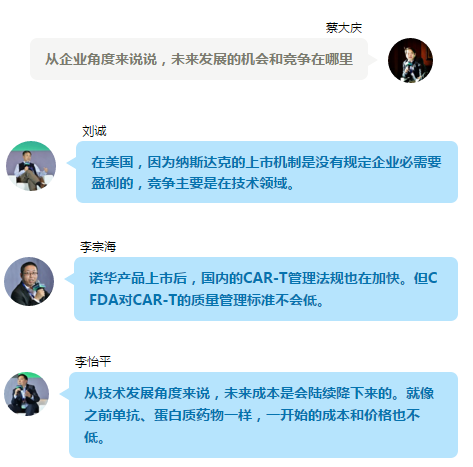
Currently, the CAR-T field faces two technical challenges: one is safety, and the other is market scale.
Safety concerns associated with CD19-targeted therapies, such as cytokine release syndrome and neurotoxicity, may pose obstacles to the market adoption of CAR-T cell therapies. Novartis and Kite Pharma have priced their CAR-T therapies at $475,000 and $373,000, respectively, excluding the costs of managing adverse effects. The average cost per patient for treating side effects is approximately $200,000, resulting in substantial commercialization expenses.
Furthermore, in terms of market size, 90% of cancer patients suffer from solid tumors, while hematologic malignancies account for only 10%. To date, CAR-T therapy has not achieved success in solid tumors. Whoever succeeds in this area has the potential to become a company valued at hundreds of billions.
Following the market launch of Novartis’ products, China’s regulatory framework for CAR-T therapies is also accelerating. However, the CFDA will not lower its quality management standards for CAR-T products.This is a process of survival of the fittest, where those with superior, high-quality products are more likely to stand out.
Meanwhile, the industry will undergo a consolidation process, during which technological innovation, alongside quality, will determine who stands out. Unfortunately, solid tumors have not yet been conquered; however, this also presents significant opportunities for the industry.
The cost issue was mentioned earlier; however, looking at other industries, many have actually undergone a transition from high to low prices.
Thirty years ago, producing one gram of monoclonal antibody or protein drug could cost thousands of dollars, with significant side effects. Today, the cost to produce one gram of monoclonal antibody is only $100 to $200. By the same token, although the cost and price of CAR-T are currently very high,From a technological development perspective, costs will gradually decrease in the future.。
For enterprises, the immediate priority should be to go all out and bring the first product to market. Every company is strategically positioning itself, and this technology may see large-scale adoption in the near future, leading to an imminent drop in costs. Current manufacturing processes rely on manual, step-by-step procedures; if automation can be achieved in subsequent stages, cost will no longer be a barrier.
CAR-T has truly made cell therapy a viable reality, and over the next one to two decades, cell therapy may gradually become mainstream.
Guest Perspectives Summary
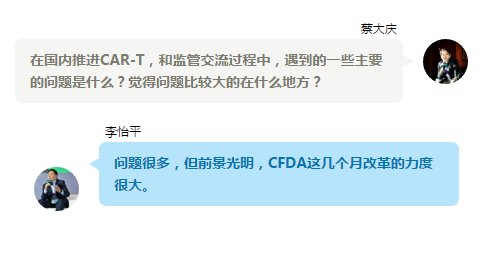
Over the past six to seven months, the China Food and Drug Administration (CFDA) has implemented substantial reforms and has maintained ongoing communication with companies involved in cell therapy. Regulatory approaches for the entire cell therapy process are still evolving globally; both Europe and the United States remain in a learning phase, with many conceptual shifts underway.
On the other hand, throughout this process, it is not only regulatory authorities that should reflect on these issues; enterprises must also consider how to enhance self-discipline and develop products using scientific methods to demonstrate the safety of cell therapies. The Immune Cell Therapy Alliance, recently established in Shanghai, aims to promote progress in this area.

Integration of Guest Perspectives
Cell therapy may become the next mainstream treatment modality, but the technical barriers to entry are exceptionally high. From another perspective, gene therapy, cell therapy, and antibody therapy have emerged as the three major technological pillars in recent years; only by mastering multiple technologies simultaneously can high-quality CAR-T cells be produced.Therefore, for CAR-T companies to achieve long-term success, they must make substantial efforts in building their technological reserves.
From an entrepreneurial perspective, CAR-T therapy indeed represents a significant opportunity for China in innovative new drug development, as this technology is highly novel and there are robust models of collaboration between China and the United States.
The United States pioneered the development of CAR-T therapy and holds significant technological advantages. However, U.S. CAR-T research has encountered bottlenecks, particularly in patient recruitment for clinical trials, due to the widespread focus on immuno-oncology (IO). In contrast, China boasts abundant patient resources, bolstered by a decade of foundational work in cell therapy and substantial reserves in equipment infrastructure.
From a policy perspective, if standards tailored to China are established and regulatory authorities enforce strict oversight, the phenomenon of “bad money driving out good” will be avoided, enabling the industry to develop in a healthy and sustainable manner.
Cell therapy is just getting started, with very promising prospects. Technologically, preliminary solutions have been found for the treatment of hematologic malignancies, and research into therapies for solid tumors has already begun. This industry holds significant promise.
Host's Summary
CAR-T therapy is a strictly regulated field abroad. Coupled with high legal compliance costs and professional self-discipline among practitioners, CAR-T has gradually become standardized. From a policy perspective, if standards tailored to China are established and regulatory authorities enforce strict oversight, the phenomenon of “bad money driving out good” can be avoided, thereby fostering healthy industry development.
Other Highlights of the Conference:
Insights on Pharmaceutical Innovation: A Discussion on the R&D Trends of Targeted Therapies