

Yilian Technology Secures RMB 15 Million Pre-A Investment from Tianyi Investment Group to Build a Medical Big Data Supply Chain Financial Services Platform
Recently, Jia Qiuzhen, founder and CEO of Beijing Yilian Technology, confirmed to VCBeat (WeChat ID: vcbeat) that Yilian Technology has completed its Pre-A round of financing led by Tianyi Investment Group (Zhongwei Fund).
"Do the right thing as quickly as possible."
Jia Qiuzhen stated that Yilian Technology has identified a new blue ocean in medical supply chain financial services and will continue to optimize its products and expand its scale. The proceeds from this round of financing will be used to expand asset-side operations and to advance the application of blockchain technology in fintech.
Yilian Technology had just secured a multi-million-yuan investment round led by Heima Lanfeng Fund in July; garnering further capital favor within months signals that the platform’s development is gaining strong momentum.
Tapping into the Medical Supply Chain Finance Services Market
MedChain Technology was established in January this year. Its founder, Jia Qiuzhen, holds an EMBA and a CMPM master’s degree from Renmin University of China. He has previously worked at Fortune 500 companies such as Acer and HP, and served as Vice President of Chinasoft International Information Technology Co., Ltd. and Partner & Vice President of Neusoft Wanghai Technology Co., Ltd. With over 20 years of experience in supply chain, big data, and the healthcare industry, Mr. Jia has extensive expertise in industrial-level internet business innovation. Previously, he designed and implemented the “Cloud Guizhou” system platform’s 7+N Cloud Project (Version 1.0), led the cloud migration and data analysis for the “National Drug Electronic Supervision Network,” and developed hospital cloud platforms and cloud-based ERP systems.

Jia Qiuzhen, Founder and CEO of Beijing Yilian Technology
Jia Qiuzhen told VCBeat that the decision to focus on the medical supply chain finance service market was primarily based on their understanding and judgment of the healthcare industry.
She stated that, based on the current situation, front-office business systems (HIS, LIS, PACS) have been widely adopted and applied in hospitals. However, the level of informatization in material management within the back-office administrative system remains low. There should be a Material Requirements Planning (MRP) system to comprehensively coordinate external collaboration and internal allocation of hospital materials.
In terms of financial needs, the hospital-centric healthcare supply chain exhibits several characteristics: high credit ratings for debt instruments, long payment terms, significant pressure on capital turnover, and high gross profit margins. These characteristics have also fostered demand for healthcare supply chain finance services.
“Hospitals have high credit ratings; social medical insurance is government-backed, making it a low-risk business.”
From the perspective of payment terms, the average accounts receivable cycle in the healthcare industry exceeds four months. Hospitals leverage their dominant position to shift financial pressure downstream, causing capital strain for supply chain enterprises and creating a need for financing and intercompany lending. Additionally, as policies such as the “Two-Invoice System” and the VAT reform are implemented, supply chain links have been compressed, further intensifying competition and increasing supply chain enterprises’ demand for capital resources.
From the perspective of industry profit characteristics, pharmaceutical and medical device trading boasts relatively high profit margins, enabling companies to afford and be willing to bear the costs of financial services to expand their business scale and withstand competition.
For these reasons, MedChain Tech has entered the medical supply chain finance market, vertically integrating resources from both the medical supply chain ecosystem assets and the capital side to build a medical data-finance ecosystem, providing scientific supply chain and financial services to all industry stakeholders.
The Medical Chain model has been largely validated.
According to Jia Qiuzhen, Yilian’s core product, “Supply+,” serves both hospitals and suppliers. It primarily provides value to hospitals through logistics management of high- and low-value consumables, equipment management, and fixed asset management, which constitutes its key competitive advantage in entering the hospital market. For suppliers, it offers services such as authorization chain management, order management, and reconciliation management. The SaaS-based model of “Supply+” leverages real transactions between hospitals and suppliers to provide scenario-specific credit data for financial risk control. On the funding side, partnerships include banks and fintech platforms. In terms of implemented cases, Yilian Technology has collaborated with Tianjin Jincheng Bank to achieve a closed-loop business process and jointly launched “Yicai Dai,” a data-driven financial product for the healthcare industry, which has been warmly embraced by companies in the medical supply chain.
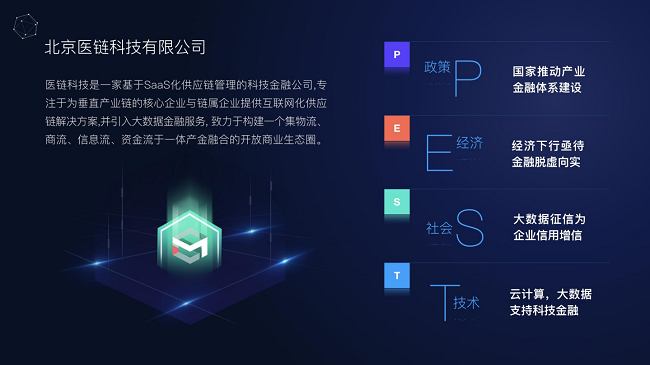
In terms of its revenue model, Yilian Technology charges suppliers SaaS fees and loan facilitation service fees, while charging capital providers referral and data service fees.
Jia Qiuzhen introduced that, as of this round of financing, the Yilian platform has signed contracts with dozens of hospitals, serves 2,000 supplier users, achieved a cumulative SaaS-based transaction volume of RMB 2 billion, and secured credit lines exceeding RMB 100 million.
From a market outlook perspective, supply chain finance services are also a key area encouraged by policy. The General Office of the State Council recently issued the Guiding Opinions on Actively Promoting Supply Chain Innovation and Application, which points out that supply chain finance should be developed in an active and prudent manner to promote supply chain services for the real economy. It encourages commercial banks, core enterprises in the supply chain, and others to establish supply chain finance service platforms, providing efficient and convenient financing channels for small and medium-sized enterprises (SMEs) upstream and downstream in the supply chain. At the same time, it promotes the development of online accounts receivable financing and other supply chain finance models.
YiLian Technology’s development model is undoubtedly well-aligned with this trend. In the niche market of medical supply chain finance, the scale of material procurement by hospitals in China ranges between RMB 1.3 trillion and RMB 1.5 trillion. Given that approximately 30% of these transactions require supply chain financial services, the annual transaction volume in the medical supply chain finance sector could reach RMB 400–500 billion, generating substantial commission revenue from transaction services.
Policy guidance, blue-ocean markets, and precise demand give reason to believe that MedChain Tech, bolstered by capital support, will be among the first to strike gold in the healthcare supply chain finance market.