

NHFPC Issues Notice Eliminating Administrative Approval for Medical Facilities within Elderly Care Institutions to Promote Integrated Medical and Elderly Care Services
VCBeat (WeChat: vcbeat)It is reported that on November 15, the General Office of the National Health and Family Planning Commission issued the "Notice on Canceling Administrative Approval and Implementing Filing Management for Medical Institutions Established Within Elderly Care Facilities," requiring that the establishment of clinics, health centers (rooms), infirmaries, and nursing stations within elderly care facilities be subject to filing management instead of administrative approval.
The notice sets forth four requirements:
I. Clinics, health centers (rooms), infirmaries, and nursing stations established within elderly care institutions shall comply with the basic standards for medical institutions. They shall primarily provide services to residents, including health management, disease prevention, geriatric healthcare, general diagnosis and treatment of common and frequently occurring diseases, nursing care, treatment of chronic diseases with clear diagnoses, emergency rescue, and palliative care. Where conditions permit, services such as home hospital beds and mobile medical visits may also be offered.
II. Elderly care institutions that establish internal clinics, health centers (rooms), medical offices, or nursing stations shall file a record with the local county- or district-level health and family planning administrative department (including the traditional Chinese medicine management department, hereinafter referred to as the same) and submit the decision of the establishing entity or its competent authority to establish a medical institution, along with the filing materials for the establishment of the medical institution.
III. Upon receipt of the filing materials, the health and family planning administrative department shall issue the "Medical Institution Practice License" within 10 working days if the materials are complete and comply with the requirements of this Notice; if the materials are incomplete or fail to meet the requirements of this Notice, the department shall inform the filer of all materials and content requiring correction at once, either on the spot or within 5 working days.
IV. After issuing the Medical Institution Practice License, the health and family planning administrative departments shall strengthen interim and ex-post supervision. Health and family planning inspection agencies shall conduct no fewer than two on-site supervisory inspections annually, with the first on-site inspection carried out within three months after the commencement of operations. Clinics, health stations (rooms), infirmaries, and nursing stations established within elderly care institutions shall establish referral collaboration mechanisms with surrounding medical institutions, continuously enhance their medical service capabilities, and ensure the quality and safety of medical care.
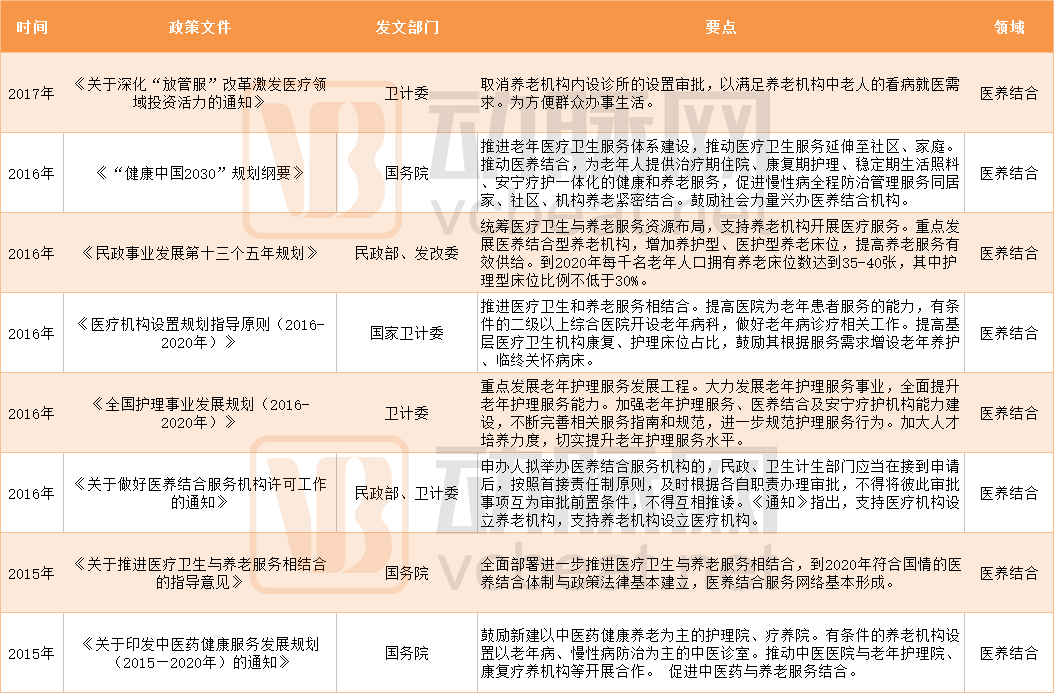
According to statistics from VCBeat, since 2015, the state has issued multiple policies to support the implementation of integrated medical and elderly care.
In October 2017, Huang Shuxian, Secretary of the Leading Party Members Group and Minister of the Ministry of Civil Affairs, stated at a press conference themed “Meeting People’s New Expectations and Safeguarding and Improving Livelihoods,” held at the Press Center for the 19th National Congress of the Communist Party of China, that there were now more than 28,000 registered elderly care institutions across China, with nearly 7 million elderly care beds, and community-based home elderly care service facilities covering all urban communities and more than half of rural communities. AndAccording to data from the National Health and Family Planning Commission, there are currently 5,814 integrated medical and elderly care institutions across China, with a total of 1.2138 million beds.
Although the elderly care sector has entered a golden age of development in recent years, the mere million-scale number of elderly care beds is clearly insufficient to meet the demands of China’s 230 million senior citizens.
Due to the shortage of hospital beds, medical and nursing care remains a formidable challenge. Some elderly individuals even engage in “bed-blocking for eldercare” by staying in hospitals to meet their healthcare needs, thereby occupying medical resources and creating a burden on the system.
In 2015, the State Council issued the "Guiding Opinions on Promoting the Integration of Medical and Health Services with Elderly Care Services," requiring comprehensive deployment to further advance the integration of medical and health services with elderly care services. By 2020, a system and policy framework for integrated medical and elderly care suited to national conditions would be basically established, and a service network for such integrated care would take shape.
Following the August 2017 issuance by the National Health and Family Planning Commission of the “Notice on Deepening the ‘Delegation, Regulation, and Service’ Reform to Stimulate Investment Vitality in the Healthcare Sector,” which proposed abolishing the approval requirement for clinics established within elderly care institutions and replacing it with a filing-based system, this latest notice effectively represents a further implementation of the filing system.
This policy directly and explicitly underscores the importance of the “integration of medical and elderly care” model, while also foreshadowing detailed legal regulations and specific implementation frameworks. In practice, many sectors—including community-based elderly care, home nursing, and smart elderly care—have already achieved such integration.
The report of the 19th National Congress of the Communist Party of China, concluded recently, also put forward the requirement to “actively respond to population aging, establish a policy framework and social environment for elderly care, respect for the elderly, and filial piety, promote the integration of medical and elderly care services, and accelerate the development of undertakings and industries for the aging population.”
Link to the original notice:http://www.nhfpc.gov.cn/yzygj/s3577/201711/ebcef4630a134efab8ec80e56ec95f1a.shtml