

Digital Marketing in Pharma: Doctor Communities and Internet Healthcare Platforms Gain Favor Among Pharmaceutical Companies
The Internet has transformed traditional communication methods, thereby driving a shift in marketing channels. In the fast-moving consumer goods (FMCG) industry, advertising placed through online channels has surpassed traditional advertising, heralding the arrival of a new marketing era.
As a key client base for the advertising industry, how can pharmaceutical companies embrace digital marketing? Due to fundamental differences in products, channels, and target audiences compared to general consumer goods such as fast-moving consumer goods (FMCG), there remains a certain time lag between the rise of online marketing for pharmaceuticals—particularly prescription drugs—and the digital marketing of FMCG.
What is the current state of digital marketing in pharmaceutical companies? What are some successful implementation cases? What problems and challenges have been encountered during development? What are the future trends?VCBeat (WeChat ID: vcbeat) interviewed Tu Honggang (Dr. 2), Chairman of Yiku Software, and Sun Chao, Partner at Strategy& (PwC’s strategy consulting arm), to discuss the aforementioned issues.
Dual Drivers: Internet Development and Pharmaceutical Policies
Previously, the marketing of prescription drugs primarily relied on visits by pharmaceutical sales representatives, industry conferences, and academic promotion. Driven by policy initiatives, the model based on sales representative visits is facing increasingly stringent compliance pressures, prompting active efforts to identify breakthroughs. Meanwhile, the rapid development of the internet and the emergence of digital tools have undoubtedly provided complementary solutions to the traditional marketing system.
Furthermore, China's pharmaceutical industry is undergoing profound transformation.“The Two-Invoice System,” “VAT Reform,” and “Pharmaceutical Representative Registration System” have been implemented, prompting changes in pharmaceutical marketing methods and channels.
Here, we first define digital marketing for pharmaceutical companies. Generally, the industry refers to the online marketing of prescription drugs as digital pharmaceutical marketing, but it does not includeOTCPharmaceuticals and health supplements. In terms of scale,OTCAdvertising and online marketing of prescription drugs are not comparable.
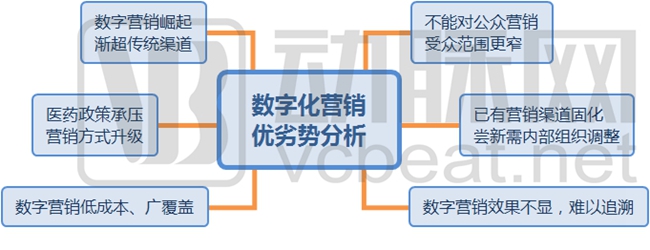
An important reason for this divergence isPrescription drugs cannot be directly promoted or marketed to the general public.According to the "Drug Administration Law" (2015 Amendment),Prescription drugs may be featured in medical and pharmaceutical professional journals jointly designated by the health administrative department of the State Council and the drug regulatory department of the State Council, but advertisements shall not be published in mass media or otherwise conducted as public-facing promotional campaigns.This also means that prescription drugs have less flexibility in online marketing than OTC drugs, and their audience reach is much narrower.
Sun Chao told VCBeat,Foreign pharmaceutical companies began exploring digital marketing at an early stage, with many establishing dedicated digital marketing departments.According to an earlier survey conducted by PwC Strategy& among more than 150 pharmaceutical executives in Europe and the United States, 90% of pharmaceutical companies have widely implemented or piloted digital tools as one of their marketing channels to deliver information and services related to diseases, products, cutting-edge academic technologies, and medical education.
According to Dr. 2, the scale of digital marketing by domestic pharmaceutical companies in China is approximately RMB 400–500 million, with multinational pharmaceutical companies accounting for the majority of the investment; only a few domestic pharmaceutical manufacturers have ventured into digital marketing.
Sun Chao stated that major pharmaceutical companies are currently leveraging digital tools primarily to serve two groups: physicians and patients. From the perspective of serving physicians, pharmaceutical companies employ digital tools for academic promotion and marketing mainly as a supplement to the traditional medical representative visit model. By capitalizing on the advantages of low cost and diversity, these tools help establish more effective information communication platforms between pharmaceutical companies and physicians, who have demonstrated an optimistic and open attitude toward digital solutions. Furthermore, pharmaceutical companies can utilize digital tools to aggregate professional knowledge and resources, thereby establishing centers of academic excellence.
In addition to fostering better engagement with physicians, another objective of digital marketing is to serve patients. For instance, leveraging internet-based tools to manage patient adherence after a physician has prescribed medication holds significant value for doctors, patients, and pharmaceutical companies alike. Due to market regulations and pharmaceutical compliance constraints, most patient education platforms are currently operated by third-party platform companies.
Dr. 2 summarizes that the widespread adoption of digital marketing for prescription drugs is primarily driven by two reasons: first,Low Cost, compared with methods such as visits by pharmaceutical representatives and academic conferences, online marketing incurs lower costs and consumes fewer resources, including personnel and materials; secondly,Broad Coverage, the hallmark of internet tools is their capacity for rapid replication and dissemination. With China’s implementation of policies such as tiered diagnosis and treatment and primary healthcare, pharmaceutical sales have become increasingly decentralized. Online marketing can help pharmaceutical companies access broader markets.
Platforms That Can “Stick” to Doctors Are Most Favored by Pharmaceutical Companies
Prescribing authority for prescription drugs rests with physicians; therefore, the primary target of online marketing is physicians. By disseminating drug knowledge, treatment protocols, and academic information, such marketing aims to influence physicians’ prescribing decisions, thereby achieving its promotional objectives.
From the perspective of specific channels, physician communities, physician tools, mobile health, and internet healthcare platforms are important channels for pharmaceutical companies’ digital marketing. Chronic disease management and health management apps have also gained favor among pharmaceutical companies. In addition to collaborating with third-party platforms, some pharmaceutical companies choose to build in-house teams to develop websites and apps, operate public accounts, and engage in other forms of online marketing.
Selected Digital Marketing Cases from Pharmaceutical Companies:
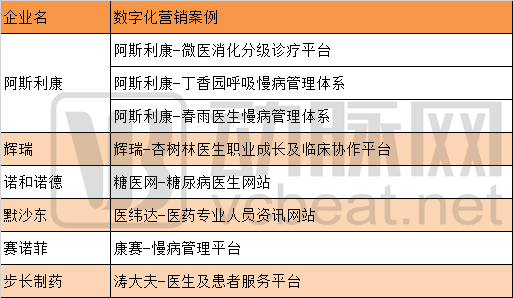
For pharmaceutical companies, when selecting a third-party platform, the number of aggregated physicians and their level of activity areHeavyRequired indicators.For third-party platforms that assist pharmaceutical companies in digital marketing, the ability to genuinely address physicians’ needs is a key strategy for attracting and enhancing physician engagement.
Physicians’ Needs Are Primarily Focused on the Following Points:Productivity Tools, which can improve the efficiency of diagnosis and treatment;Learning Tools,Facilitates convenient and rapid learning;Patient Management Tools, enabling more convenient communication with patients and patient management;Brand Building Function, thereby enhancing their visibility and building a personal brand. Currently, domestic platforms targeting physicians can meet one or several of the aforementioned needs.
For example, DXY, which started as a physician community, offers features such as professional networking, access to medical literature, and continuing education, thereby attracting a large base of physician users. It was also an early adopter of digital marketing collaborations with pharmaceutical companies. According to industry insiders, revenue from digital marketing services for pharmaceutical firms accounts for approximately half of DXY’s total revenue.
Yiku Software offers similar features, including literature search, exemplary medical records, and medical videos. After accumulating a substantial base of physician users, it launched digital pharmaceutical marketing services. According to Dr. 2, Yiku has currently partnered with pharmaceutical companies such as Yangtze River Pharmaceutical Group, Huapont Life Sciences, and Rundu Pharmaceuticals, providing them with specialized digital marketing solutions.
Xingshulin takes physician tools as its entry point. Its core products, Bingli Jia (Medical Record Folder) and Yi Koudai (Doctor’s Pocket), cater to physicians’ needs for electronic medical records and medical reference databases, thereby accumulating a substantial base of physician users. Building on this foundation, the company has developed additional products and services such as Cloud Academy, Cloud Ward, and Private Doctor, resulting in a more diverse product portfolio and creating more touchpoints for digital marketing collaborations with pharmaceutical companies. Xingshulin’s pharmaceutical partners include Sanofi, Pfizer, AstraZeneca, and Livzon Pharmaceutical Group, with cooperation spanning academic information promotion, patient management, and other areas.
In fact, for physician communities, physician tools, and mobile health vendors, providing digital marketing services to pharmaceutical companies is a key avenue for monetization and an integral component of their business models.
Looking at international cases, pharmaceutical companies are a key payer for physician aggregation platforms. For instance, WebMD, which was acquired by KKR Group for $2.8 billion this July, has a long history dating back to the late 1990s. Its core business consists of two main components: one is the consumer-facing WebMD portal, which provides health news and medical science popularization information.Possesses extensive traffic resources in the health information sector,The domestic benchmark case is 39 Health Network; the second is the MedScape platform, which targets clinicians and provides literature, news, and academic updates. Domestic platforms such as DXY and Yiku can be benchmarked against it.
According to WebMD’s annual report, its revenue in 2016 was $705 million, with advertising and sponsorship income totaling approximately $560 million, accounting for about 80% of total revenue. The primary source of this advertising and sponsorship income is pharmaceutical companies, as WebMD’s main service offering is online marketing targeted at physicians. In comparison, revenue from consumer-facing health services and data sales is relatively insignificant. Although the majority of WebMD’s traffic comes from ordinary patients, its primary monetization channel is the Medscape platform, which targets physicians—a testament to the immense value of this professional group.
The WebMD case holds significant implications for domestic physician platforms in China. Although the domestic prescription drug market still lags behind that of the United States, the vast population and large base of physicians underscore the immense potential of digital pharmaceutical marketing. In the future, with the rise of online marketing for prescription drugs in China, such platforms may enter a monetization phase, while pharmaceutical companies will gain access to diverse channels and platforms for their digital marketing efforts.
“Wherever core users go, advertisers will follow, albeit with a time lag. A decade ago, advertising revenue on video streaming platforms was virtually zero; ten years later, it reached RMB 50 billion, while a large number of small and medium-sized television stations and print media outlets began to face operational difficulties. The power of this trend is irreversible,” said Dr. 2, noting that pharmaceutical companies’ pursuit of platforms whose primary user base consists of various types of physicians also aligns with this trend.
In terms of pharmaceutical companies building their own digital marketing platforms, MSD’s Yiweida website has been online for several years. Positioned as an essential online resource hub for healthcare professionals, it provides content including medical news, clinical medication guidance, case studies, and physician training, and has also become a key channel for MSD’s academic marketing efforts.
Overall, however, pharmaceutical companies’ self-built online marketing platforms have underperformed. Dr. 2 told VCBeat that over the past five to six years, more than a thousand pharmaceutical companies have created tens of thousands of WeChat accounts and mobile apps tailored to different medical specialties, diseases, and target physicians, investing billions of resources, yet achieving limited results. Dr. 2 analyzed thatThe primary reason for the limited effectiveness of self-built platforms by pharmaceutical companies is the lack of high-quality content, which fails to capture physicians’ attention and retain them.
From the perspective of pharmaceutical companies’ own investments, the budget of a single company is insufficient to support the diverse needs of physicians. Doctors may require access to medical literature, clinical guidelines, educational materials, and other resources; these needs are complex and fragmented, making it extremely difficult for pharmaceutical companies to cover them comprehensively. In addition, platforms built in-house by pharmaceutical companies are typically housed within their marketing departments, emphasizing short-term returns and constrained by KPI assessments. This lack of long-term planning results in low product completeness and fails to attract sustained engagement from physicians.
Domestic Pharmaceutical Companies May Become the Main Force in Digital Marketing in the Future
Despite its immense potential and the existence of suitable international benchmarks, the performance of digital tools in pharmaceutical marketing and the value they generate for pharmaceutical companies have yet to reach an ideal state.
Sun Chao stated,A global survey by Strategy& shows that 31% of respondents question the effectiveness of digital tools.He believes that although the traditional commercial marketing model of pharmaceutical representative visits is characterized by high costs and a relatively narrow target audience, it remains the most acceptable marketing approach for pharmaceutical companies and holds irreplaceable value in marketing. In contrast, digital marketing has not yet gained full industry recognition in practice; it is still in an exploratory phase, with no single model having achieved widespread acceptance or endorsement.
From the perspective of the domestic market, Chinese pharmaceutical companies have few innovative products; the market is dominated by relatively mature products and treatment modalities. As physicians are already well-versed with these offerings, there is no need to convey extensive academic or product information, thereby reducing pharmaceutical companies’ incentive to pilot digital marketing initiatives.
Meanwhile,The driving force behind the sales of mature pharmaceutical products often lies not in information dissemination, but in the “emotional” bonds established by traditional medical representatives. This is why large domestic pharmaceutical companies maintain extensive sales forces that will neither be reduced nor eliminated in the short term.
Moreover, the most direct and critical reason is that pharmaceutical companies’ digital marketing efforts have yielded unsatisfactory conversion results. Pharmaceutical companies invest funds in producing cutting-edge academic research, new treatment modalities, and drug information within therapeutic areas. While physicians may express strong interest and demand for such content, it remains difficult to determine the extent to which this engagement ultimately translates into prescription behavior.Compared with representative visits, the traceability of digital marketing effectiveness is not as strong.
In addition to external factors, implementing digital marketing also poses challenges to the organizational structure of pharmaceutical companies. If a pharmaceutical company chooses to build an in-house team, issues such as budget allocation, division of labor, and coordination with other marketing departments will become new problems that the company must address.
When collaborating with third-party platforms, it is necessary to balance the overall marketing budget and coordinate on marketing content, which also requires dedicated personnel and teams for management. For business departments, if results are not visible in the short term, they are highly likely to reduce investment in digital marketing, which would undoubtedly be a significant setback for nascent digital initiatives.
Therefore,Pharmaceutical companies should not take a short-sighted approach to piloting digital marketing; instead, they should make sustained investments to thoroughly validate the effectiveness of digital marketing applications.
The low-cost nature of digital marketing offers pharmaceutical companies more opportunities to experiment with this approach. Dr. 2 recommends that pharmaceutical firms, particularly large and medium-sized enterprises, shift their marketing philosophies, innovate their marketing models, and pilot digital marketing initiatives. He anticipates that as China’s healthcare reform and pharmaceutical reforms advance, structural changes will occur within the pharmaceutical industry, creating new opportunities for digital marketing.
For instance, with incentives for drug innovation, innovation will become the core competitiveness of domestic pharmaceutical companies. As innovation advances, new drugs and therapies need to be communicated to physicians, and digital dissemination is undoubtedly an effective approach.
Furthermore, policies such as the separation of prescribing and dispensing, and tiered diagnosis and treatment will also reshape traditional pharmaceutical distribution channels. With the separation of prescribing and dispensing, sales of prescription drugs will partially shift away from hospitals, leading to an expanded market share for retail pharmacies, clinics, and other outlets; digital marketing holds significant potential in these channels. Tiered diagnosis and treatment indicates a more decentralized pharmaceutical distribution landscape, shifting focus from doctors in large hospitals to comprehensive coverage of physicians across all levels of hospitals, clinics, and village health stations. Digital tools can provide substantial convenience in reaching this vast physician population.
In fact, Chinese pharmaceutical companies are increasingly embracing internet channels. Companies such as China Resources Sanjiu, Jiangzhong Group, Harbin Pharmaceutical Group, and Xiuzheng Pharmaceutical have experimented with online variety shows, video advertisements, and brand product placements for their over-the-counter (OTC) drugs. Once these companies taste the “sweetness” of digital marketing, they are likely to extend their efforts to the online promotion of prescription drugs, thereby driving a wave of digital marketing adoption across the domestic pharmaceutical industry.
There are approximately 200 pharmaceutical companies in China with annual domestic sales exceeding RMB 1 billion. With each company investing tens of millions in digital marketing, the future domestic digital marketing market is projected to reach RMB 2 billion, which is undoubtedly an encouraging prospect.
In summary, the development of the internet has brought new opportunities to pharmaceutical marketing, while transformations in the pharmaceutical industry and healthcare services market have compelled pharmaceutical companies to adopt new tools such as digital marketing. The convergence of these factors suggests that the future potential for digital marketing in the pharmaceutical sector is immense, with promising long-term prospects.