

Philips and Baiax Smart Tech Forge Strategic AI Partnership to Deliver Personalized Precision Diagnosis and Care
On November 17, 2017, VCBeat learned that Philips (China) Investment Co., Ltd. and Qingdao Baiyang Intelligent Technology Co., Ltd., a subsidiary of Baiyang Pharmaceutical Group, held a signing ceremony at the newly completed campus of Philips’ Greater China headquarters in Daning, Jing’an District. The two parties will leverage their respective technological and resource advantages to explore innovative business models for AI-based precision diagnosis and treatment solutions, starting with the field of oncology. This collaboration aims to provide decision support for physicians and deliver personalized diagnostic and therapeutic services for patients.
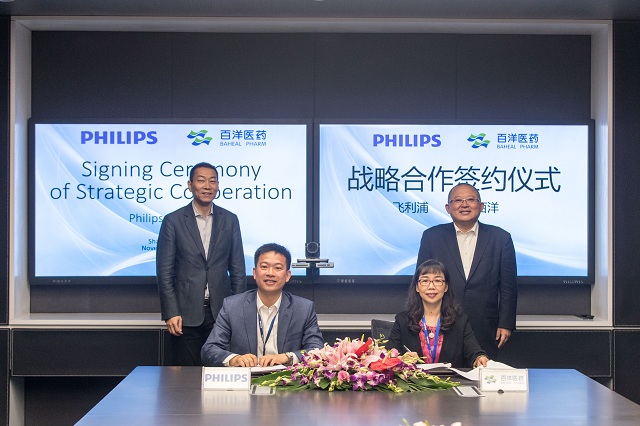
Pursuant to the Memorandum of Strategic Cooperation, the initial phase of collaboration between the two parties will focus on the field of oncology, leveraging Baiyang Pharmaceutical Group’s established capabilities in patient education and brand management, as well as its robust marketing network connecting healthcare providers and patients.Enable Philips’ AI-powered imaging-assisted diagnostic system, the Nebula Workstation, to provide decision support for physicians and deliver personalized, precision diagnostic services directly to patients through cloud-based connectivity, thereby allowing patients to gain a more transparent and objective understanding of the diagnostic process and their condition, and ultimately enhancing their autonomy in personal health management.。
The collaboration between the two parties will begin in the field of lung cancer, one of the malignant tumors with the fastest-growing incidence and mortality rates in China, posing the greatest threat to public health and life. The vast majority of lung cancer patients are already at a stage of tumor metastasis and spread when diagnosed, making early screening and definitive diagnosis of lung cancer critically important.
Therefore, early screening and precise assessment of pulmonary nodules facilitate proactive intervention and effectively prevent the onset and progression of lung cancer. The two parties plan to leverage intelligent imaging technologies to automatically identify pulmonary nodules during health check-ups for healthy individuals, providing diagnostic decision support for physicians. By delivering easy-to-understand imaging diagnostic reports, patients can clearly understand their condition, thereby offering a reference for subsequent in-depth treatment plans and significantly reducing the rate of missed diagnoses of pulmonary nodules during health screenings. The two parties intend to gradually extend this model to other clinical conditions in the future.
As a company focused on the “Health Tech” sector, Philips leverages its extensive clinical experience, deep consumer insights, and advanced digital and artificial intelligence technologies. It is committed to launching integrated innovative solutions across the entire “healthcare continuum”—spanning healthy lifestyles, disease prevention, diagnosis, treatment, and home care—to enhance people’s health and improve healthcare outcomes.
Advances in imaging equipment and technology not only enable physicians to detect lesions at an early stage, thereby enhancing the accuracy of tumor diagnosis and staging, but also serve as guidance for targeted tumor therapies, making surgical procedures more precise and safe while improving therapeutic outcomes. Philips boasts not only advanced equipment in the field of diagnostic imaging, but also image post-processing and advanced visualization applications that integrate AI technologies with clinical expertise.
The IntelliSpace Portal workstation provides powerful multimodal image fusion tools, capable of fusing images from CT, MRI, ultrasound, PET/CT, and even intravascular ultrasound. This enhances lesion visualization, offers more intuitive observation, and enables more accurate selection of surgical approaches. During surgery, medical imaging guidance helps physicians perform procedures with greater precision, predict outcomes in advance, and conduct timely postoperative assessments, ultimately improving both surgical quality and patients’ quality of life.
As the flagship entity of Baiyang Pharmaceutical Group’s internet application ecosystem and a pioneer in China’s new wave of medical informatization, Baiyang Intelligent Technology is committed to leveraging technology to improve health. It has taken the lead in achieving three key transformations: SaaS-based software, mobile Hospital Information Systems (HIS), and intelligent decision-making. By partnering with internationally advanced companies and using AI as a breakthrough point, the company has built a “Three-Terminal, Two-Cloud, One-Platform” architecture. This includes the Intelligent Decision-Making Terminal, the Post-Diagnosis Patient Management and Prescription Information Sharing Terminal, and the Physician Skill Enhancement Terminal, along with the Bodhi Medical Cloud, which provides informatization services to hospitals, and the Mingjing Marketing Cloud, which offers intelligent precision marketing services to the industry.
Guowei He, CEO of Philips Greater China, stated, “Artificial intelligence is a crucial component of Philips’ strategy. We anticipate that the majority of Philips’ future products will be built upon AI technologies. Capitalizing on the convergence trend between consumer personal health and professional medical care, we are committed to leveraging innovative solutions that combine AI technology with clinical expertise. These innovations aim to assist healthcare professionals in making faster and more accurate diagnostic decisions, enhancing work efficiency and outcomes, while enabling the management and care of a larger patient population through effective remote means. Meanwhile, we strive to provide consumers and patients with more convenient and efficient healthcare services at lower costs. Baiyang Smart Technology’s ‘intelligent + health’ service model, characterized by its ‘three terminals, two clouds, and one platform’ architecture, has pioneered an innovative business model for Philips’ AI-assisted imaging diagnostic system. This enables the system to play a broader and more widespread role in early screening for diseases such as lung cancer, benefiting more physicians and patients. By providing decision support to physicians, it empowers patients to better manage their own healthcare, ensuring they understand the efficacy and value of the medical services they receive, rather than merely being passive recipients of consumption.”
Fu Gang, Chairman of Baiyang Pharmaceutical Group, stated: “Baiyang Pharmaceutical Group is a pharmaceutical enterprise driven by intelligent information technology, boasting strong capabilities in healthcare industry integration. Our network covers 1,200 distributors, 12,000 hospitals, and 230,000 pharmacies across China. Meanwhile, new-type healthcare informatization, including artificial intelligence (AI), constitutes the core development direction of Baiyang Pharmaceutical Group, and we have already provided healthcare informatization solutions to medical institutions in multiple provinces and municipalities nationwide. Through this collaboration with Philips, we will jointly explore B2C promotion models in the field of intelligent medical imaging. Leveraging Baiyang’s extensive marketing network and mature customer base, we aim to rapidly bring Philips’ AI-assisted imaging diagnostic system to market, thereby quickly benefiting both physicians and patients. Currently, China sees 4.3 million new cancer cases annually, with a five-year survival rate of only 37%, compared to 67% in the United States. A significant contributing factor is the imperfection of China’s health examination and prevention system. Looking ahead, we hope to enhance early cancer screening by collaborating with world-leading health technology companies like Philips and increasing our own R&D investment in cancer warning and screening technologies. This will provide intelligent support for clinical decision-making, facilitate early detection and standardized treatment of cancer, and ultimately improve patients’ survival opportunities.”
Furthermore, under the agreement, both parties intend to collaborate based on big data and artificial intelligence (AI) technologies to establish the first independent imaging center in Qingdao, Shandong Province. Upon completion, the center will leverage Philips’ AI-assisted imaging diagnostic system to achieve cloud-based interconnectivity with medical institutions at all levels, health examination centers, and sanatoriums. It will provide imaging diagnostic services to help physicians improve diagnostic speed and accuracy, thereby promoting the standardization of healthcare quality and reducing rates of misdiagnosis and missed diagnoses. Both parties will leverage their respective resource advantages to continuously enhance the service quality, depth, and accessibility of the center.