

Real Estate Meets Healthcare: Over RMB 300 Billion Invested in 2017 as Premium Healthcare, Elderly Care, Medical Malls, and Wellness Towns Gain Momentum – 2017 Year-End Review
2017 was a busy yet hopeful year for real estate developers.
Some are busy identifying hospital acquisition targets, others are engaged in signing cooperation agreements with governments, some are seeking partners in the healthcare industry, others are focused on building new hospitals, and still others are developing health-themed towns... In short, they are fully immersed in the cross-sector healthcare landscape.
On the other hand, under the strategic backdrop of the new healthcare reform and "Healthy China," not only are an increasing number of real estate developers entering the big health industry, but policy support is also growing stronger.
The "big health industry" referred to here denotes the aggregate of activities encompassing product manufacturing, service provision, and information dissemination aimed at "maintaining, restoring, and promoting health." It includes multiple production and service sectors closely related to human health, such as medical services, pharmaceutical and healthcare products, nutritional and wellness products, medical and healthcare devices, leisure and wellness services, and health consultation and management.
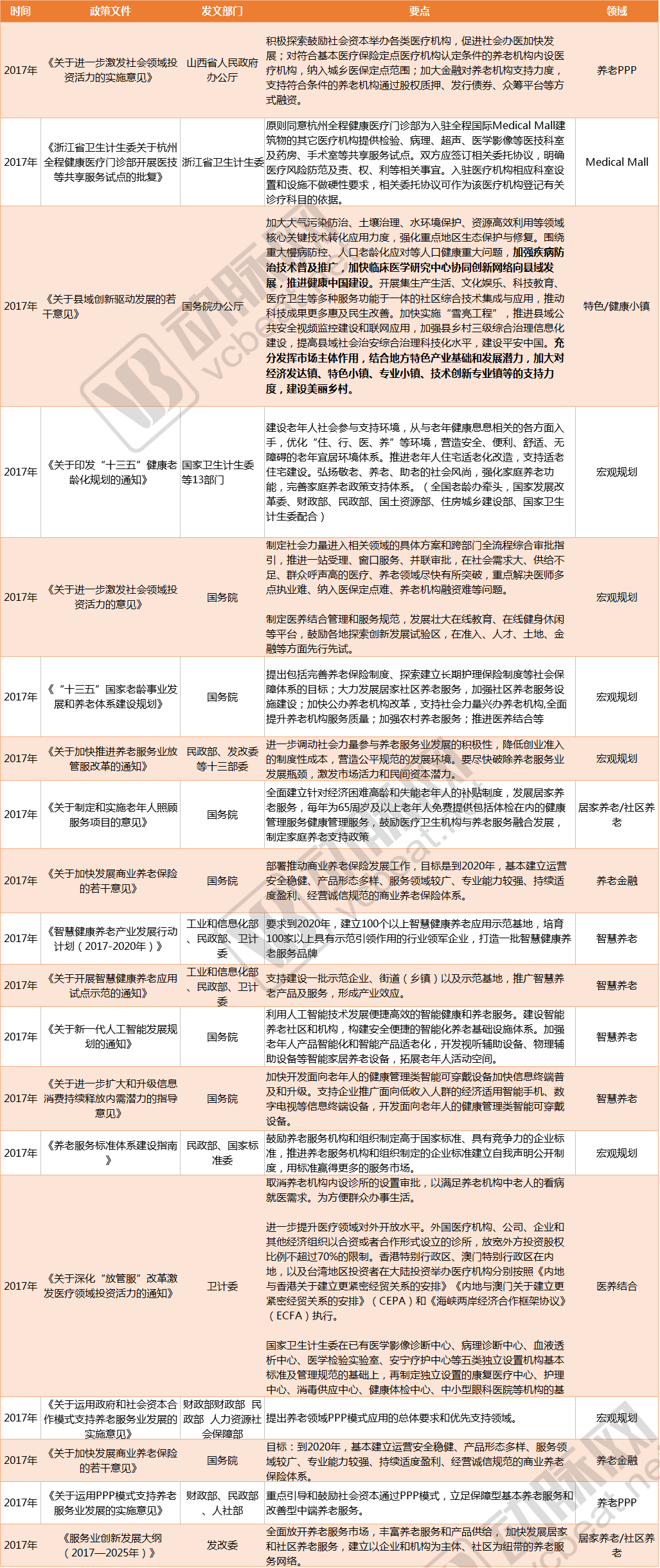
Note: Based on public information search
As can be seen from the list, a considerable number of policies were issued in 2017 for industries such as elderly care and health-focused towns, involving numerous agencies including the Ministry of Human Resources and Social Security, the National Development and Reform Commission, the National Health and Family Planning Commission, the General Office of the State Council, and the Ministry of Civil Affairs.
In October 2017, the report to the 19th National Congress of the Communist Party of China reiterated the implementation of the Healthy China Strategy, adhering to prevention first, deeply carrying out the Patriotic Health Campaign, advocating healthy and civilized lifestyles, and preventing and controlling major diseases. It called for the implementation of a food safety strategy to ensure public confidence in food consumption, improving national health policies, and providing comprehensive, full-lifecycle health services to the people.
Establish a policy framework and social environment that supports elderly care, filial piety, and respect for the elderly; promote the integration of medical and elderly care services; and accelerate the development of both public initiatives and industries related to aging.
The report to the 19th National Congress of the Communist Party of China also stated that the principal contradiction facing Chinese society has evolved into one between unbalanced and inadequate development and the people’s ever-growing needs for a better life. Among these, the imbalance in the allocation of medical resources is particularly pronounced.
In the Government Work Report delivered during the Two Sessions, elderly care was mentioned six times. The requirements and emphasis set forth by top-level design became the most steadfast guiding principle for the development of elderly care services in 2017.
According to relevant statistical data, the health services market is enormous, exceeding RMB 8 trillion, and thus warrants in-depth cultivation and strategic positioning. Evidently, the broader healthcare industry has entered a period of accelerated growth, with high sector prosperity.
In brief, the following four engines continue to drive the industry’s rapid growth:
First, population aging and environmental pollution have increased residents' potential demand for health care and medical services;
Second, the heightened health awareness among residents has expanded healthcare expenditures;
Third, policies advance the construction of a Healthy China;
Fourth, the state actively supports “Internet + Healthcare” and encourages social forces and private capital to participate in the health service industry.
These favorable factors are expected to continue gaining momentum in the future, thereby driving the sustained development of the broader health and wellness industry.
VCBeat has identified a number of real estate developers that have diversified into the healthcare industry through public data searches. According to the list below, 29 real estate companies, including Wanda Group, Evergrande Health, Vanke, Zhongnan Construction, Poly Real Estate, Greentown, and China Resources Group, have expanded their presence in the healthcare sector this year.
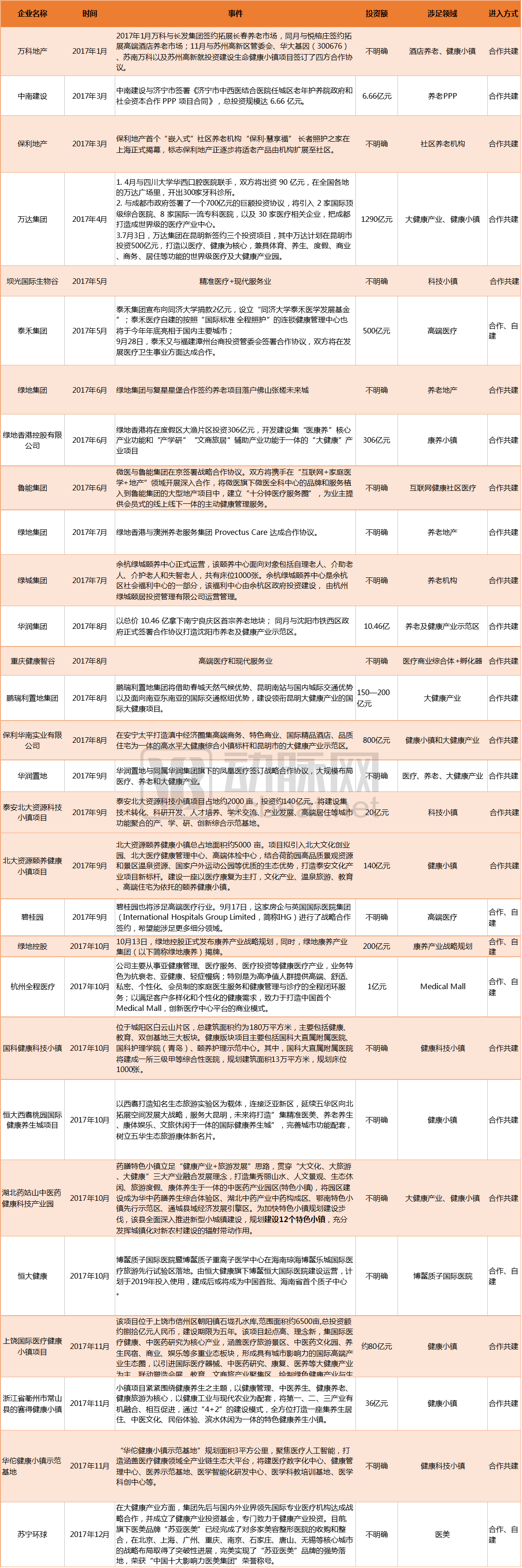
Note: Based on a search of publicly available information
These real estate developers have primarily adopted two models to expand into the healthcare sector: joint development through partnerships or co-investment in self-built projects. The areas involved include elderly care, community healthcare, high-end medical services, health-themed towns, and Medical Malls, with total investments exceeding RMB 335.1 billion. Among them, Wanda Group, Poly South China Industrial Co., Ltd., Greenland Hong Kong Holdings Limited, and Taihe Group have contributed the largest capital injections.
An analysis of the sectors entered by real estate developers reveals that elderly care, health-themed towns, and Medical Malls are highly favored. We believe these areas will continue to attract the attention of real estate developers in the coming year.
Numerous Entrants in the Elderly Care Sector, Vast Market Potential, Yet Profitability Remains Elusive
From the perspective of elderly care, as the demographic dividend fades and the burden of elder support intensifies, the imbalance between supply and demand has created substantial market opportunities. Public institutions face severe bed shortages, while private providers exhibit marked polarization, leaving elderly care seekers torn between “prolonged waiting lists” and “exorbitant costs.”
The pronounced mismatch between supply and demand in the elderly care market has created opportunities for real estate developers to diversify into this sector. Vanke can be regarded as a pioneer in this field; its first step into elderly care was marked by the initiation of the “Suiyuan Jiashu” project in Hangzhou in 2009. Currently, Vanke’s three major elderly care product lines under the “Suiyuan Series” have begun to operate at scale.
As of the end of 2016, Vanke’s Suiyuan Home community-based elderly care services, centered in Hangzhou and Ningbo, had covered more than 100 day-care centers, marking the onset of large-scale operations. Over the next three years, it plans to establish 1,000 service outlets, directly serving over 50,000 clients and reaching a senior population of 600,000.
The "China Health and Elderly Care Industry Report (2016)" indicates that since the elderly care industry began its marketization in 2013, various enterprises have successively entered the field. This trend evolved from the influx of real estate, insurance, medical services, and rehabilitation aid companies in 2014; to the gathering of industry chain-related enterprises in real estate, insurance, healthcare, nursing care, medical devices, internet, and general health sectors in 2015; and further to the capital involvement and cross-sector entry of large state-owned enterprises and private enterprise groups in 2016. The year-by-year evolution of the main competitors in the market not only highlights the diversity of participants in the elderly care industry but also gradually reveals the future competitive landscape of the sector.
The First Medical Mall: Whether It Will Succeed Remains to Be Seen
The emergence of the “Medical Mall” has fully ignited real estate developers’ ambitions to cross over into the healthcare sector.
First, the Medical Mall model is already well-established abroad. It not only revitalizes commercial real estate projects but also meets residents’ healthcare needs, with numerous reference cases available, such as Centuria Medical Makati in the Philippines and Jackson Medical Mall in the United States.
Second, a Medical Mall has also emerged in Hong Kong, China, though it is known by a different name: “Clinic Building,” with its operational model primarily based on leasing.
Third, at the press conference held on August 20 this year, Jiao Yahui, Deputy Director of the Bureau of Medical Administration and Hospital Management under the National Health and Family Planning Commission (NHFPC), recommended that journalists pay attention to Hong Kong’s “clinic building” model. She explained that a single office building in Hong Kong may house numerous clinics; after providing consultations, these clinics can refer patients to third-party institutions for necessary examinations, thereby sharing medical technical resources—a practice aligned with international experience. In light of these considerations, the NHFPC has recently established five new categories of independently set-up medical institutions.
Fourth, Hangzhou Quancheng Medical is a Medical Mall directly approved by the Zhejiang Provincial Health and Family Planning Commission. Committed to building China’s first Medical Mall and innovating the business model of the medical center platform, it quickly gained nationwide renown.
Although many believe that this model is ill-suited for the development of China’s healthcare industry and faces numerous obstacles, it is worth noting that, with the approval of the Zhejiang Provincial Health and Family Planning Commission, these clinics can operate on a “turnkey” basis. Medical technology departments such as laboratory testing, pathology, ultrasound, and medical imaging, as well as pharmacies and operating rooms, can all adopt a shared-service model, eliminating the need for substantial capital investment.
It is foreseeable that an increasing number of Medical Malls will emerge in the future. Building a hospital no longer requires worrying about establishing key departments or recruiting department heads. By simply setting up foundational medical technology departments—such as laboratory medicine, pathology, ultrasound, and medical imaging—as well as pharmacies and operating rooms, and by introducing a cluster of clinics and other medical institutions, one can effectively assemble a high-end hospital.
This is also a significant boon for physician entrepreneurs: as long as they possess proprietary technology and a strong brand, they need not worry about the substantial capital required to build hospitals.
From a site selection perspective, Medical Malls are typically located in well-connected commercial districts, ensuring the accessibility of medical services and steady patient flow. Industry insiders note that the concentration of high-quality medical teams and clinics inevitably creates an agglomeration effect, similar to restaurant clusters, thereby enhancing their appeal to consumers.
Thus, for real estate developers seeking to transition into the healthcare sector, physicians aspiring to start their own practices, and entrepreneurs aiming to establish brick-and-mortar medical services, the Medical Mall model may represent the most straightforward and already operational approach. Of course, this is still in its early stages; whether this model suits Chinese consumers remains to be validated, and we do not rule out the emergence of newer Mall models in the future. Nevertheless, the patient-centric philosophy and the trend toward shifting from passive to proactive healthcare are irreversible.
Health Towns are one of the mainstream initiatives for further improving health outcomes across China.
The 19th National Congress of the Communist Party of China identified the principal contradiction facing Chinese society as the one between unbalanced and inadequate development and the people’s ever-growing needs for a better life. In this context, with “Healthy China” officially established as a core national development strategy, the health industry is poised to enter a significant period of growth opportunities over the next two decades. Meanwhile, alongside the implementation of the national strategy for “Characteristic Towns,” the central government has introduced a series of policies over the past year to encourage local governments to promote the development of such towns from multiple perspectives.
The national strategies of “Healthy China” and “Characteristic Towns” are calling for the active development of “Health Towns,” which will become one of the mainstream, characteristic development models for comprehensively improving public health, upgrading industries, and driving economic growth across China in the next stage.
Currently, there are three mainstream models for health towns: Health and Wellness Towns, Health Technology Towns, and Medical Health Towns. The details are as follows:
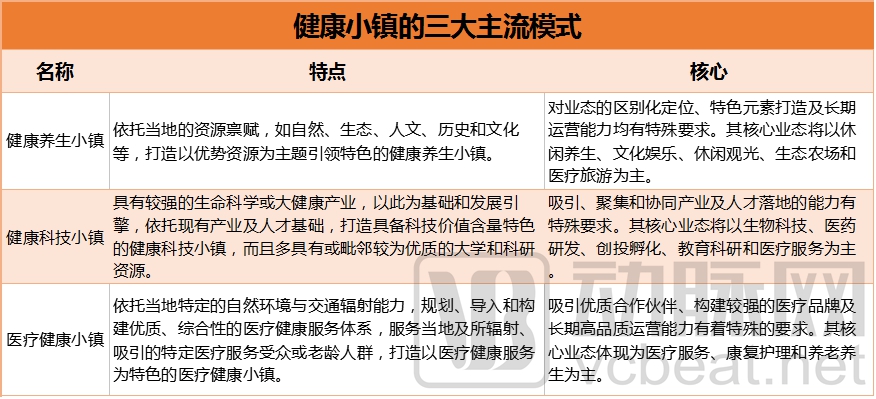
Due to the severe imbalance between supply and demand in China’s elderly healthcare market, health towns that integrate medical care, rehabilitation, nursing, and eldercare services to provide continuous health services for the elderly population have immense potential for growth.
We believe that the “Healthy Elderly Care Town,” which focuses on serving the elderly population, will become the primary and foundational model for the “Medical Service-Integrated Health and Medical Town.”
Centered on healthcare services and the elderly care industry, with sales of elderly care facilities serving as a financial balance and supplement, the model integrates professional healthcare (medical, rehabilitation, nursing, and elderly care) and supporting business operators to build long-term capabilities in healthcare services and elderly care operations. This approach aims to establish a core healthcare service industry and achieve sustainable development of the town’s industrial ecosystem.
On November 29, 2016, the General Office of the People’s Government of Yunnan Province issued the “Notice on Printing and Distributing the ‘Development Plan for Yunnan Province’s Biopharmaceutical and Big Health Industry (2016–2020) and the Three-Year Action Plan (2016–2018).’” Regarding the section on “Accelerating the Development of Medical and Wellness Service Bases,” it proposed creating a number of well-known wellness and elderly care bases, while innovating collaborative models between medical institutions and elderly care facilities. It also aimed to promote the development of integrated elderly care service complexes, establish a technological standard system and technical solutions for elderly care services with a focus on intelligent services, functional rehabilitation, and personalized adaptation, encourage the development of health products for the elderly, and cultivate the “silver-haired” industry.
In mid-April 2017, the Executive Meeting of the Kunming Municipal People’s Government reviewed and approved in principle the “Implementation Plan for Kunming’s Big Health Development Planning (2016–2020).” According to the Plan, Kunming will comprehensively advance six major initiatives comprising 23 key projects, vigorously leverage the radiating and driving effects of major projects, and conduct targeted investment promotion for leading enterprises, thereby achieving a doubling of the scale of its big health industry.
By 2020, the average life expectancy will reach 79 years, the added value of the health industry will exceed RMB 100 billion, and there will be 5–8 leading enterprises with outputs at the ten-billion-yuan level. Among these initiatives, the “Five Major Industrial Integration Development Projects” include: implementing a plan to create premium high-altitude convalescence services by integrating them into tourism products, aiming to develop 20 high-altitude convalescence tourism routes and establish 2 premium high-altitude convalescence tourism zones; implementing a plan to build health and wellness culture experience centers, adding 25 such centers; implementing a plan for the integrated development of finance and health, striving to develop four new commercial health insurance products; implementing a plan for the construction and interconnectivity of a national health big database, enabling “one-card” services for registration, medical consultation, inquiry, payment, health management, and reimbursement settlement under the New Rural Cooperative Medical Scheme; and implementing a plan to build animal and plant gene databases, with the basic completion of these databases.
Meanwhile, the “Health Town Development Initiative” mandates the coordinated development of a batch of characteristic towns centered on industries such as life and health, medical science and education, wellness and elderly care, and eco-tourism. It emphasizes the thorough exploration and protection of historical relics and sites, with priority given to advancing key projects including the Tangchi Hot Spring Characteristic Tourism Town, Yunnan OCT Eco-Tourism Town, and Luomian Ethnic Characteristic Tourism Town. The goal is to achieve “one town per county,” thereby establishing a networked system of health towns.
Recently, the Ministry of Finance issued a notice to launch pilot programs for the development of rural complex initiatives in 18 provinces, including Hebei and Shanxi. These rural complexes provide more specific directions and development pathways for agriculture-themed characteristic towns. This initiative aligns with the concrete policy directives outlined in the Central Government’s No. 1 Document, offering support through financial subsidies, land allocation, institutional improvements, and fixed asset investments.
However, the development of health towns also faces numerous obstacles, such as market access restrictions, inefficient flow of production factors, lack of a credit system, talent shortages, and simple, repetitive construction."Moving forward, it is essential to develop implementation recommendations for addressing issues from the perspective of policy innovation."
Specifically, policy innovations and implementation recommendations for the development of Health Towns are mainly reflected in the following aspects:
First, relax market access requirements to attract diverse entities to participate in development. Given the continuous emergence of new formats and types within the health industry, the government must carefully consider the establishment of access standards and regulations to ensure that a sufficient number of participants are attracted to the development of Health Towns.
Secondly, break down barriers and leverage the role of the market. Health towns must harness the market’s role in facilitating the flow of health-related factors to remove restrictions and barriers, thereby enabling the agglomeration of high-end health resources.
Third, cultivate talent and build a team of multidisciplinary professionals. Talent is indispensable for the successful development of Health Towns. In the future, we should actively promote the integration of industry, academia, and research to nurture more professionals dedicated to the construction of Health Towns.
Finally, strengthen regulation and improve standards and the integrity system for the health industry. Currently, certain segments of the health sector are characterized by disordered competition and a mix of reputable and dubious players, primarily due to the lack of industry standards for quality safety and technical certification, as well as an inadequate integrity oversight system.
In addition to the aforementioned four aspects, future development of Health Towns should also promote the growth of the health information and health insurance industries, while avoiding redundant construction and cutthroat competition.