

Medical AI in 2017: 27 Funding Rounds, Over ¥1.7 Billion Raised – From Boom to Battle for Real-World Implementation
In September 2017, VCBeat used the term “Dawn” to describe the state of medical artificial intelligence at the time while hosting the “2017 China Medical Big Data and Artificial Intelligence Industry Practice Forum.”
In just over three months, the development of this industry seems to have brought dawn to industry perceptions.
According to the VCBeat database:
In 2017, the medical artificial intelligence industry witnessed a total of 27 financing events. Including several companies that did not disclose their funding details, the total amount raised in this sector exceeded RMB 1.7 billion in 2017, with industry leaders having already reached Series B financing stages.
In 2017, policies related to the medical artificial intelligence industry were also gradually advancing. According to VCBeat, since the State Council released the "Development Plan for New Generation Artificial Intelligence" on July 20, both the National Institutes for Food and Drug Control (NIFDC) and the China Food and Drug Administration (CFDA) have been actively engaging with industry stakeholders, while relevant policies and regulatory frameworks are being intensively formulated.
In 2017, tech giants such as Alibaba, Tencent, and iFlytek successively launched AI-powered healthcare products, deployed them in hospitals for real-world validation, and collaborated to build smart hospitals based on artificial intelligence technologies.
In 2017, leading experts in healthcare and artificial intelligence from around the world returned to China to participate in the surge of medical AI startups. Among them were Stanford University Professor Lei Xing, Deep Genomics co-founder Huiyuan Xiong, and Tao Xiaodong, former Chief Architect of Radiology Solutions at Philips Healthcare...
In 2017, the number of healthcare institutions where various medical AI companies deployed their solutions exceeded 1,000. As one hospital president attending a medical conference remarked, “If a hospital isn’t talking about artificial intelligence this year, it feels outdated.”
In 2017, the Medical Artificial Intelligence Alliance gradually took shape, with members beginning to collaborate for mutual development and joint implementation...
After Series B, will the fierce competition begin?
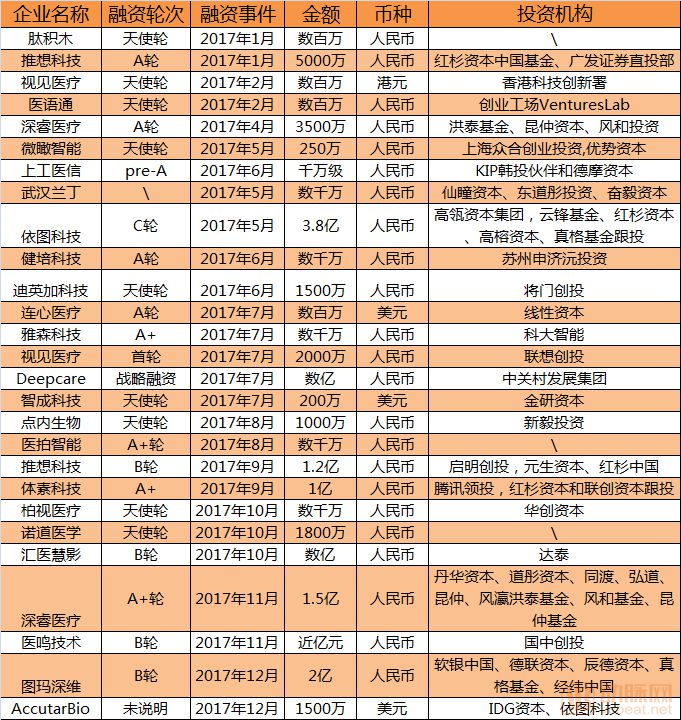
In 2017, a total of 27 financing events in the medical artificial intelligence industry were publicly announced. If companies that did not disclose their financing information are included, the total financing amount in this field exceeded RMB 1.7 billion in 2017. Angel rounds mostly occurred before June, while many companies secured Series A or Series A+ funding in the second half of the year. Industry leaders had already entered the Series B stage. According to information obtained by VCBeat, there are several other companies in China whose financing details have not been made public.
Among these companies, Infervision, Deepwise, and TomoDeep each secured two rounds of financing within a year, with the latest round exceeding RMB 100 million for all three, thereby boosting confidence across the industry.
These financing events also reveal certain patterns in funding. Among the 13 initial-round financings, four were in the range of several million RMB, while nine fell between RMB 10 million and RMB 35 million, accounting for 69.2%.
Among the eight Series A and Series A+ funding rounds, six involved amounts in the tens of millions of RMB, while two slightly exceeded RMB 100 million. Furthermore, with the exception of Infervision’s and Deepwise’s Series A rounds, which occurred in the first half of the year, the remaining six took place in the second half.
In September 2017, Infervision ushered in the Series B funding era for medical AI. Subsequently, Huiyi Huiying, Yiming Technology, and Tuma Shenwei also announced their Series B financing rounds, each exceeding RMB 100 million.
Compared with the eight financing deals in 2016, medical AI has developed at a rapid pace this year. However, in recent months, products from various companies have successively matured. During implementation, apart from forming alliances for joint development, competition among companies with similar products is inevitable. Beyond 2017, competition between companies with overlapping product offerings will become increasingly pronounced. Whether a company can secure Series B funding and sustain itself through to Series C depends not only on its product but also on market data, which serves as a critical consideration.
Policy: The plan has been released, and detailed rules are being gradually implemented.
"New Generation Artificial Intelligence Development Plan"
The "New Generation Artificial Intelligence Development Plan" involves four aspects related to healthcare:
1. Preliminarily establish the legal, ethical, and policy framework for AI by 2025
2. Establish a foundational theoretical framework and a system of key generic technologies for next-generation artificial intelligence
3. Accelerate the cultivation and aggregation of high-end artificial intelligence talent
4. Develop Convenient and Efficient Intelligent Services
This information holds profound significance for the field of medical artificial intelligence, which remains a legal “blank slate.” As an emerging industry, medical AI cannot follow the same approval processes as traditional medical devices. Even if applications were submitted, regulators would exercise greater caution given the rigorous nature of healthcare.
Furthermore, as the foundation of medical artificial intelligence, medical big data currently lacks a comprehensive legal framework for regulation. There are no clear legal guidelines regarding data ownership and usage rights, privacy standards for medical data, data security, liability norms, or whether the law can accommodate non-malicious errors arising from innovation.
While the lack of legal regulations has contributed to the current boom in medical artificial intelligence (AI), the absence of rules and standards is unsustainable, and such unchecked development may not be beneficial in the long run. If preliminary legal frameworks had been established by 2025, although this might have triggered industry reshuffling, it would have fostered more robust and sound development of medical AI.
“Notice of the General Office of the National Health and Family Planning Commission on Issuing the Technical Plan for Tiered Diagnosis and Treatment Services for Diabetic Retinopathy”
The National Health and Family Planning Commission organized experts to develop the “Technical Scheme for Tiered Diagnosis and Treatment Services for Diabetic Retinopathy” in accordance with current requirements for tiered diagnosis and treatment of diabetes, aiming to achieve early detection and early intervention for diabetic retinopathy through the implementation of the tiered diagnosis and treatment system, thereby reducing the disease burden on the population.
In the tiered diagnosis and treatment service plan issued by the National Health and Family Planning Commission, it is clearly stated that ophthalmic issues require referral, while strict control of blood glucose, blood pressure, and blood lipids, along with regular patient follow-up and education, must be implemented at the primary care level. Given the scarcity of ophthalmologists capable of diagnosing eye diseases, the use of artificial intelligence for screening diabetic retinopathy has become an important approach. Furthermore, health management for patients following screening will also serve as a significant revenue stream for enterprises.
Released the "Medical Device Classification Catalog" on September 4
According to the latest classification regulations, if diagnostic software provides diagnostic recommendations through algorithms and serves only as an auxiliary diagnostic tool without directly issuing diagnostic conclusions, it shall be registered as a Class II medical device. However, if it automatically identifies lesions and provides explicit diagnostic prompts, it shall be regulated as a Class III medical device.
It is worth noting that Class III medical devices are required to undergo clinical trials, while Class II devices have an exemption catalog for clinical trials. The China Food and Drug Administration (CFDA) has not yet issued specific regulations on whether diagnostic software applications can qualify for such exemptions.
This specification will come into effect on August 1, 2018. If medical AI companies wish to enter hospital procurement channels, obtaining certification from the China Food and Drug Administration (CFDA) is mandatory. For Class III medical device certifications, or if diagnostic software does not qualify for exemptions, extensive real-world clinical application data will significantly support companies’ applications. To this end, VCBeat has compiled clinical data from major medical AI companies to assess their current development status.
Ministry of Science and Technology Announces the First Batch of National Open Innovation Platforms for Next-Generation Artificial Intelligence
On the 15th, the Ministry of Science and Technology convened a launch meeting for the Development Plan for New-Generation Artificial Intelligence and major science and technology projects, marking the full-scale entry into the implementation phase of the plan and these key initiatives. The meeting announced the first batch of national open innovation platforms for new-generation artificial intelligence:
① Relying on Baidu Inc. to build the National New Generation Artificial Intelligence Open Innovation Platform for Autonomous Driving,
② Relying on Alibaba Cloud to build the City Brain National New Generation Artificial Intelligence Open Innovation Platform,
③ Relying on Tencent to build the National New Generation Artificial Intelligence Open Innovation Platform for Medical Imaging,
④ Relying on iFlytek to build the National Next-Generation Artificial Intelligence Open Innovation Platform for Intelligent Voice.
In early August, Tencent launched an AI medical imaging product—Tencent Miying. As the first AI-based esophageal cancer screening system, Tencent Miying achieves an accuracy rate exceeding 90%. For pulmonary nodules, Miying can detect minute nodules measuring 3 millimeters or larger, with a detection accuracy rate surpassing 95%. In the future, Tencent Miying will collaborate with medical schools and healthcare institutions to facilitate the detection of a broader range of diseases.
On November 17, the AI-powered medical imaging diagnosis project “Tencent Miying” was officially launched at Wenzhou Central Hospital. The system is expected to significantly improve the detection rate of early-stage esophageal cancer.
The National Institutes for Food and Drug Control (NIFDC) is conducting quality evaluations of medical AI.
Currently, artificial intelligence (AI) technology is rapidly advancing in the healthcare sector, with a proliferation of AI-based medical products primarily focused on medical imaging, clinical decision support, and disease prediction. This trend has imposed new requirements and challenges for the quality evaluation and regulatory oversight of medical devices. As a national technical support institution for regulatory affairs, the National Institutes for Food and Drug Control (NIFDC) undertakes quality evaluation and research on AI-based medical products. (The National Institutes for Food and Drug Control (NIFDC), formerly known as the China National Institute for Food and Drug Control, is a public institution directly affiliated with the China Food and Drug Administration. It serves as the statutory body for quality inspection of food, drugs, and medical devices in China, as well as the highest technical arbitration authority.)
Leveraging its extensive experience in medical device software testing, the Optoelectromechanical Laboratory has established a dedicated AI team to undertake this task. The team members are professionals with backgrounds in computer software, medical image processing and data mining, and biomedical engineering.。
The AI team has recently carried out the following work:
1. Undertook dozens of medical AI products, primarily involving areas such as AI-assisted diagnosis for diabetic retinopathy screening, lung cancer screening, skin cancer screening, brain tumor diagnosis, chest X-ray imaging analysis, and fracture detection.
2. Held multiple thematic technical seminars on products. For each product, in-depth discussions were conducted with enterprise engineers regarding data composition, data structure, algorithmic frameworks, model optimization, and clinical application.
3. Continued discussions with the Center for Drug Evaluation, the Chinese Academy of Sciences, and industry technical experts on product quality evaluation methods. Medical artificial intelligence products differ from traditional medical device software; previous testing methods cannot comprehensively evaluate product quality, particularly regarding focal issues such as the quality of training datasets, robustness of algorithmic models, and risks associated with real-time iteration of algorithmic frameworks. The research team is reaching a preliminary consensus with these experts.
Medical Artificial Intelligence Alliance
Large corporations possess the capability to independently conduct R&D in new fields. Startups, meanwhile, have their own strategic approach: forming medical AI alliances. For instance, companies specializing in diabetic retinopathy screening, intelligent voice entry, pathological image recognition, radiological image recognition, and clinical decision support systems can establish an alliance once their products are mature. Under principles of equality and mutual benefit, these entities can collaborate on hospital implementation and share resources and data, thereby consolidating their strength to enhance competitiveness and influence.
Currently, there are two well-known alliances in the industry.One is the Medical Artificial Intelligence Special Committee of the China Association for Medical Device Industry (CAMDI); the Special Committee is affiliated with the China Association for Medical Device Industry., the Association’s supervisory authority is the State-owned Assets Supervision and Administration Commission of the State Council, and it operates under the professional guidance of the China Food and Drug Administration (hereinafter referred to as “CFDA”).
A total of 24 organizations initiated the association, including Aeonmed, Zhongke Huineng, Infervision, Yipai Intelligence, Jinglun Century, Peking University Third Hospital, and the Fifth Affiliated Hospital of Zhengzhou University.
The other is the Medical Artificial Intelligence Alliance initiated by Zhejiang University.。
The alliance comprises 12 members, including Zhejiang University, 10 hospitals, and WeDoctor Cloud.
As a vice-chairman unit of the alliance, WeDoctor announced that it would open its WeDoctor Cloud’s cloud computing and cloud storage capabilities to the entire industry, fostering multi-directional collaboration with alliance members as well as more medical institutions, physician teams, pharmaceutical companies, and research organizations to jointly advance the development of smart healthcare in China.
This alliance also serves as a prime example of the integration of industry, academia, and research. The hospital provides data, clinical scenarios, and requirements; Zhejiang University, the hospital, and WeDoctor Cloud jointly conduct R&D; and WeDoctor Cloud then facilitates the commercialization of the developed products, delivering the most advanced research findings to the public with maximum speed.
Additionally,In late October, Tencent Miying joined forces with 69 members of the “Western Ophthalmology Alliance,” including Xi’an No. 4 Hospital, to establish the “Joint Laboratory for Artificial Intelligence in Medical Imaging,” thereby launching its screening applications for eye diseases.。
In summary, there are two emerging models for collaborative R&D in medical AI: independent development and consortium-based collaboration. Rather than establishing comprehensive platforms akin to those of Alibaba or Baidu, these models have organically evolved as business or R&D approaches driven by actual clinical, hospital, and corporate needs.
“AI+ Medical Imaging” is a concept akin to “Internet+.” Although current collaborations focus on clinical information, genetic testing, and pathological data, it is poised to engage with a broader range of medical AI domains in the near future. Moreover, future collaborations will not be limited to models centered solely on AI for medical imaging; instead, they are likely to involve cross-disciplinary cooperation among various fields of medical artificial intelligence.
This approach can facilitate the implementation of medical AI products, bringing them closer to the real-world clinical scenarios of hospitals and physicians, thereby serving as effective assistants to doctors.
Corporate Strategy of Major Companies
Among publicly listed companies, iFlytek boasts the most comprehensive layout and the greatest number of achievements in the field of medical artificial intelligence.
Voice Electronic Medical Record Product, enabling real-time voice documentation so that physicians no longer need to stay up late writing medical records. By leveraging iFlytek’s leading artificial intelligence speech recognition and natural language understanding technologies, combined with professional-grade directional microphones, the system allows physicians to achieve structured entry of medical records during consultations, thereby improving the efficiency of medical documentation and the quality of medical records.
Imaging-Assisted Diagnostic System, empowering physicians with a medically savvy “Monkey King” endowed with piercing vision and meticulous attention to detail. Leveraging image recognition and deep learning technologies, the iFlytek Medical Imaging Computer-Aided Diagnosis System integrates clinical expertise from medical specialists with large-scale sample datasets to automatically detect lesions in medical images and assess their benign or malignant nature, thereby assisting physicians in completing imaging diagnoses rapidly and accurately.
Intelligent Medical Assistant, ensuring that every physician is backed by a prestigious team of experts. Leveraging deep learning technology and integrating data from professional medical textbooks, clinical guidelines, and classic cases, “Zhiyi Assistant” can assist primary care physicians in conducting consultations and providing diagnostic and treatment recommendations. In 2017, iFlytek and Tsinghua University jointly developed “Zhiyi Assistant” and participated in the comprehensive written examination of the National Medical Licensing Examination for Clinical Practitioners. The test results have recently been officially released: “Zhiyi Assistant” passed the evaluation with an outstanding score of 96 points above the passing threshold, becoming the first artificial intelligence robot in China and even globally to pass the comprehensive written examination of the National Medical Licensing Examination.
Through a private placement and accompanying fundraising plan, Chint Smart Technology introduced RMB 400 million in capital from Suqian Jingdong Jinquan Enterprise Management Co., Ltd. (whose actual controlling shareholder is Liu Qiangdong) in September 2017.
CSG has launched health advisor robots and medical imaging analysis robots for the healthcare sector. By integrating machine vision, natural language processing, and wearable devices, the health advisor robot captures user health data and leverages big data analytics to benchmark against relevant indicators. This enables physicians to identify potential health risks at an early stage, facilitating preventive care. Furthermore, the robot can optimize treatment plans by analyzing current clinical conditions in conjunction with big data insights.
Additionally, the investor in Yasen Technology's Series A+ round is CSIG.
“Over the next twelve years, we will fully integrate technology into all of the Group’s products, businesses, and services, building an intelligent commercial ecosystem centered on cloud computing, artificial intelligence, and robotics,” said Liu Qiangdong.
Alibaba’s Explorations in Medical AI This Year Are Impressive
In March this year, Alibaba’s ET Medical Brain was launched. As part of Alibaba Cloud’s artificial intelligence strategic roadmap, ET will be equipped with a range of medical capabilities, serving as a “doctor’s assistant” in multiple areas, including disease risk prediction, medical imaging diagnosis, precision treatment planning, drug efficacy mining, new drug research and development, disease surveillance, and health management.
On the same day as the official launch of the ET Medical Brain, Alibaba Cloud announced a partnership with Intel and LinkDoc (a startup dedicated to oncology big data research) to launch the Tianchi Medical AI Series Competition, a three-year crowdsourced competition for medical AI algorithms. The first season focuses on lung cancer, the most prevalent malignant tumor worldwide.
“Doctor You”’s intelligent healthcare system offers four solutions: a cloud-based medical imaging platform, an AI-powered pulmonary nodule detection system, a research data platform, and a physician competency training platform.
This August, Tencent released “Tencent Miying,” its first AI product applied in the medical field.
Tencent Miying comprises six artificial intelligence systems, covering diseases such as esophageal cancer, lung cancer, diabetic retinopathy, cervical cancer, and breast cancer. Among these, its intelligent screening system for early-stage esophageal cancer is the most mature, achieving a laboratory accuracy rate of 90%. On September 12, Tencent Miying’s early esophageal cancer screening system was launched at the People’s Hospital of Guangxi Zhuang Autonomous Region.
On November 15, “Tencent Miying” was selected into the national AI team, just three months after its inception.
In 2017, Baidu dissolved its healthcare division and permanently shut down “Baidu Doctor,” marking its exit from the mobile healthcare sector. However, Baidu Medical Brain, powered by artificial intelligence (AI), has continued to operate. In April this year, Baidu Medical Brain announced a partnership with Community 580, a leading provider of community healthcare services in China, to empower community healthcare with AI and launch “Meile Yi,” offering users 24/7 medical consultation services. This collaboration between Baidu Medical Brain and Community 580 will inject an AI-driven “technical brain” into the tiered healthcare system.
Top Talent Joining
Recently, with the surge in artificial intelligence, some have begun to discuss how long this AI wave will last in the healthcare sector and whether it will merely be a short-lived frenzy, akin to the previous mobile health boom.
These issues can, in fact, be addressed from a different perspective. This year has seen numerous leading AI experts, along with executives from GPS and major pharmaceutical companies, enter the medical AI industry.
In March 2017, Tao Xiaodong, former Chief Architect of Philips Healthcare’s Radiation Solutions division, took the helm of iFlytek’s “AI + Healthcare” initiative, strengthening R&D efforts in medical imaging.
In June 2017, internationally renowned gene and artificial intelligence scientist Xiong Huiyuan will join Infervision, as the company seeks to incorporate genetic data and expand into overseas markets;
In August 2017, Lei Xing, a tenured professor at Stanford University, joined the company, as Huiyi Huiying planned to implement its Global Talent Program.
In October 2017, Xi Weiling and Ding Wei, senior executives from Philips and GE, respectively joined Infervision to oversee marketing operations.
In addition, Wu Ren, formerly a Distinguished Scientist at Baidu’s Deep Learning Institute, joined Xici Heterogeneous Computing; Qiao Xin, former Vice President of Siemens Greater China and President of its Healthcare Business, founded Deepwise Medical……
These industry leaders possess a thorough understanding of artificial intelligence technology and the healthcare market. It was their recognition of the immense potential of AI in healthcare that motivated them to embark on a new journey.
Additionally, from the timing of talent acquisitions, we can observe:In the first half of the year, companies were actively recruiting top-tier technical talent, with a focus on product and technology. By the second half of the year, medical marketing experts—particularly executives with experience at GPS (GE Healthcare, Philips, and Siemens Healthineers)—became highly sought after. This trend indirectly reflects a shift in corporate focus toward marketing, regulatory validation, and sales.。
Prepare for the Storm
In 2017, the field of medical artificial intelligence witnessed a series of promising developments, with a bright future ahead; however, the path proved arduous for some companies.
First, the underlying technologies of most Chinese medical AI companies are not superior to those in the United States, but our applications in this field are no less advanced than those in the U.S.Part of the reason is that our regulatory and supervisory frameworks are significantly weaker than those in the United States, particularly regarding medical data and market access, which has, to some extent, accelerated industry development.。
However, the Chinese government has recently recognized this issue and is formulating relevant policies. Once these policies are implemented, the industry will become more standardized, and certain practices will no longer be permissible. Enterprises should make preparations in advance.
Second, currently, some niche industry leaders have emerged in this field. Building on their mature products, they are expected to obtain CFDA certification in the near future, which will further strengthen their competitive advantages and exert increasing competitive pressure on startups.
Third, after the financing boom subsides, consolidation becomes inevitable, and securing the next round of funding will be relatively more challenging, particularly for Series B and C rounds. Whether a company can present impressive product and operational metrics to hospitals and investors before obtaining its next round of funding is critical to its future development. After all, the cost of AI talent is prohibitively high, and companies are well aware of how long their Series A financing can sustain them.
Prepare for the storm and take preventive measures to survive in the next phase of competition.