

Fudan University Obstetrics & Gynecology Hospital Partners with Tencent to Build a Smart Hospital, Highlighting AI+Healthcare Collaboration
On the afternoon of November 21, Fudan University Obstetrics and Gynecology Hospital and Tencent held a signing ceremony in Shanghai. The two parties will cooperate on innovation and application of “Internet Plus” to improve the operational efficiency within the hospital and its medical consortium, enhance the capability and efficiency of patient-oriented medical services, and establish a new benchmark for smart specialized hospitals. Meanwhile,Leveraging Tencent Miying, Tencent’s first AI-powered medical product, the two parties will also collaborate and explore applications in the “AI + Healthcare” sector, particularly for screening diseases such as cervical cancer and breast cancer.。
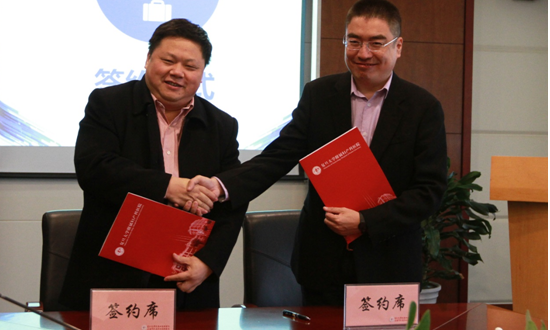
Xu Congjian (left), President of the Obstetrics and Gynecology Hospital of Fudan University, and Zhang Wei (right), Vice President of Tencent Internet Plus, sign a cooperation agreement.
Creating a More Patient-Centered Healthcare Experience
With advancements in computer vision and deep learning, integrated with medical textbooks, clinical guidelines, and classic case studies, artificial intelligence (AI) has evolved beyond enabling machines to “hear” and “read” to empowering them to “see.” On this basis, AI assists physicians in disease diagnosis and provides treatment recommendations, marking a significant innovation in healthcare. It is against this backdrop that Red House Hospital and Tencent have joined forces in this powerful partnership.
With a 133-year history, the Obstetrics and Gynecology Hospital of Fudan University is the earliest specialized obstetrics and gynecology hospital established in China and one of the birthplaces of modern obstetrics and gynecology in the country. In recent years, the hospital’s overall strength has continued to grow, ranking second nationwide and first in East China for eight consecutive years on the National Hospital Specialty Reputation Ranking, while securing the top position among specialized obstetrics and gynecology hospitals. In 2016, the hospital recorded 1,598,247 outpatient visits, 66,908 discharges, and 26,929 cases of level III and IV surgeries, accounting for 63.95% of all surgical procedures. In the first half of this year, the hospital delivered 7,500 babies, and general obstetric outpatient visits reached 73,000.
The Obstetrics and Gynecology Hospital of Fudan University has entered into a partnership with Tencent.will"Smart Hospital"Leveraging application upgrades as a strategic entry point, we will collaborate across numerous domains—including WeChat Official Accounts, WeChat-based medical insurance payments, WeChat commercial insurance payments, and cross-regional settlement for the New Rural Cooperative Medical Scheme—by capitalizing on Tencent’s advantageous resources in online social networking, Tencent Cloud, and mobile payments.To provide patients with a higher-quality, more patient-centered healthcare experience.
Regarding Official Accounts, Tencent will assist hospitals in integrating their Official Accounts with Mini Programs, optimizing patient care processes, enhancing service efficiency, and better meeting patients’ service needs. Meanwhile, aligning with the hospital’s development plans, Tencent aims to establish the hospital as a benchmark brand for WeChat-based healthcare services in the medical industry.。
To address the long-standing “three longs and one short” issue that has plagued patients, the hospital will partner with Tencent to launch WeChat-based medical insurance payment. This initiative enables social security cards to be used for end-to-end payments throughout the entire care journey—from appointment scheduling and registration to consultations and hospitalization—thereby completely bridging the “last mile” in online medical payment. By linking their social security cards to WeChat via electronic medical visit cards stored in the WeChat Card Package, patients can eliminate all unnecessary trips to physical counters, except for those required for actual consultations, examinations, and treatments. Pilot data from selected regions previously indicated that this approach saves patients an average of 43.6 minutes.
In the areas of commercial health insurance and the New Rural Cooperative Medical Scheme (NRCMS), the hospital will partner with Tencent to build a unified external platform for commercial insurance. This platform will enable rapid online claims settlement, customized design of new insurance products, and the application of scenario-based insurance solutions. Meanwhile, WeChat-based NRCMS payments will be integrated with existing NRCMS service windows, therebyOff-site SettlementThe process has moved online, shortening the previously cumbersome and lengthy out-of-town reimbursement procedure to just one minute, significantly reducing patients’ time costs and cash flow pressure.
Leveraging Tencent Miying for AI+Healthcare Collaboration
In the field of medical big data, the Obstetrics and Gynecology Hospital of Fudan University and Tencent will conduct research on physician training tools, automated imaging diagnosis, and computer-aided diagnostic tools. As part of this collaboration, both parties will leverage Tencent Miying to explore and advance AI-driven healthcare initiatives. Previously, Tencent Miying has already demonstrated capabilities in assisting with the screening of conditions such as esophageal cancer, gastric cancer, lung cancer, and diabetic retinopathy. In the future, the two parties will also conduct research focused on auxiliary screening for diseases such as cervical cancer and breast cancer.
It is understood that Tencent Miying was developed by integrating cutting-edge technologies, such as image recognition and deep learning, with medical practice. It serves not only as a highly effective general practice assistant for physicians but also facilitates the dissemination of top-tier specialist expertise to primary care settings. Tencent Miying can screen an endoscopic examination in under four seconds, thereby supporting hospitals and medical research institutions in driving innovation and the widespread adoption of AI-assisted diagnosis and treatment, improving diagnostic accuracy, and enabling early detection and timely treatment for patients.
At the launch meeting for the “Development Plan for New-Generation Artificial Intelligence and Major Science and Technology Projects” convened by the Ministry of Science and Technology on November 15, it was announced that Tencent had joined the national AI team. It was further specified that, in the direction of AI + healthcare, Tencent would be relied upon to build the National New-Generation Artificial Intelligence Open Innovation Platform for Medical Imaging. Tencent Miying is the AI + healthcare product tasked with fulfilling this important mission.
As a renowned obstetrics and gynecology hospital in the industry, The Obstetrics and Gynecology Hospital of Fudan University has provided strong support for this collaboration through its advanced medical technology, authoritative team of experts, and extensive collection of reliable imaging data.
It is reported that the two parties will also discussOnline Consultation and Electronic Prescription CirculationExpand collaboration. The former will establish communication channels between in-hospital physicians and out-of-hospital patients, providing patients with a better online consultation experience; the latter will offer patients more options, allowing them to receive electronic prescriptions issued by physicians after hospital visits and freely choose to pick up medications either within the hospital or at designated out-of-hospital pharmacies.
Seizing the opportunity of this strategic partnership, Red House Hospital will collaborate with Tencent to drive innovation and expand applications. By leveraging Tencent’s strengths in artificial intelligence and Red House Hospital’s expertise in medical technology, the two parties aim to progressively develop a systematic and mature “Integrated Smart Hospital Solution.” This initiative will enhance hospital operational efficiency, quality of care, and patient satisfaction, make valuable contributions to the application of AI in specialized obstetrics and gynecology hospitals, and lead advancements in the field of OB-GYN diagnostics, ultimately establishing itself as an industry leader.