

Insights from Health Industry Leaders: How to Navigate and Innovate in the Greater Health Sector

On November 22, 2017, the event “Key Insights for Entrepreneurship in the Big Health Industry,” hosted by Pintu Group’s *Si Bai Wei*, was held as scheduled at the LandoWork Innovation Accelerator. The conference brought together opinion leaders, industry experts, and entrepreneurs from major medical institutions, healthcare startups, medical investment firms, and health management sectors. The event was moderated by Yan Rui, Editor-in-Chief of Pintu’s *Si Bai Wei*.
At the conference, Qu Feiyu, Executive Director of Pintu Group, first put forward his viewpoint—the big health industry will explode in the future. In addition to innovation in data, there also needs to be innovation within the industry itself to create new value. Pintu's original intention is to allow more investors who are innovating in this industry to see more professional viewpoints and find investment opportunities. The future direction of Pintu is to root itself in the field of industrial innovation, do well as a media and aggregator in high-growth industries and sectors, and serve the industry with a professional attitude.

Qu Feiyu, Executive Director of Pintu Group
At this salon, prominent figures gathered to discuss the broader health sector, including Dong Mifang, Executive Director of Yuyue Medical Fund; Xue Yuning, CEO of Shengdao Investment; Nan Zhe, Founder of Mint Dentistry; Lai Lipeng, Co-founder of XtalPi; Fu Yike, Co-founder of Nuoli Medical Aesthetics; Liu Siting, Founder of Vbros; and Wang Tengfei, Executive Dean of Yijian Sanye.
Will the healthcare industry give rise to major unicorns?
Dong Mifang, Executive Director of Yueyin Medical Fund and a former hospital professional, delivered a presentation titled “Analysis of Investment Trends in the Healthcare Sector,” offering an investor’s perspective on entrepreneurship in the health industry. She highlighted eight major pain points in internet healthcare: How to address the issue of high cash burn without tangible implementation? How can companies survive during a capital winter? Is success determined by winning over doctors or patients? How to select an appropriate business model? How to align with policy regulations and mitigate risks? How can companies develop self-sustaining revenue capabilities? Who will bear the costs—insurance companies or pharmaceutical distributors? How to choose the right market segment?
Since 2010, the inaugural year of investment in the healthcare and wellness sector, medical institutions and diagnostics have remained focal points for health-sector investors. The life sciences sector has also become a highly active segment within the private equity (PE) and venture capital (VC) landscape. In addition, technological innovation, immunotherapy, liquid biopsy, and gene sequencing are among the other prominent hotspots.
In addition, Dong Mifang shared insights on investment, noting that team, sector, and business model are the three key factors investors focus on most. An “ideal” investment relationship encompasses strategic fit, value-add, clear terms, and well-defined expectations. When engaging with investors, candor, openness, and interaction are the three essential elements for effective communication.

Dong Mifang, Executive Director of Yueyin Medical Fund
Nan Zhe, founder of Bohe Dental, opened his speech, “Breaking and Building: The Entrepreneurial Journey for Physicians,” with the question, “What is entrepreneurship?” Nan Zhe posits that entrepreneurship constitutes a localized improvement to the socioeconomic fabric and a redistribution of industry discourse power. No industry can alter the core logic of entrepreneurship itself; rather, it enhances efficiency through optimization and integration, thereby driving a shift in discourse power.
Nan Zhe believes that entrepreneurship is also the greatest embodiment of individual value. When explaining why he “took off his white coat,” Dr. Nan drew an analogy: “I have a flame that can boil a pot of water, or I can ignite an entire hillside—it all depends on where this fire is placed.”

Nan Zhe, Founder of Mint Dentist
Dr. Nan believes that with the evolution of social industries, the dual themes of “professional ethics” and “economic interests” have remained prominent. He raised the question, “What is a physician?” to engage in interactive discussions with clinicians on site. Some physicians shared the view that doctors are individuals entrusted with health and lives, bearing the responsibility of saving human lives. Others argued that the term best representing physicians is “benevolent healers.” In contrast, Nan Zhe contends that physicians are craftsmen and fragmented, refined egoists.
For physician entrepreneurs, the primary goal is self-actualization of value. Beyond financial compensation for their labor, a deeper sense of purpose is fulfilled through a dedicated platform. Physician entrepreneurship represents a redistribution of decision-making power and professional voice.
Lai Lipeng, Co-founder of XtalPi, delivered a presentation titled “How New Computational Foundations Accelerate Pharmaceutical Innovation,” highlighting the current state of the pharmaceutical industry: first, exceptionally high costs; second, excessively long R&D cycles.
Li Lipeng pointed out that traditional experimental methods are fraught with significant uncertainty. Many experiments are akin to searching for a target in complete darkness. The goal is to leverage technological approaches to accurately identify molecular structures within this “dark forest” of molecules that pharmaceutical companies can develop into drugs. This objective is achieved through computational methods.
Lai Lipeng introduced the current approach to drug development, which leverages “quantum mechanics + cloud computing” as the entry point for research, and also outlined the three primary directions for data acquisition:
First, public data. This is a major area of focus for both the U.S. Food and Drug Administration (FDA) and China’s National Medical Products Administration (NMPA).
Second, a large volume of high-accuracy simulated data was generated using quantum mechanical calculations, and machine learning models were trained based on these data.
Third, through collaborations with pharmaceutical companies and research institutes, we have access to extensive internal datasets. Since machine learning algorithms do not differentiate between successful and failed data points, integrating both successful and failed cases yields robust results.
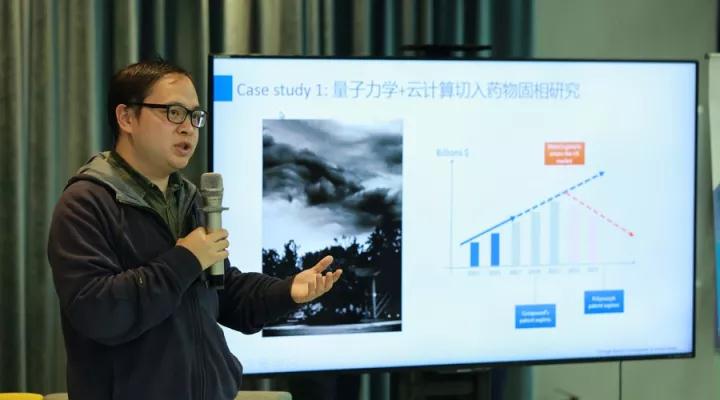
Co-founder of XtalPi, Lai Lipeng
To Be a “Clear Stream” in the Health Sector
During the roundtable discussion, Wang Tengfei, Executive Dean of Yijian Sanye; Liu Siting, Founder of VBROS; Fu Yike, Co-founder of Nuoli Medical Aesthetics; Xue Yuning, CEO of Shengdao Investment; and Yan Rui, Editor-in-Chief of Pintu’s “Four Hundred Flavors,” jointly explored entrepreneurship in the big health sector.
Yan Rui began by asking how perceptions of the healthcare industry have evolved since entering the field. Wang Tengfei, Executive Dean of Yijian Sanye, summarized the current state of the medical sector as “complex.” He believes that China’s healthcare system remains akin to a feudal society, noting that the level of complexity encountered after taking over hospital operations was beyond imagination. Wang emphasized that four key professional groups in the healthcare field—physicians, nurses, pharmacists, and biomedical engineers—require greater attention, opportunities, and resources.

From left to right: Wang Tengfei, Executive Dean of Yijian Sanye; Liu Siting, Founder of VBROS; Fu Yike, Co-founder of Nuoli Medical Aesthetics; Xue Yuning, CEO of Shengdao Investment; Yan Rui, Editor-in-Chief of VCBeat’s “Four Hundred Flavors”
Liu Siting, founder of Vbros, outlined user consumption habits from the perspectives of content, standards, and scenarios, arguing that the current fitness industry remains relatively “outdated.” This is primarily manifested in the rapid optimization of product categories and sectors, while the underlying industry structure and business models remain stagnant, necessitating innovation in content. Liu Siting identified two major areas of prosperity on the internet: first, transactional internet; and second, informational internet. She noted that “product internet” remains an unresolved challenge and is the focus of their current efforts, aiming to meet user needs through customization.
Fu Yike, co-founder of Nuoli Medical Aesthetics, described her initial impression of the medical aesthetics industry as “chaotic.” Currently, the marketization level of medical aesthetics institutions is relatively high. Fu Yike believes that medical aesthetics is a serious and solemn endeavor that must return to the essence of healthcare. As healthcare requires substantial investment, it is essential to establish standards and regulations, promote industry self-discipline, and gradually balance the significant disparity between supply and demand. Traditional medical aesthetics procedures are performed infrequently; to upgrade beauty services to medical-grade aesthetics, better products must be developed.
Xue Yuning, CEO of Shengdao Investment, believes that physicians are scientists with a humanistic spirit. Given the limited medical resources in public hospitals, differentiated services are needed to address the needs of certain patients. Currently, the top priority is to build patient trust in non-public medical institutions. In terms of investment direction, the industry views the essence of healthcare through the lens of consumer behavior, emphasizing the need for more convenient, minimally invasive surgical approaches.
In response to Xue Yuning’s assertion that the medical aesthetics industry has become a fiercely competitive “red ocean,” Fu Yike offered a differing perspective. Fu Yike believes that for medical aesthetics institutions, high-quality services, advanced technologies, and superior products can still achieve rapid growth, indicating that the sector remains a “blue ocean.” Yan Rui from VCBeat’s “Four Hundred Flavors” column expressed agreement with Fu Yike’s vision of becoming a refreshing force in the medical aesthetics field, stating, “Only when there are many such refreshing streams will clear springs emerge; and only when there are many clear springs will rivers, lakes, and seas form.”



Salon Site