

Zhou Shuiping of Tasly: Building a Boundary-Free Research Institute and an Innovative Drug Industrialization Platform
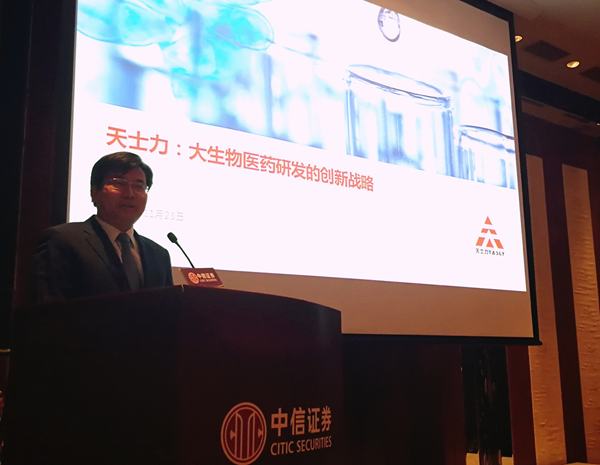
Speech by Zhou Shuiping, Executive Dean of Tasly Research Institute, at the CITIC Securities Capital Annual Conference
With the in-depth advancement of the “Healthy China” strategy, the growing health demands of Chinese residents have fueled an explosion in China’s biopharmaceutical industry. In recent years, there has been a continuous emergence of initial public offerings (IPOs) and mergers and acquisitions (M&A) among domestic biopharmaceutical companies, signaling that the entire sector has entered a period of vibrant innovation.
Biopharmaceuticals is an industry in which there remains a significant gap between China and developed countries. According to McKinsey’s report, “Building a Sustainable Ecosystem for Pharmaceutical Innovation in China,” the global market for innovative drugs is nearly $600 billion, while China’s share is still under $10 billion. However, with the launch of national drug regulatory reforms in recent years, China’s biopharmaceutical industry has gradually entered a fast lane of development, attracting considerable attention from investors.
Recently, Zhou Shuiping, Executive Dean of the Tasly Research Institute, stated at the CITIC Securities Capital Annual Conference that the company has maintained steady growth over the 15 years since its listing, with revenue and net profit increasing by 16.18% and 13.5%, respectively, in the first three quarters. Its commercial segment has also recently been listed independently. Initially focusing on traditional Chinese medicine (TCM), Tasly established a chemical research institute in 1999 to develop chemical drugs and founded a biological research institute in 2001 for biopharmaceutical R&D. Over the past decade, under its internationalization strategy, Tasly has gradually formed a synergistic development pattern encompassing TCM, biologics, and chemical drugs. In the future, Tasly aims to become an innovative platform spanning the three major fields of TCM, biologics, and chemical pharmaceuticals.
Portfolio of Over 60 Drugs Across Three Major Therapeutic Areas, with Innovative Drugs Accounting for More Than One-Third
According to Zhou Shuiping, Tasly’s independent R&D expenditure in 2016 amounted to RMB 440 million, with approximately RMB 390 million invested through collaborative R&D and other models, bringing the total actual R&D spending to around RMB 830 million. The R&D intensity, measured as the proportion of R&D expenditure to pharmaceutical industrial revenue, reached a high of 13.4%. To date, the company has developed and established a pipeline of more than 60 drug products across traditional Chinese medicine (TCM), chemical drugs, and biologics, including over 20 innovative drugs.
From the perspective of its biologics portfolio, Tasly has achieved comprehensive coverage in key therapeutic areas—including fully human antibodies, long-acting fusion proteins, and viral therapeutic vaccines—through its development of candidates such as the fully human anti-IL-17 monoclonal antibody (Anmeimu mAb), the fully human anti-CD47 monoclonal antibody, the lipid-lowering fully human anti-PCSK9 monoclonal antibody, TSLB1344, injectable glucagon-like peptide, long-acting GLP-1 analogs (with priority rights in the investment market), and therapeutic hepatitis B vaccines.
Currently, Puyouke, a thrombolytic biologic for the treatment of acute myocardial infarction, has been included in the National Reimbursement Drug List. Financial reports indicate that its sales revenue increased 226-fold in the first three quarters. Furthermore, two new indications for Puyouke (stroke and pulmonary embolism) are progressing smoothly through development and expansion. In addition, three other biologics are in clinical trials, with multiple drug candidates advancing steadily; these are expected to receive clinical trial approvals in the coming years.
TSLB1344 is a first-in-class innovative biologic with a novel mechanism of action for the treatment of diabetes. Independently developed by Shanghai Tasly, this Class 1 biologic agent based on FGF21 is indicated for type 2 diabetes. It works by binding to the complex of FGF21, FGFR, and β-klotho, thereby promoting the expression and translocation of glucose transporters, enhancing glucose uptake, and increasing hepatic glycogen synthesis. Additionally, it inhibits gluconeogenesis by reducing the secretion of glucose-6-phosphatase and PEPCK. Furthermore, FGF21 inhibits SGLT1 and SGLT2, reducing glucose reabsorption from the intestine and renal tubules.
Based on the results of preliminary animal studies, the glucose-lowering indicators are highly stable. The market size for type 2 diabetes is projected to reach RMB 70 billion, while that for non-alcoholic steatohepatitis (NASH) stands at RMB 5 billion. In the future, the product’s indications can be expanded to include NASH, atherosclerosis, hepatic fibrosis, severe obesity, hyperlipidemia, and anti-inflammatory applications.
Tasly has also introduced PXT3003, an innovative drug from the French company Pharnext. The product has completed enrollment and screening of 300 patients with mild-to-moderate Charcot-Marie-Tooth disease type 1A (CMT1A) worldwide. It is currently advancing through Phase III international clinical trials while seeking early market access authorization in Europe, demonstrating significant potential in both European and North American markets.
This drug meets the criteria for simultaneous domestic and international development and dual filing, and the rights for the Greater China region have been fully licensed to Tasly. It is expected to benefit from new regulatory policies in China that expedite the review process. Charcot-Marie-Tooth disease is a rare disorder with no effective therapeutic products currently available on the market; similar R&D projects by other companies worldwide are still in the preclinical stage.
“Four-in-One” Framework for Building Sustainable Innovation Capabilities
It is widely recognized within the industry that the pharmaceutical sector is characterized by high risks and high returns, involving substantial R&D investment and significant risk exposure. Through long-term exploration, Tasly has adopted a “four-in-one” R&D model—comprising independent R&D, collaborative R&D, product in-licensing, and investment in market priority rights—to leverage R&D resources, mitigate risks, accelerate the translation of innovative achievements, and establish sustained innovation capabilities.
Taking the successful inclusion of Puyouke, a Class I national innovative thrombolytic drug, in the National Reimbursement Drug List as an example, its 16-year development cycle fully demonstrates Tasly’s R&D capabilities and strategic patience. Currently, Puyouke is undergoing expansion of its indications. In the future, Puyouke will address a vast market with 800,000 new annual cases of myocardial infarction, 1–1.5 million new cases of cerebral infarction, and 800,000 new cases of pulmonary embolism, potentially becoming a new blockbuster product for the company.
Furthermore, through independent R&D, Tasly has multiple biologics in development and is pursuing additional indications; through collaborative R&D, it established Genor Biopharma, an international R&D incubation platform, in partnership with France’s Transgene; through product in-licensing, it introduced multiple biologic drugs from Shanghai Saiyuan Biotechnology; and through priority marketing rights, Tasly has secured future priority licensing rights for the commercialization of several biologic products.
Among these, Anmeimu Monoclonal Antibody (recombinant fully human anti-EGFR monoclonal antibody, a Class 1 therapeutic biologic) is the core product of Shanghai Saiyuan Biotechnology, in which the company holds a controlling investment. This drug can overcome the drawbacks of significant side effects associated with marketed products, serving as an alternative therapy targeting EGFR, and is currently in Phase I clinical trials.
Therapeutic Hepatitis B Vaccine is a Class 1 new biological drug for therapeutic use, developed by Genesis Biopharmaceuticals, a joint venture between Tasly and the French company Transgene. It is the first novel targeted immunotherapeutic biological product approved in China that uses a viral vector for the treatment of chronic hepatitis B. Unlike existing antiviral drugs, the unique feature of this therapeutic vaccine lies in its ability to activate the patient’s own immune response targeting HBV antigens, ultimately leading to protective immunity and sustained control of the disease.
Industry analysts suggest that Tasly will leverage its “four-in-one” R&D mechanism, combined with its robust investment capabilities and global business development expertise, to shorten the product development cycle for both domestic and international markets. By tapping into these two markets, Tasly aims to achieve orderly product launches, thereby providing strong innovative product support for its steady performance growth.
Building a Wall-less Research InstituteBuilding an Industrialization Platform for Innovative Drugs
Zhou Shuiping stated that Tasly has been committed to building an open, innovative platform that attracts diverse mechanisms, technologies, and products to take root here, effectively becoming a “wall-less” research institute. More importantly, Tasly possesses integrated commercial capabilities spanning R&D, manufacturing, and sales, positioning it as a key platform for the industrialization of innovative drugs in China and offering greater advantages compared to single-product innovation.
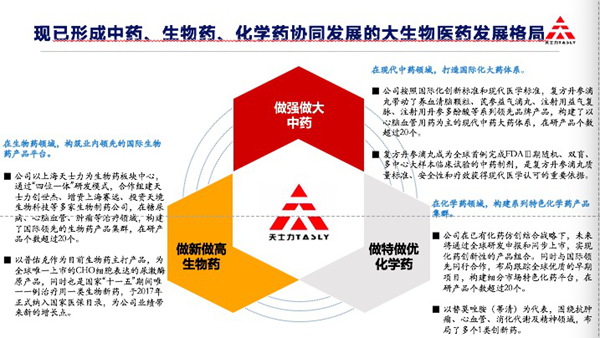
As is well known, Tasly initially focused on traditional Chinese medicine (TCM) during its early development stages. In recent years, it has gradually expanded into a comprehensive biopharmaceutical layout encompassing biologics and chemical drugs. Taking Shanghai Tasly as an example, the company is developing new products centered on core therapeutic areas such as diabetes, cardiovascular and cerebrovascular diseases, and oncology. By leveraging core technologies in proteins, viruses, and antibodies, and integrating research and development, manufacturing, and sales, it has established a closed-loop industrial chain. Currently, its Class 1 original biologic drug, Puyouke, has been launched, and more than 10 biologic drugs are under development.
Furthermore, Tasly has built a lean production and manufacturing platform through years of accumulation. It is reported that Tasly Pharmaceutical Group was awarded the title of “2016 Intelligent Manufacturing Pilot Demonstration.” It was also the only enterprise in Tianjin approved for this project. Among the 63 approved enterprises nationwide, only four were engaged in pharmaceutical manufacturing.
The marketing system is a crucial component in the commercialization of pharmaceutical products. Tasly boasts a robust marketing infrastructure, a comprehensive sales team, a mature academic promotion system, and a nationwide marketing network, making it one of the few companies in China that integrates drug research and development, manufacturing, and sales into a unified commercial platform. Furthermore, Tasly has established its platform architecture and a multi-dimensional, networked intellectual property protection system in accordance with international standards. Leveraging the capabilities of this platform, Tasly has become the only enterprise in China to simultaneously hold the titles of National Key Laboratory, National Engineering Laboratory, and International Joint Research and Development Center.
It is evident that Tasly adheres to a dual-wheel drive model of “industry + capital.” By leveraging external capital, the company generates sufficient momentum to integrate resources within the pharmaceutical industry. Meanwhile, relying on its long-established industrial advantages, Tasly continuously enhances capital efficiency, transforming it into strategic value-added returns for investors, and has gradually built an innovative drug industrialization platform.