

Aegicare Secures RMB 15 Million in Angel Funding to Advance AI-Powered Genomic Intelligence for Clinical Decision Support in Genetic Disorders

2017Year11Month28Day, Angelcare announced that it has secured1500RMB 10,000 angel round of financing. This round of financing was led by Danhua Capital(DHVC)Lead investor; Hemeng Venture Capital participated as a co-investor.These are the first companies invested in by Danhua Capital since the establishment of its inaugural RMB-denominated fund.
In the early 21st century, the completion of the Human Genome Project gave rise to the concept of personalized medicine, which aims to leverage genomic information to tailor treatment plans based on individual patient characteristics. However, the practical implementation of personalized medicine has encountered numerous challenges. The primary obstacle lies in the fact that genetic diseases often involve multiple genes; thus, elucidating the associations between genes, disease phenotypes, and drug responses within the intricate landscape of multi-locus genetic variations has become the most significant barrier to advancing personalized therapy.
In 2016, AlphaGo’s victory over Lee Sedol ushered in the inaugural year of artificial intelligence, propelling AI applications to new heights. As the “AI+” wave swept across the globe, it also rekindled hope for personalized medicine. Against this backdrop, Angikangr was established.
Clinical Testing for Genetic Disorders: A Niche Yet Promising Blue Ocean Market
Angikangr was established in early 2017, dedicated to integrating genomic big data with artificial intelligence to build a precision medicine platform for clinical decision support. Unlike the vast majority of companies currently focused on oncology clinical testing, non-invasive prenatal testing (NIPT), and health management based on next-generation sequencing (NGS), Angikangr concentrates on the field of genetic disorders.
Dr. Li Yang, Founder and CEO of AngiCare, earned his degree in Bioinformatics from the University of Illinois at Urbana-Champaign in the United States and was a recipient of the National Outstanding Self-Funded Student Scholarship. After graduation, Dr. Li joined INVITAE, a leading U.S. company specializing in genetic sequencing for hereditary diseases.
In 2016, a friend in China approached Li Yang, seeking his assistance in arranging genetic testing for hereditary tumors, as multiple members of the friend’s family had been diagnosed with breast cancer. Since Li Yang was in the United States at the time, he contacted a genetic testing company in China to conduct the test.
However, the test results ultimately provided by the company came as a shock to him. The results indicated that all individuals tested were at high risk for breast cancer, yet the specific mutation sites reported were exclusively common genetic polymorphisms found in the general population. “These cannot even be classified as low-frequency mutations, let alone justify claims of high tumor risk,” stated Li Yang.
At that time, he witnessed the chaos in China’s genetic testing market, which spurred his decision to return to the country and enter the genetic testing industry.
Both domestically and internationally, clinical-grade testing represents the “heavy industry” segment of the NGS sector. However, unlike abroad, most companies in China have focused on non-invasive prenatal testing (NIPT) and tumor targeted therapy companion diagnostics, with few specializing in clinical genetic disease testing.
In terms of sample volume, domestic genetic testing companies in China conduct only a few thousand clinical genetic tests on average each year. However, this small-scale, workshop-style service falls far short of meeting potential demand. Taking neonatal birth defects as an example, the birth defect rate in China is approximately 5%–8%. Based on an annual birth population of 20 million, there is a substantial unmet need, with millions of newborns requiring confirmed diagnoses of genetic disorders.
““This market size is no smaller than that of the oncology market.”Li Yang revealed to VCBeat. Perhaps it was at that time that he made up his mind to return to China.
Big data and analytical interpretation are the core, with a bioinformatics algorithm team that is “uniformly composed.”
Invitae is a genetic information company that places particular emphasis on bioinformatics algorithms and the automation of analytical interpretation. Li Yang told VCBeat that when he joined the company in 2014, the team consisted of approximately 150 employees, 80 of whom were engaged in software development. Even geneticists who did not write code were deeply involved in the development of the automated interpretation system.
“It is hard to imagine in China that a genetic testing company would have such a high proportion of staff dedicated to software and algorithm development,” Li Yang told VCBeat.
The complexity of clinical testing for genetic diseases and the challenges in clinical interpretation are greater than those for NIPT and oncology. If only 10 or 100 samples are processed per month, manual labor can still manage the workload. However, what if the sample volume increases to 1,000 or 10,000? It is hard to imagine that manual efforts could ensure report turnaround time under such a massive workload, let alone guarantee the accuracy of result interpretation.
Based on this logic, INVITAE has invested substantial resources in system development with the aim of establishing an automated workflow from genetic bioinformatics to intelligent data interpretation. This approach enables them to ensure both the accuracy of interpretation and computational scalability for large sample sizes.
In its conversation with Li Yang, VCBeat observed that Invitae’s logic has had a profound influence on him. As Hemon Ventures’ Biomedical Fund believes, in the field of AI plus genomic big data, commercial application scenarios are important in the short term, but in the long run, philosophy and industry-leading technologies are the keys to ensuring a company’s breakthrough.
All five members of Angikang’s founding team come from the field of bioinformatics. The company’s CTO, Liu Yang, was Li Yang’s high school deskmate. He earned his bachelor’s degree in Computer Science from Tsinghua University and later obtained a Ph.D. in Bioinformatics from the Academy of Military Medical Sciences, specializing in large-scale omics data analysis.
COO Lü Peitao graduated from the Department of Biomedical Engineering at Peking University and possesses extensive experience in computational simulation, design, and development of microfluidic systems.
Zhang Yang, Director of Bioinformatics, was Li Yang’s junior fellow student at the University of Illinois at Urbana-Champaign. His primary research focuses on the functional annotation of genomic regulatory elements and their applications in human genomic diseases. He has extensive experience integrating experimental analysis with computational algorithms.
Professor Ma Jian, the Chief Scientific Advisor, is Li Yang’s doctoral supervisor and currently serves as an Associate Professor in the Department of Computational Biology and Machine Learning at the School of Computer Science, Carnegie Mellon University (CMU), USA.
Moreover, more than half of Anjikang’er’s current team consists of bioinformatics and software development professionals. Adhering to Invitae’s approach, they aim to leverage genomic big data and artificial intelligence algorithms to provide technical support for interpretation, thereby making it more accurate, faster, and cost-effective.
“Every individual’s genome harbors tens of thousands of mutation sites. Identifying the key disease-causing genetic mutations from such complex information to support clinical decision-making is inherently a task that cannot be accomplished solely by manual effort,” said Li Yang.
Zhang Dadi, Managing Partner of Danhua Capital’s China Region, stated, “The gene industry is currently brimming with opportunities and vitality. Genetic testing not only plays an irreplaceable and pivotal role in disease prevention, control, and medication guidance, but it will also become a standard screening tool for every resident. Amid the rapid iteration of both legacy and emerging genetic testing technologies, the Angenkangr team’s strong professional background, technical expertise, and swift execution capabilities make them well-suited to meet these challenges.”
From instrument data to decision support, aspiring to be a pioneer in genomic intelligence
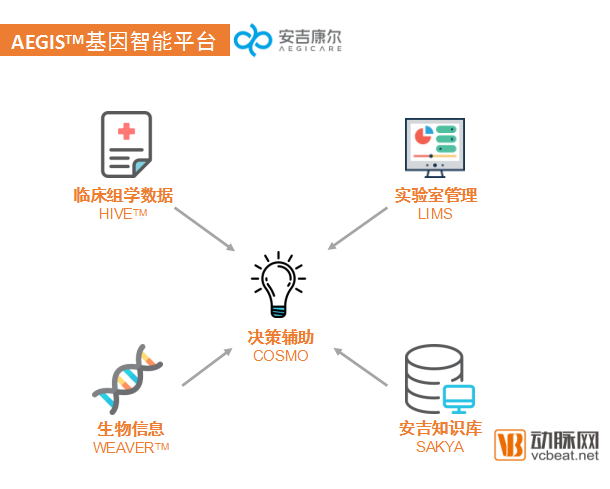
AEGIS Gene Intelligence Platform
AnjiKang is dedicated to the research and development of AEGIS™, a high-precision, fully automated system for sequencing data analysis and intelligent interpretation of genetic diseases. Many of AnjiKang’s business operations are centered around this system, which is primarily divided into four modules.
The first module is the bioinformatics algorithm module (WEAVER). Compared with its domestic peers, AngiKang places particular emphasis on gene copy number variations (CNVs). In 2016, Li Yang and Ma Jian collaboratively developed the Weaver algorithm, which was published in Cell Systems, a sub-journal of Cell focusing on systems biology and computational biology.
Previously, CNV algorithms were linear and one-dimensional, whereas the Weaver algorithm leverages probabilistic graphical models (Markov random fields) to upgrade from one-dimensional to two-dimensional analysis. By treating the genome as an undirected graph for comprehensive scanning, it achieves single-locus resolution and enables quantitative detection of CNVs.
The second module is the HIVE Clinical Sequencing Information System, which provides clinicians and researchers with genomic big data management capabilities. The management and data mining of clinical omics big data are key to achieving precision medicine. As next-generation sequencing (NGS) technology continues to improve, whole-exome sequencing has gradually become mainstream in the diagnosis of genetic diseases.
Whole-exome sequencing generates vast amounts of data, yet clinicians require interpretable clinical reports that encompass patients’ clinical manifestations, syndromes associated with identified genetic mutations, and corresponding testing and adjunctive diagnostic strategies. By leveraging its HIVE system, Angelcare integrates exome sequencing data with imaging findings, biochemical markers, family genetic history, and environmental and lifestyle factors to formulate personalized precision diagnosis and treatment plans.
The third module is the knowledge base (SAKYA). This module encompasses the integration of public databases and in-depth mining of proprietary data. The knowledge base serves as a key component for establishing connections among phenotypes, diseases, genes, mutations, and drugs.
The fourth module is the Clinical Decision Support System (COSMO). At this stage, the system’s task is to semi-automatically generate genetic disease testing reports by integrating bioinformatics data, clinical data, and knowledge bases, requiring only simple proofreading by genetic counselors. In the future, the COSMO system will match patients’ clinical information with genomic data to provide intelligent recommendations for diagnosis and treatment plans, thereby advancing the practical implementation of precision medicine.
Zhang Shoucheng, founder of Danhua Capital and tenured professor at Stanford University, stated: “Genes are the fundamental principles underlying all things in the world, while the genome constitutes a complex system. The concept of ‘genetic intelligence’ proposed by Angicon aligns closely with the development trends in genomics and the commercialization direction of precision medicine, as it employs basic mathematical and computational models to address challenges in genomic data analysis and clinical guidance.”
Li Yang told VCBeat that the company has jointly established a Gene Intelligence Collaborative Innovation Laboratory with the Department of Biomedical Engineering at Peking University to cooperatively advance the research and development of the AEGIS™ system. Currently, the initial version of the AEGIS™ system is used only internally within the company to meet its own needs for data interpretation and reporting.
In the future, if hospitals and clinical laboratories have such needs, they also hope to deploy solutions in these settings to provide diagnostic and therapeutic services for genetic diseases.
Future Goals: Targeting the healthy population and covering newborn screening
Currently, the company’s products are primarily focused on the clinical diagnosis of diseases, aiming to confirm diagnoses in patients who already present with clinical symptoms to support clinical decision-making. However, some genetic disorders cannot be intervened or controlled once they manifest. Li Yang revealed that their next goal is to achieve screening for healthy populations, particularly newborns.
“Only by clearly calculating the probability of disease and critical time points before symptoms appear can early clinical intervention be implemented,” stated Li Yang.
Implementing newborn screening requires both a reduction in upstream sequencing costs and efficient, precise technical support for database management and analytical interpretation. The interpretation phase is particularly critical. In diagnostic settings for symptomatic patients, there are suspected disease directions to guide the process; potential pathogenic mutations can be targeted based on clinical phenotypes, and variants of uncertain significance (VUS) can be reclassified by leveraging family history and other data. Therefore, designing an efficient and precise clinical-grade screening product for the healthy population presents significant challenges.
“Theoretically, newborn screening should cover all genetic diseases, but current databases and analytical interpretation capabilities are lagging behind, leaving the entire industry with very limited capacity,” said Li Yang.
He revealed to VCBeat that, given the current trend of declining sequencing costs, a reduction in upstream costs is only a matter of time. Instead, localized databases and capabilities for data analysis and interpretation will become the future technological bottlenecks, which brings us back to Angenkangr’s logic regarding genetic intelligence.