

Truth or Hype? Insights from Seven AI Experts on the Reality of Medical Artificial Intelligence
“Viewed horizontally, it appears as a ridge; from the side, a peak. It looks different from afar or near, high or low.”
There is no better way to describe people’s current understanding of artificial intelligence than with this line of poetry.
Since the advent of the artificial intelligence wave, various forms of “AI” have emerged in the healthcare sector. At medical conferences, wearable devices, automated systems, expert systems, intelligent equipment, advanced computer-aided diagnostic systems, and traditional computer-aided detection (CAD) technologies are all referred to as artificial intelligence by companies or physicians.
What exactly is artificial intelligence? Or, what defines AI in the new era, and how does it differ from the AI that emerged over a decade ago? In the healthcare sector, what stage has research reached? And how long will this wave of innovation last? These are questions frequently heard recently.
Armed with these questions, the reporter reviewed relevant materials and interviewed a range of experts—including an AI professor at Stanford University, specialists from Baidu’s Deep Learning Institute, chief scientists at medical AI companies, entrepreneurs, a Jilin University professor overseeing AI in smart healthcare, and investors who have committed hundreds of millions of yuan to medical AI—in hopes of obtaining answers.
Parrot Intelligence and Crow Intelligence
Song-Chun Zhu, a professor of statistics and computer science at the University of California, Los Angeles (UCLA) and director of the Center for Vision, Cognition, Learning, and Autonomous Robotics, offered two intriguing metaphors in his article “A Brief Discussion on Artificial Intelligence: Current Status, Tasks, Architecture, and Unification | Getting to the Root of the Matter,” published by Visual Quest: “parrot intelligence” and “crow intelligence.”
Parrots possess a strong capacity for linguistic mimicry; with repeated training by humans, they can reproduce certain human phrases. This is analogous to current data-driven chatbots. While both parrots and chatbots can generate speech, neither understands the context or semantics of what is being said, nor can they map their utterances to objects, scenes, or individuals in the physical world and society, failing to adhere to principles of causality and logic.
Crows are far more intelligent than parrots; they can use tools and possess an understanding of basic physics and simple human social norms.
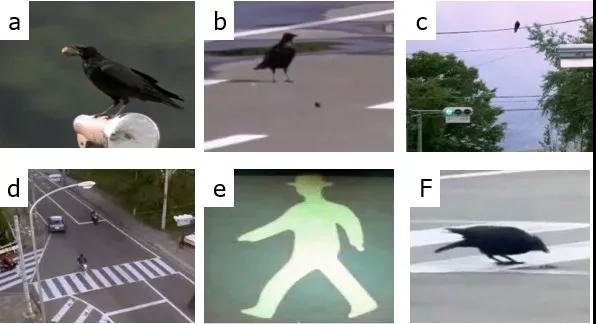
The image above was captured by Japanese researchers through longitudinal tracking; the crow is wild. It lives entirely autonomously, relying on its own observation, perception, cognition, learning, reasoning, and execution.
To access the food inside nuts, after various attempts, it discovered that placing the nuts on the road and letting vehicles run over them would crack them open (Figure b). However, with heavy traffic on the road, this approach carried a high risk of fatal injury. It then perched on a utility pole above the road to observe, having not undergone any prior big data training. It noticed that at intersections near traffic lights, vehicles and pedestrians sometimes came to a stop. At this point, it needed to further decipher the complex causal chain linking traffic lights, crosswalks, pedestrian signals, vehicle stops, and pedestrian halts (Figures c, d, and e). Ultimately, it identified the pattern and successfully obtained the food.
In this process, the crow operates as a fully autonomous intelligence, capable of independent perception, cognition, reasoning, learning, and execution. It does not rely on millions of training data samples for learning. Furthermore, its learning process is highly energy-efficient (the human brain consumes approximately 10–25 watts, whereas the crow’s brain, being about 1% the size of the human brain, consumes only 0.1–0.2 watts).
Parrot intelligence belongs to the currently popular data-driven intelligence in applications. Although there is a gap compared with crow intelligence, it is promising in the vertical field of healthcare. Crow intelligence represents the artificial intelligence that people aspire to.
Specifically, Zhu Songchun provided a systematic summary of what research and applications fall under the scope of artificial intelligence, covering six domains:
(1) Computer vision (for the time being, issues such as pattern recognition and image processing are included therein);
(2) Natural Language Understanding and Communication (provisionally including speech recognition, synthesis, and dialogue);
(3) Cognition and reasoning (including various physical and social common sense);
(4) Robotics (mechanics, control, design, motion planning, task planning, etc.);
(5) Game Theory and Ethics (Issues such as interaction, confrontation, and cooperation among multi-agent systems, and the integration of robots into society);
(6) Machine learning (various statistical modeling, analytical tools, and computational methods).
Due to the fragmented nature of these disciplines, most professionals engaged in related research, such as PhDs and professors, often focus only on one of the aforementioned fields, or even dedicate themselves long-term to specific issues within a single discipline. For instance, face recognition is a narrow subfield within computer vision, while deep learning is a prominent school of thought within machine learning.
At the level of medical applications, VCBeat has learned that the medical artificial intelligence products currently available on the market, such as computer-aided diagnosis systems and imaging-assisted diagnostic systems, are all outcomes of multidisciplinary collaboration combined with clinical practice; it is difficult to achieve significant results by relying solely on research within a single field.
Three Questions to Help You Identify AI Companies
Wu Ren, a globally renowned expert in computer game theory, believes that there are three main reasons for the unprecedented progress achieved by artificial intelligence in this round:
First, the accumulation of big data.In the medical field, with the accumulation of electronic medical records and digital imaging, a vast amount of structured case data suitable for research has been preserved. This big data starts at a minimum scale of 100,000 cases and consists of data that can be directly used for model training.
Second, the enhancement of computational capabilities.In recent years, advancements in computing power—such as cloud computing and GPUs—have laid the foundation for big data processing, shortening model training time to just a few days.
Third, the integration of big data and computing power enables researchers to rapidly develop and train algorithmic models for practical application.Modern products that can be termed artificial intelligence must involve deep learning technology. Previous AI technologies did not effectively solve problems, and it was the emergence of deep learning that propelled this current wave.
Wu Ren stated that it is precisely due to the current surge in artificial intelligence that this wave will be sustained rather than intermittent. The achievements made thus far are also validating this assertion.
Based on these three areas of common sense, we can use the following questions to identify AI companies in the new era.
1. What is the source of the company's data? Is it downloaded from the internet, or is high-quality annotated data obtained from hospitals?
2. What is the origin of the company’s algorithmic models? Are they pre-trained models downloaded from the internet, or are they self-trained? If the models are self-trained, which training software is used, and what is the computational capacity?
3. What are the differences between self-trained models and open-source models from others? How many GPUs are in the training computer?
Three Easy-to-Understand Criteria
Beyond technical differentiation, Zhong Xin, founder and CEO of TumorDeep, also offered an easy-to-understand framework for evaluating medical AI companies.
1、A Core Technical Team with Extensive Experience in AI Technology Research within the Healthcare SectorFor instance, Dr. Chen Yunqiang, Chief Scientist at Tuma Shenwei, majored in Biomedical Engineering at Tsinghua University. After graduation, he joined the Institute of Automation of the Chinese Academy of Sciences (CAS), China’s highest academic institution for natural sciences, where he specialized in artificial intelligence. In 1998, he pursued his Ph.D. in the Department of Electrical and Computer Engineering at the University of Illinois at Urbana-Champaign, studying under Professor Thomas S. Huang, widely regarded as the “Father of Computer Vision.” He has long been engaged in research and development of medical image computer vision and artificial intelligence at Siemens’ global R&D center. Such interdisciplinary talents with profound expertise in both medicine and artificial intelligence are extremely scarce. The ability to attract top-tier experts like Dr. Chen represents one of Tuma Shenwei’s core competitive advantages.
2、 Participate in domestic and international academic conferences and exhibitions related to medical artificial intelligence to exchange research findings.. During the conference, companies engage in academic and scientific discussions, naturally showcasing their corporate profiles and product portfolios through these exchanges. For instance, at this year’s North American Radiological Society Annual Meeting, Tuma Shenwei unveiled its six major product systems and conducted in-depth exchanges with industry professionals from both China and abroad. Many competitors also participated in the exhibition and academic exchanges at this event. While we may have competitive relationships with them now or in the future, we hold great respect for their research achievements. However, if a company remains long detached from the artificial intelligence community and merely engages in superficial packaging and promotion, its credibility warrants skepticism.
3、The company needs to have products implemented in hospitals, as well as physician recognition of the products.Tumavis has analyzed over 50,000 chest CT scan cases, earning widespread recognition from physicians. If a company merely claims to be an artificial intelligence firm on its website without offering tangible products, it will struggle to gain the trust of end-users for clinical deployment, thereby jeopardizing its long-term viability.
Zhong Xin concluded that companies that have truly mastered core technologies, remained grounded in their execution, and successfully translated physicians’ needs into tangible products enjoy strong development prospects.
Artificial intelligence must comprehend the physical world and its causal chains.
Experts have stated that artificial intelligence can uncover connections unknown to humans, rather than simply replicating expert functions. The forms of intelligence vary under different environmental conditions. Any intelligent machine must understand the physical world and its causal chains, and adapt to this world.
Song Jie from Xi Shi Yi Gou stated that the development of medical AI must not rely solely on human understanding of disease associations and characteristics to enable computers to make diagnostic judgments. Medicine cannot be perfectly structured. It is important to recognize that human understanding of nature may account for only a few percent of its true essence. If we use this limited “experience” to “standardize” AI’s understanding of nature, AI will certainly fail to achieve breakthroughs, and its development will remain constrained by the cognitive limits of human physicians. Instead, we hope that AI can help us uncover additional disease associations and optimal treatment pathways that have yet to be recognized.
Various modern technologies may hold promising applications in healthcare. However, the core problem AI addresses is the efficiency of human understanding of diseases. AI can identify disease associations and characteristics that would otherwise take humans years to discover, accomplishing this in a much shorter timeframe—potentially days, or even hours in the future. This represents the true capability of AI!
Conversely, at this stage, AI relies on support from existing large-scale human data. Any claim that a robust model has been “developed” based on very limited data cannot be considered true AI. While various technologies may hold promise for medical applications, they do not necessarily need to piggyback on AI.
Some argue that medical artificial intelligence is capable of automatically or semi-automatically diagnosing diseases.
The system processes vast volumes of electronic medical records and medical knowledge to autonomously construct a knowledge graph equipped with logical reasoning capabilities. It infers diagnoses based on inputted patient disease characteristics and provides the rationale for these diagnoses. At its core, the system independently identifies disease features and patterns, and formulates its own rules, rather than relying on researchers to explicitly define disease characteristics.
Systems that hardcode rules are not considered artificial intelligence. For instance, if a system is programmed with ten specific features of a disease and only renders a diagnosis when all ten criteria are met, it clearly does not qualify as an AI system.
Deep Learning Is the Hallmark of Artificial Intelligence in the New Era
Zhu Songchun stated that, within the framework of probability and statistics, many current deep learning methods fall under what he terms the “big data for small task” paradigm. This approach involves designing a simple loss function for a specific task, such as face recognition or object recognition, and training specialized models with large volumes of data. While this method proves effective for certain problems, it results in models that lack generalizability and interpretability.
Ye Weigang, founder of Data Capital, stated that AI in the new era must possess deep learning capabilities. A review of medical AI startups in China and the United States reveals that most are founded by professionals with computer science backgrounds. These companies often apply basic data directly to mathematical models; however, effectively integrating these computational models into clinical workflows requires substantial industry-specific expertise and integration capability.
As a capital investor, Datai focuses not only on companies with foundational R&D technologies but also on application-oriented artificial intelligence (AI) enterprises. When well-localized, application-oriented AI companies can effectively address industry pain points. For instance, Huiyi Huiying, a company invested in by Datai, has conducted targeted development and optimized its underlying framework based on general deep learning algorithm architectures to address specific challenges in medical imaging, such as three-dimensional reconstruction, large-scale data processing, high grayscale resolution, and small sample sizes. This has enabled AI to achieve high recognition accuracy in medical imaging and established significant industry barriers for medical imaging applications.
Results Matter
Finally, a physician with extensive experience in artificial intelligence research offered a different perspective. The doctor argued that any system capable of improving efficiency, reducing repetitive tasks, and enhancing diagnostic accuracy can be termed an artificial intelligence system, regardless of its underlying technology. There is no need to overly concern oneself with the origin or nomenclature of the technology.