

Chinese AI Medical Imaging Companies Shine at RSNA 2017: Radiomics and Machine Learning Take Center Stage
The 103rd Annual Meeting of the Radiological Society of North America (RSNA) is currently being held in Chicago, USA. With more than 54,000 members worldwide, RSNA hosts the largest global medical conference and exhibition each year. The 2017 event attracted approximately 50,000 attendees, nearly half of whom were medical imaging professionals, and featured 667 exhibiting organizations. VCBeat (WeChat ID: vcbeat) reported on the event by compiling on-site materials provided by domestic institutions and information from overseas websites.
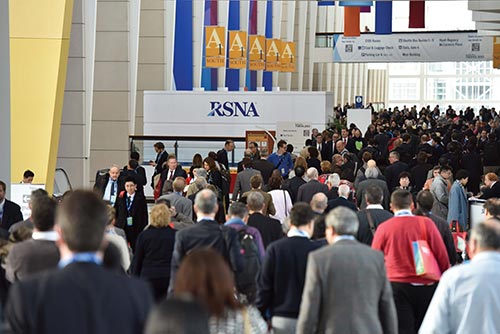
Based on the information we have gathered, while RSNA 2017 made progress in precision medicine, breast and prostate imaging, molecular imaging, and novel 3D printing applications for surgery, AI dominated the event. As described by a quote from “Transworld Data,” this year’s RSNA meeting was characterized as follows: “Radiology AI and deep learning take over RSNA 2017” (RSNA 2017 was the year of radiology AI and deep learning).
Among the participating companies this year, traditional imaging equipment manufacturers such as GPS (GE Healthcare, Philips, and Siemens Healthineers) remained the mainstay. However, a large cohort of Chinese AI imaging companies—including Infervision, Huiyi Huiying, Yitu Healthcare, TumorDeep, Deepwise, and Bosh Vision—also took part. These companies are no longer merely renting booths to showcase their products; instead, they are actively engaging in cutting-edge academic exchanges and collaborations, leading global applications in the field of AI-enabled medical imaging.
A Steady Stream of New Imaging Products
AI-related products and topics emerged in abundance at this year’s exhibition.
Infervision Unveils Latest Research Achievement, “AI Stroke Solution” (AI-CT Stroke Screening System, hereinafter referred to as AI-CT Stroke), at the RSNA Annual Meeting.
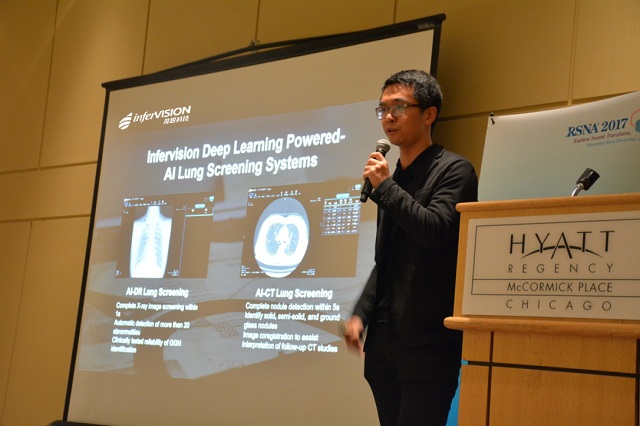
As the flagship product of Infervision’s AI brain solutions, AI-CT Stroke can rapidly and efficiently identify and annotate hemorrhagic lesions from brain CT images, assisting radiologists in making accurate diagnoses of hemorrhagic conditions. It instantly generates structured reports containing clinically significant information, such as precisely measured lesion volume and location, thereby securing the golden window for stroke treatment, reducing surgical risks, improving effective rescue rates, and comprehensively enhancing stroke cure rates. The integrated pre- and post-image comparison feature enables physicians to compare CT scans from any time point, offering substantial clinical value for prognosis assessment.
Infervision has entered into a strategic partnership with EnvoyAI (whose parent company, Terarecon, is a world-class leading provider of 3D CT image management solutions and has established mature interfaces with all five major general PACS vendors in the United States).
At RSNA 2017, Fujifilm launched the FDR Go Plus portable DR system.The new system retains Fujifilm’s signature smooth, compact tube head. A foldable column has been added to maximize visibility during transport. The portable DR system also features an extra-large display for optimal bedside preview and offers flexible maneuverability. Other enhancements include a user-adjustable drive handle, an optional wireless barcode reader, an optional RFID reader, and extensive dedicated storage space.
Siemens Healthineers Launches GOKnee3D, a Magnetic Resonance Imaging (MRI) Application, significantly reducing the time required for comprehensive diagnostic examinations. Currently, a typical knee examination takes approximately 20 minutes, whereas GOKnee3D enables button-operated, high-resolution 3D knee joint diagnostics in just 10 minutes.
High-resolution 3D image acquisition allows for flexible evaluation of images in all possible planes, including oblique and curved planes, which is particularly important for improving MRI efficiency in this manner.
Knee joint examination is a common type of MRI scan, accounting for 11% of all scans and ranking third among all examined conditions.
AI Startup Aidoc Announces CE (Conformité Européenne) Mark for Deep Learning Medical Imaging Solution for Head and Neck, the CE mark allows Aidoc to commercialize its products in Europe.
Aidoc’s solution enhances radiologists’ workflows by comprehensively detecting abnormalities in head and neck imaging. The company states that this solution could have a significant impact on trauma cases, reducing the time physicians take to make diagnoses.
Samsung Electronics unveiled its OmniTom mobile 16-slice computed tomography (CT) scanner at the conference.The product received approval from the U.S. Food and Drug Administration (FDA) in the U.S. market on August 18 of this year.
OmniTom features a range of improvements over the Samsung CereTom CT scanner, including:
Workflow Optimization: According to Samsung, OmniTom is the world’s first all-around wheeled mobile imaging device, designed to maximize mobility and enable easy, quiet maneuvering in confined spaces;
Improving Image Quality: 16-slice (0.625 mm per slice) advanced data acquisition system, effectively optimizing radiation dose;
Expanded Scope of Use: Maintain a compact size suitable for mobile use, while increasing the gantry opening to 40 cm to improve coverage of the adult head and neck, ensuring capability for both whole-body and pediatric scans;
Enhanced Security System: OmniTom features an internal drive system, resulting in lower portability, and also offers intelligent collision-avoidance software to maximize control and patient safety.
In addition to OmniTom, Samsung showcased its next-generation CT technology—spectral CT. Samsung’s team also presented a range of healthcare solutions, including mobile CT, digital radiography, and ultrasound, all designed to bridge gaps in care delivery and maximize efficiency.
Hologic Announces Development and Distribution Agreement with Clarius Mobile Health for Wireless Handheld Ultrasound ScannersThe agreement between Hologic and Clarius is designed to expand access to accurate global breast cancer screening and biopsy solutions.
“Clarius’s ultrasound systems offer superior image quality and portability, which, combined with our industry-leading deep learning algorithms, bring us closer to ensuring that all women receive the breast care they need and deserve,” said Pete Valenti, President of Hologic’s Breast & Skeletal Health Solutions division.
In addition, GE has entered into a strategic partnership with NVIDIA, the leading AI hardware company. Siemens established an AI-dedicated zone at its booth, aiming to leverage artificial intelligence to optimize imaging technology, assisted screening, and interventional treatment across three dimensions.
DSI Helps AI Land in Radiology
The Data Science Institute (DSI) of the American College of Radiology will provide frameworks, strategies, and standards to the industry to translate artificial intelligence from concept into routine radiology practice.
Dr. Bibb Allen, Chief Medical Officer of the Data Science Institute, stated, “The ACR DSI develops an open-source framework for AI use cases in radiology,”Defines the standards for training, testing, validation, integration, and monitoring of AI algorithms in clinical practice, which provides a standardized platform for the ACR DSI and other organizations to help optimize radiology practice.”
The American Institute for Radiology Data Science will play five major roles:
1. Develop an open-source standard framework for radiology AI for healthcare institutions and developers;
2. Define specific ACR DSI AI use cases built around these criteria, which represent the most relevant needs of the specialty;
3、To provide a standardized pathway for algorithm validation and certification, ensuring algorithmic efficacy and patient safety, and facilitating an accelerated FDA regulatory review process;
4. Establish interoperability standards and pathways for radiology workflows to integrate AI algorithms into clinical practice;
5. Provide continuous post-market assessment of algorithm performance and effectiveness through its AI registry.
Radiomics and Machine Learning Emerge as Key Trends
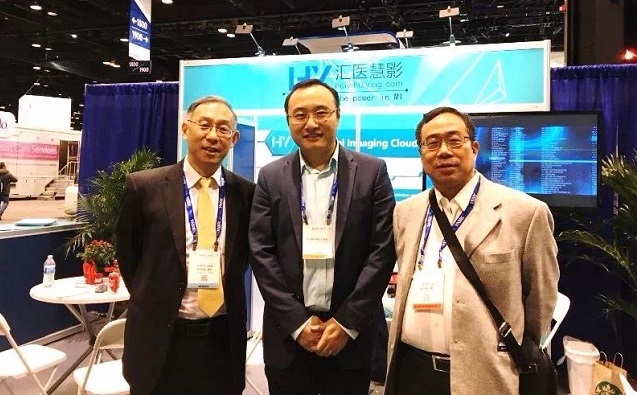
At the technology exhibition, Huiyi Huiying’s Radiomics Cloud Platform stood out as the only radiomics product on display.
Radiomics encompasses a multidisciplinary knowledge system spanning imaging, computer science, statistics, and other fields. For a long time, clinicians have struggled with complex coding, statistical analysis, and the processing of massive imaging datasets, which has hindered their ability to focus more intently on specialized research.
Huiyi Huiying's Radiomics Cloud Platform Fully Meets This Need, the platform provides one-stop services for lesion delineation, feature value calculation and analysis, and machine learning, and issues detailed quantitative reports for different diseases, actively promoting the translation of scientific research achievements into clinical practice.
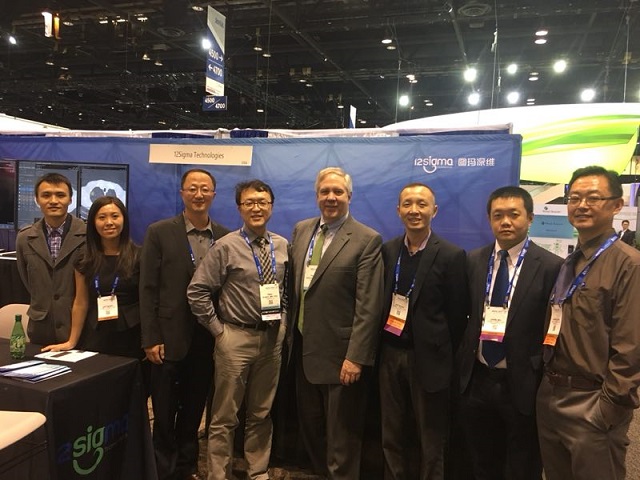
Moreover, at RSNA,TumashenweiAlso showcased six flagship products:
1、σ-Discover-Lung Pulmonary Nodule Detection System, designed for clinical decision support, it helps physicians easily detect and segment nodules and assess their benign or malignant nature; with one-click report generation, lung nodule screening becomes both accurate and effortless.
2、σ-Discover-Lung-FollowUp Nodule Follow-up System, assisting physicians in accurately and conveniently comparing and tracking lesion progression, and promptly adjusting treatment plans based on computational results.
3、σ-Discover-Lung-Nodule Retrieval Helps Physicians Establish a Pulmonary Nodule Diagnostic Database, and can retrieve biopsy results of similar nodules from the database based on nodule characteristics, thereby enabling a more precise assessment of the nodule's developmental trend.
4、σ-Discover-DR can simultaneously differentiate from X-ray lung images, diagnose various pulmonary diseases, significantly reducing the workload of physicians in lung disease screening.
5、σ-Discover-Liver: The First System for Detecting Liver Cancer Nodules, helping physicians easily diagnose liver cancer.
6、σ-Discover-Radiomics Radiomics System, helping physicians easily calculate and generate radiomics reports.
Dr. Paul Chang of the Chicago Medical School stated, “Although there is currently much hype and even fear surrounding the role of deep learning and artificial intelligence in radiology, in fact, both technologies hold immense potential value and will demonstrate their unique worth in the field of radiology in various ways. Deep learning will not replace us; rather, it will redefine us.”
Driven by the growing demands of clinical imaging, radiology requires machine learning technologies more than ever before. On one hand, datasets are becoming increasingly complex; on the other, there is a sharp rise in the need to correlate imaging with other clinical information for practical application, such as in radiogenomics.
Dr. Chang further stated, “Deep learning can assist us because we require tools and mechanisms to meet new imaging demands and challenges, thereby maintaining and improving the quality of our daily work. However, there are still numerous challenges on the path to truly integrating deep learning and AI into radiology practice.”
Conference Chair Dr. Richard L. Ehman, MD, stated: “Artificial intelligence and machine learning remain topics of significant interest within the radiology community.””
According to attendees, there was strong audience interest in forums related to radiomics and machine learning, with radiomics sessions being nearly at full capacity.
AI + Medical Imaging: China Leads the World
As a media outlet that has long focused on the field of medical artificial intelligence, VCBeat reviewed RSNA-related coverage from international technology websites such as MarkoInsights, Transworld Data, and Imaging Technology News, much of which centered on artificial intelligence. The topics discussed by foreign media were largely consistent with the information we received in China. Examples include “AI cannot replace radiologists, but radiologists who master AI will be more sought-after than their peers,” “AI’s support for clinical decision-making,” and “How AI is transforming medical imaging.”
These are also topics we are currently exploring or have already reached conclusions on. While we may lag behind the United States in foundational technologies and computational power, China has taken a global lead in terms of currently launched products and research directions, particularly in the application field of medical imaging combined with AI.
We expect them to create greater value and bring forth true “Chinese strength.”