

Babytree CEO Allen Wang Unveils Five Standards for Offline Early Childhood Education Centers
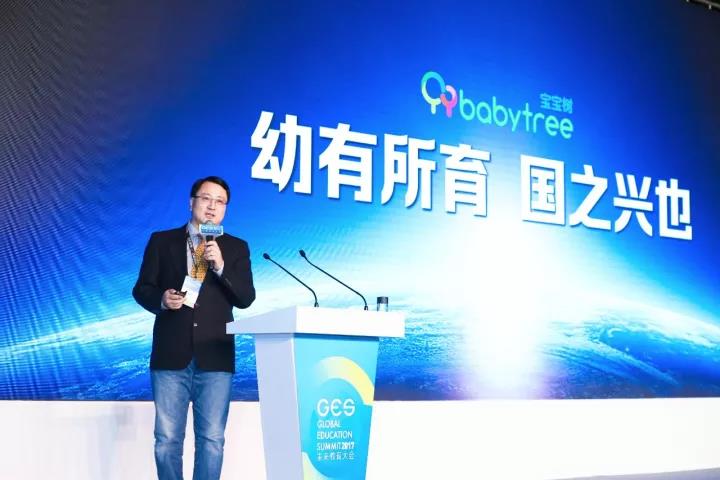
BabyTree’s Wang Huainan Discusses Smart Early Education Integrating Advanced Science and Technology
From November 28 to 29, the GES 2017 Global Education Summit, themed “Technological Innovation Drives Educational Progress,” was grandly held in Beijing.
As the helm of a leading enterprise in China’s maternal and infant family sector, Wang Huainan, Founder and CEO of Babytree, was invited to attend this prestigious event, where he shared insights on the development of Chinese families under the theme of “Ensuring Care for the Young” with representatives from the global education, political, and business communities.
Through a decade of dedication and perseverance in the maternal and infant family sector, BabyTree has built a platform that is internet-based yet not confined to the digital realm. It precisely meets young families’ needs for knowledge acquisition, social interaction and networking, growth tracking, and consumer shopping, establishing itself as a gateway-level platform for young families in China.
This year, BabyTree is no longer limited to providing online parenting knowledge and early education products and services; instead, it has officially expanded into offline early education, aiming to build a standardized community-based early education brand for young Chinese families.
Throughout the process of raising their babies, Chinese mothers have consistently faced two major dilemmas: how to select products within each consumer category, and concerns regarding their safety and quality.
BabyTree leverages technological solutions to create a highly trustworthy consumption environment for young Chinese families. Meanwhile, it utilizes big data analytics to identify the key pain points in household consumer product demand, enabling the development of C2M (Customer-to-Maker) customized products that more precisely meet the personalized needs of each family.
VCBeat (WeChat: vcbeat) shared the key points of his speech.
BabyTree is not a fast-moving company; in fact, it has been in existence for a full ten years as of this year. From the very first day our platform went live, we told ourselves: BabyTree aims to build an internet-based maternal and infant family service platform that is not confined to the internet alone.
"For ten years, we have had only this one mission."
We aim to use our community as an entry point to connect parents across China, helping them access knowledge, socialize and make friends, document their children’s growth, and shop for products.
Whenever we have a moment to breathe, we ask ourselves: What kind of company will BabyTree become in three, five, or ten years? What vision do we hope to see realized?
From tools to community, from community to integrated new forms of commerce, we hope that young parents in China can use and trust BabyTree, and play a role in the meaningful work of educating the next generation, helping parents raise children who are healthy, loving, wise, and brave.
“Looking back on the past decade, it feels like it passed in the blink of an eye for a founder. Among all the careers I have pursued in my life, BabyTree is the one I have stuck with the longest. To be frank, its future potential still appears boundless.”
What has BabyTree, the “slow company” of the internet sector, achieved over the past decade? We take modest pride in three accomplishments that we would like to share.
First, BabyTree is the largest internet portal for young families in China;
Second, even more pride-inducing than its scale is the fact that when you mention “BabyTree,” users will tell you it is a warm and trustworthy brand.
Third, a decade of accumulation has yielded extensive big data on young Chinese families.
Today, the vast user base on our platform has a strong demand for educational services. To fulfill the mission that BabyTree established a decade ago, we are venturing into the unfamiliar territory of education.
Ten years ago, BabyTree was ignorant yet fearless. Today, to be frank, we have gained some knowledge, but we remain fearless.
So, I would like to share our vision for the future of early childhood education in China, as observed during our journey.
A series of incidents occurred at kindergartens four or five days ago. As a member of the industry, I have deeply felt the growing burden and responsibility on my shoulders.
The most fundamental families in Chinese society have several key needs: childcare for the young, education for students, medical care for the sick, income security for the elderly, eldercare support, housing for all, and assistance for the vulnerable. Among these seven areas, the ones most closely aligned with BabyTree’s target audience and mission are childcare for the young, education for students, and medical care for the sick.
There are many serious issues in early childhood care and education, which are essentially rooted in an imbalance between supply and demand. On the Babytree platform, 80%–90% of Chinese mothers hope their children can have access to quality early education. However, in reality, only 15% of families are actually able to enroll their children in early learning institutions.
What Causes the Lack of Early Childhood Education? If you live in a first-tier city, mothers’ groups will tell you that the current experience with early childhood education institutions is such that for a single class lasting less than 45 minutes, a family typically needs to dedicate half a day to a full day to bring their child to the learning center. Meals take up 1–2 hours, and the commute home consumes another 1–2 hours, thereby occupying most of the day.
Among the mothers who were fortunate enough to enroll their children in classes, 60% expressed dissatisfaction. What is the reason? They would explain, “I neither saw my child play happily nor did I see them truly gain anything.”
For users in third-, fourth-, and fifth-tier cities, early childhood education resources in China are extremely scarce, resulting in a poor alignment between supply and demand.
The underlying data is, in fact, quite staggering. Today, China’s most significant supply-demand imbalances undoubtedly include those in education and healthcare. BabyTree is fortunate to be actively addressing these two critical gaps. For us, this represents not only a challenge and an opportunity, but also a mission.
What would the ideal scenario look like for BabyTree’s current involvement in the early childhood education sector?
1. The best early childhood education is universal early learning programs widely distributed across Chinese communities, ensuring that children nationwide have equal and fair access to early education opportunities;
2. The best early childhood education is one that allows children to express their innate nature and learn through “play,” enabling them to explore independently through games in order to understand themselves and the world around them;
3. The best early childhood education should also help mothers gain sufficient freedom, realize their self-worth, and maintain good physical and mental health, as a mother in such a state is the most direct form of early education for her child;
4. The best early childhood education should also ensure that teachers are fairly compensated and their professional dignity is upheld; only in this way can the healthy development of the early childhood education industry be truly promoted;
5. The best early childhood education should integrate advanced scientific and technological innovations to achieve smart parenting.
First, the ideal early childhood education institution in our minds must be a nationwide, community-based early learning system that is widely distributed across Chinese society.
Frankly speaking, I personally do not believe that education should be exclusive to the wealthy; it must be universally accessible. In fact, 80%–90% of users are willing to engage with early childhood education institutions, yet the actual penetration rate stands at only 15%. This disparity stems from a highly inequitable distribution of resources. I envision early childhood education centers in China being as accessible as neighborhood Starbucks stores, located within the immediate vicinity of where people live.
Additionally, BabyTree hopes that early childhood education will prioritize children’s happiness and play as its central theme. When the post-80s, post-70s, and even post-60s generations were growing up, China essentially had no early childhood education centers; the earliest such centers likely emerged around 1992.
The most important aspects of early childhood education are broadening horizons, enhancing physical and mental well-being, and nurturing children’s interest in the world around them. By engaging in play both outdoors in nature and indoors at Play Centres, children can develop positive habits, build self-confidence, and discover their life goals.
For parents, BabyTree aims to truly bring confidence and self-esteem to both dads and moms.
During pregnancy and the neonatal period, discussions among mothers are often permeated by a profound sense of sorrow. Young mothers, in particular, experience panic and anxiety stemming from ignorance and helplessness during pregnancy, imposing significant pressure on both families and society.
Following the relaxation of the two-child policy, many mothers having their second child are aged 40 or older. This demographic is particularly susceptible to depression, and many of their needs and concerns have yet to be adequately addressed.
Therefore, I hope Babytree’s early education initiatives will address the immense challenges faced by Chinese mothers aged 25 to 40, empowering them to become more self-reliant and confident.
Furthermore, there is substantial room for improvement in the social care, trust, and well-being afforded to teachers. High-quality early childhood education must strategically challenge the current landscape by ensuring that teachers are treated with dignity, which requires concrete implementation through enhanced training and compensation.
How to Excel in Early Childhood Education: Breaking Decades-Old Conventions and Patterns
Is the function of an early childhood education center limited to merely providing educational services? Can it also serve as a new social platform connecting neighbors, and simultaneously operate as a novel retail hub? In fact, new business models are emerging from this integration. Consequently, our revenue streams and strategic combinations will differ significantly from traditional approaches.
Internet technology is the core DNA of BabyTree. I believe that future early childhood education will inevitably integrate internet technologies. Take site selection, for example: it is an extremely challenging task, as real estate developers are reconfiguring their strategies, making prime retail locations increasingly difficult to secure.
However, we can leverage the heatmap distributions accumulated from Babytree users to analyze and superimpose population density around each community, thereby informing future site selection.
While respecting teachers and providing them with substantial support, we also employ technologies such as 24/7 comprehensive surveillance. Furthermore, we leverage artificial intelligence technologies, including facial recognition, to help parents feel more confident about enrolling their children in any kindergarten.
Finally, we can integrate the vast amount of big data generated during pregnancy for mothers and infants, data from the neonatal stage, and various growth metrics starting from six months of age through toddlerhood, extending even through primary and secondary school years. Ultimately, every user on the BabyTree platform will have their own comprehensive health and growth records.
BabyTree, the entry-level platform for young Chinese families, is not a “fast-moving” company, nor have I ever sought to make it one. On the entrepreneurial journey, many companies fail to persevere—especially in the parenting and child-rearing sector. Beyond dreams and passion, all that remains is steadfast persistence.
As a company that has long been committed to serving Chinese families with mothers and infants, BabyTree will shoulder the mission entrusted by society and the times, dedicating itself to addressing the imbalance between supply and demand in education, consumption, and healthcare, ensuring that children in Chinese families have access to proper upbringing and medical care.
Note: VCBeat has made additions and deletions without altering the speaker’s original intent.