

Infervision's Key Edge in Medical Imaging AI Lies Not in Technology, But in Over 200,000 Completed Screening Cases

Infervision
Artificial Intelligence Product Developer
As November passed, it was time for the annual review. While preparing materials, the reporter found that in 2017 alone, 20 companies in the medical imaging sector secured financing. These companies claimed partnerships with thousands of hospitals collectively, indicating increasingly fierce competition. Medical artificial intelligence appears to have gained widespread momentum, yet there are still challenges in its actual development.
Some time ago, while attending the National Annual Conference of Radiologists, this reporter chatted with several radiologists. Some of them indicated that although their hospitals had introduced AI-based medical imaging systems, the utilization rates were less than ideal. The reasons varied: some physicians lacked trust in the technology, while others found the systems difficult to use.
When discussing this topic with Chen Kuan, CEO of Infervision, he appeared quite relaxed. He noted that Infervision’s mature product, the Pulmonary Nodule Detection System, had already been successfully deployed and was in use at numerous large hospitals across China. Under the premise of voluntary adoption by physicians, the average click-through rate among doctors stood at approximately 64.5%.
In an era where medical AI is witnessing a hundred schools of thought contend, Infervision’s greatest advantage in medical imaging AI lies not in its technology, but in its accumulated track record of over 200,000 imaging screening cases and the physicians who have become accustomed to using its system.。
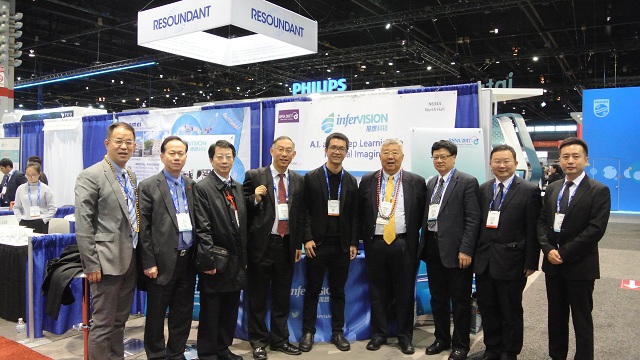
Group Photo of Infervision CEO Chen Kuan and the RSNA China Imaging Expert Panel
Screening results ultimately require a physician's signature.
Compared with CAD technology from the 1990s, today’s artificial intelligence systems are not only user-friendly but also generate highly detailed auxiliary screening reports that closely resemble those routinely issued by physicians. However, due to legal, regulatory, liability, safety, and ethical considerations, AI-generated screening results must be signed off by a physician to become valid. This final review by the physician provides an additional layer of security for individuals undergoing screening.
AI has cumulatively completed over 200,000 imaging screenings
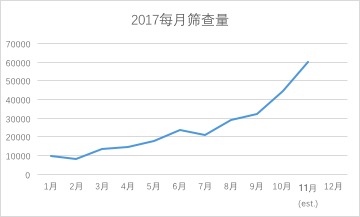
Infervision's Monthly Imaging Examination Volume
Data provided by Infervision shows that in 2017, the company completed over 200,000 imaging examinations. As can be seen from the growth curve in the chart, examination data grew steadily from January to September of this year, with a significant acceleration in growth after October. The primary reasons behind this trend are not only the increase in the number of hospitals adopting the system but, more importantly, the growing reliance of physicians on the system.
As a leading AI medical imaging company in China, Infervision holds certain industry advantages in terms of technology, the number of hospitals where its solutions are deployed, and the quality of those partner institutions. However, Infervision is well aware that in the open-source AI landscape, many companies are capable of building strong algorithm teams and developing basic deep learning models. Nevertheless, relying solely on algorithmic expertise and models trained on open-source data is insufficient to achieve productization breakthroughs in the field of AI-driven medical imaging.
The advantage that has enabled Infervision to maintain its leadership in this sector lies in the more than 200,000 real-world clinical imaging screening cases already completed, as well as the rapidly growing volume of real-world screening data expected in the future.
These 200,000 screening cases demonstrate that Infervision’s system is continuously cultivating usage habits among physicians at hospitals where its solutions have been deployed, while building a strong reputation within the industry through its robust product performance. This established physician adoption and brand equity driven by word-of-mouth create competitive barriers that are difficult for later entrants to surpass. In turn, this reinforces the deployment and adoption of Infervision’s products.。
The development of artificial intelligence is somewhat akin to doing business or investing and managing finances; once a certain foundation of wealth and resource accumulation has been established, the rate and volume of wealth growth will accelerate increasingly.
Infervision has accumulated a vast amount of real-world screening data, while cloud computing and GPUs have long since resolved computational challenges. This September, the addition of three executives from “GPS” to Infervision has further strengthened its market competitiveness, propelling the company into a phase of rapid growth.
Accuracy, Robustness, and Ease of Use
"Given that doctors use it entirely on a voluntary basis, achieving such high click-through rates and remarkable results is primarily attributable to Infervision's three evaluation criteria for its AI medical imaging solutions: accuracy, robustness (stability), and ease of use."
Accuracy: This accuracy refers to the system’s ability to identify nodules both comprehensively and precisely. Regarding accuracy, the reporter spoke twice with Dr. Liu Kai, a radiologist at Shanghai Changzheng Hospital. The first conversation took place in March 2017, when the reporter was investigating physicians’ perspectives on the use of artificial intelligence. At that time, Dr. Liu believed that the greatest value of Infervision’s system lay in reducing missed diagnoses. In October of this year, the reporter spoke with Dr. Liu again. Over the past six months, he noted that AI has been continuously iterated and improved. Many physicians in his department have become reliant on Infervision’s products, which have become valuable aids in their clinical practice.
Comprehensive and accurate—this is a consensus among many radiologists. On one hand, when writing reports, their greatest concern is missing a diagnosis; they will repeatedly review images that appear normal in routine screenings, as missed diagnoses carry liability. On the other hand, they aim to identify only malignant nodules. Including additional nodules in the report not only increases the workload for referring physicians but also causes unnecessary anxiety for patients.
Robustness: The system model can be deployed across various hospitals while maintaining high accuracy.
The wide variety of equipment models used in hospitals across China, coupled with inconsistent operational protocols across different regions, has resulted in the absence of a unified official standard for imaging data. Consequently, achieving system universality is a key challenge that many companies strive to address.
Xia Chen, CMO of Infervision, stated that the company’s training data is sourced from top-tier hospitals across various regions in China, ensuring its representativeness. Furthermore, during the training process, Infervision intentionally incorporates data from diverse equipment sources to guarantee that variations in hardware do not compromise the model’s performance across different hospitals.
What they value most is the actual click-through rate by physicians. During market promotion, they also discovered that although some hospitals have AI medical imaging systems, physicians do not use them.
Usability: Although the CAD technology introduced to China in the 1990s shares some similarities with modern AI-based medical imaging, it was not widely adopted. When reporters consulted multiple radiology department directors on the reasons, the consensus was that CAD systems were complex and difficult to use.
Infervision has learned from this experience and simply provides a button within the physician’s routine operating system. Clicking this button automatically displays AI-generated auxiliary screening information for the physician’s reference. If the physician does not click the button, they can proceed with their standard workflow as usual.
Leveraging these three advantages, Infervision uses physicians’ voluntary click-through rates to gauge product quality, gradually developing an AI-assisted imaging screening solution that doctors are eager and willing to use.
In the field of AI-powered medical imaging, it is difficult to crown a single industry leader, as each company possesses its own unique strengths. Publicly listed internet companies entering the healthcare sector bring substantial resources and strong backing, while startups demonstrate bold determination and benefit from first-mover advantages. Ultimately, which player will establish a firm foothold in this domain remains to be seen, with data serving as the final arbiter.