

Gengmei Files IPO Prospectus: Leveraging Big Data to Empower Clinics and Solidify Its Position as the Leading Aesthetic Medicine Platform
MPCi
Venture Capital Institutions in High-Tech Startup Fields

Liu Di, Founder and CEO of Gengmei
The battle for mobile medical aesthetics platforms has been raging for three years, with the prize being a ticket to becoming the leading gateway for medical aesthetics information. The ultimate weapons to break the deadlock are the streamlining of business logic, sustained backing from industrial capital giants, precise insights into market consumption, and strong team execution capabilities.
With annual transaction volume exceeding ten figures, this was the operational data for the Gengmei platform in 2016. Few medical aesthetic platforms in the industry have reached such a scale. After the market shakeout, only a handful of medical aesthetic apps remain. They command over 80% of online traffic, establishing new customer acquisition channels and user education methods beyond traditional medical aesthetic avenues.
Against the backdrop of consumption upgrading, a recent 2017 report by Deloitte indicates that China’s volume of legitimate medical aesthetic procedures (including both surgical and non-surgical treatments) accounts for approximately 10% of the global total, making it the third-largest market worldwide. The growth rate of China’s medical aesthetics market is expected to remain above 20% over the next five years, with the market size projected to exceed USD 10 billion in 2017.
The bustling plastic surgery departments in hospitals, social media influencers dominating major platforms, and the widespread pursuit of beauty—echoed both online and offline with the mantra “Life is not born, but made”—have provided a more tangible real-world context for these figures.
The medical aesthetics industry is experiencing rapid growth. In light of current challenges in China’s medical aesthetics sector—including the lack of an effective system for evaluating physicians, the difficulty consumers face in selecting doctors amid an overload of information, high customer acquisition costs for institutions, and insufficient operational data—VCBeat (WeChat ID: vcbeat) interviewed Liu Di, Founder and CEO of Gengmei, to gain insights into the company’s strategic steps and layout for the second half of the year.
As a leading platform for medical aesthetics information, Gengmei focused on two key areas in the B2B sector in 2017: its traditional business and a new database.
The first part covers the business operations of traditional communities and e-commerce. In the first half of 2017, Gengmei updated its brand positioning to “Life Is Not Predestined” and carried out extensive brand promotion efforts. Following this repositioning and promotional campaign, many clinic owners provided feedback stating, “The Gengmei platform has indeed established a verifiable revenue model, and we should pursue in-depth, long-term cooperation in the future.” B-side institutions have gained a better understanding of the Gengmei brand, which has proven highly beneficial for subsequent customer acquisition and collaborations with merchant institutions.
“In the second half of the year, Gengmei will strive to expand its market share and solidify its leading position, gradually entering a harvest phase.”
The second part is that Gengmei is making significant efforts in organizing data across the entire medical aesthetics industry.
Gengmei’s medical aesthetics industry database encompasses information on all merchants, physicians, and multi-tiered physician ratings, resembling a five-star hotel evaluation system. Based on the ratings of physicians and clinics, Gengmei provides corresponding support and follow-up services. Gengmei is establishing a scoring and evaluation system to conduct scientific analyses of every plastic surgeon in China.
In addition to access to bundled financial services, complimentary consumer insurance, and lower interest rates on medical aesthetic installment plans, highly rated physicians are granted superior platform resources. These include the assignment of a dedicated branding team to help doctors strategize their positioning on the platform and optimize their communication with consumers.
“The biggest problem with traditional channels is that they are only responsible for directing users to plastic surgery hospitals. Gengmei, on the other hand, has placed all pre-operative aspects of the medical aesthetics industry—excluding the surgical procedures themselves—onto its platform, establishing itself as an authoritative database and online gateway within the vertical medical aesthetics sector. ‘Gengmei is confident and capable of surpassing Baidu in this category.’”
On the user side, to further shorten users' decision-making time, in April 2017, the Gengmei app launched a new feature called “Intelligent Facial Analysis,” which helps users analyze their face shape and facial features by uploading photos and provides corresponding medical aesthetic recommendations.
In July, Gengmei rolled out a functional upgrade, introducing the new “Plastic Surgery Simulator” feature. By uploading photos, users can not only receive precise analyses of their facial contours and features but also view simulated outcomes for four types of double-eyelid procedures.
Plastic Surgery Simulator: Leveraging platform big data to intelligently analyze users’ facial features and generate comprehensive facial analysis reports, this feature simulates the most popular double-eyelid styles. It provides scientific and intuitive references for aesthetic enhancement, shortening the decision-making process from the typical 1–2 years to just 6 months, 6 days, or even less.
Liu Di stated that, similar to features such as “Plastic Surgery Diary” and “Live Streaming,” the Plastic Surgery Simulator is a key tool used by the Gengmei APP to attract traffic and feed back into its community and e-commerce platforms, thereby serving as a crucial component of its overall transaction closed loop.

The purpose of the ranking design is to enhance user decision-making efficiency.
The pain point in consumer decision-making lies in the fact that, although there are numerous medical aesthetic institutions on the market, their quality varies significantly. Currently, there is no third party capable of providing a credible standard to help users make quick and accurate selections and decisions.
As users were uncertain about how to select hospitals and physicians, Gengmei launched its recommendation rankings and filtering controls for the first time in August. Leveraging big data metrics such as order volume, consultation response rate, user reviews, refund rate, and complaint rate, the rankings provide personalized recommendations based on individual search habits and indicate the proximity to the user.
Additionally, new filter controls have been added to the US shopping page to help users more efficiently find their desired products.
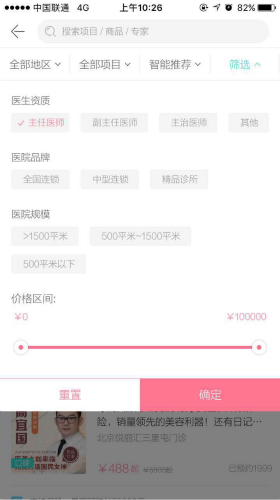
Optimize filter controls to more efficiently locate desired products.
Why are such functional modules being continuously launched? Liu Di stated, “Through extensive operational experience, Gengmei has accumulated a vast amount of first-hand business data. We are now able to provide objective ratings for medical aesthetic institutions by comprehensively analyzing massive volumes of user reviews, case studies, sales figures, complaints, institution-uploaded licenses and certificates, and physician credentials. Based on these ratings, we have developed two functional modules—filtering and rankings—to help users make more rational decisions regarding medical aesthetic consumption.”
Prior to 2016, Gengmei primarily operated on a sales commission model. In 2017, revenue from several business segments began to grow gradually.
First is the advertising business. Due to a significant decline in the efficiency of traditional channels, more advertising spending has shifted to online medical aesthetics platforms. As a leading entry point for medical aesthetics information, Gengmei boasts substantial traffic and covers the entire process—from traffic acquisition and transactions to medical services and post-operative management. This enables precise ad placement for institutions, making it highly favored.
For key core merchants, Gengmei adopts a “stable plus incremental” advertising cooperation model. This volume-guaranteed advertising partnership is currently progressing well, with many processes being streamlined. Each city now targets only 1 to 3 KA (Key Account) merchants, i.e., core merchants.
For traditional channels, the ratio of advertising to sales expenditure for offline medical aesthetic institutions typically ranges from 1.5:1 to 2:1. The advertising efficiency on the Gengmei platform is 2–5 times that of traditional channels, with a peak ratio reaching 1:10.
“The data provides merchants with a powerful psychological impetus. Essentially, offline institutions come to us with their budgets in hand for advertising placements. Many merchants spend millions of yuan annually on advertising on the Gengmei platform.” This exemplifies Gengmei’s deep operational model with its key merchants.
Second is the fee structure for enterprise clients. Drawing on the mature monetization models of Taobao and Tmall for B-side businesses, Gengmei, which already commands substantial traffic, has begun charging merchants listing fees, backend functionality usage fees, and data service fees.
In a nutshell, the free backend previously offered by Gengmei provided only basic features. As its products and services continued to iterate, advanced premium features were shifted to a paid model.
3. Financial Services Business. The financial services segment, which was still in its investment phase in 2016, has become a new growth driver for Gengmei in 2017. While the consumer finance sector is highly competitive and this business unit is expected to reach break-even in the future, it remains in a market-cultivation stage in the short term.
Fourth are offline institutions. Gengmei is deeply involved in the operations of these offline institutions, collaborating with them in various forms by providing technical guidance and streamlining their processes. At times, Gengmei even leases space from these institutions to serve as venues for doctors on its platform to practice independently and at multiple sites. Additionally, Gengmei offers year-round consulting and training services to help certain institutions transform their business models.
Gengmei is currently exploring the operation of “boutique clinics,” implementing user segmentation for refined operations and services. In August 2016, Gengmei launched its Physician IP Initiative, followed by a clinic incubation program. This strategic decision was grounded in the recognition that high-net-worth users in China, particularly in first- and second-tier cities, indeed require differentiated, personalized mid-to-high-end services. The boutique clinics currently under exploration aim to cater to the needs of this specific user segment.
Since its inception, Gengmei has been exploring new profit models. “Apart from the one thing we won’t touch—operating our own hospitals—Gengmei has entered the offline business ecosystem of medical aesthetic institutions through various channels. These were some of our initiatives in 2017.”
Liu Di stated, “Gengmei’s refined traffic routing based on user profiling enables institutions at all levels to acquire their target users.”
Over the past two years, a large number of emerging institutions have begun shifting their marketing budgets from traditional channels to emerging medical aesthetics platforms. “For institutions that rely heavily on us, approximately 50%–60% of their traffic comes from Gengmei. Some large-scale institutions are gradually reallocating their marketing budgets to the Gengmei app.”
“Good products are used and then left behind”—this is Zhang Xiaolong’s product philosophy; “a high-quality medical aesthetics platform can effectively shorten the time and path of users’ consumption decision-making”—this is Gengmei’s strategy.
Users of the Gengmei app fall into two categories: mature e-commerce users and relatively novice community users.
For users of mature e-commerce platforms, who have already decided on the products they wish to purchase, the primary purpose of using the app is price comparison and transaction completion. The Gengmei app need only optimize its product features to help these users quickly locate relevant information.
In contrast, the user base of community-based products is far more complex. While these users have demand for medical aesthetics, they lack sufficient understanding of the industry and remain concerned about safety and efficacy, having not yet decided whether to purchase products or undergo cosmetic procedures. To address this, the Gengmei app launched the “Plastic Surgery Diary” feature, which serves as a core content strategy for user retention on the platform by providing decision-making references and evidence. Currently, it features 3.4 million authentic plastic surgery diaries.
These users are willing to devote substantial time to immersing themselves in “plastic surgery diaries,” browsing real user case studies, and engaging in extensive reading and interaction—such as chatting and posting non-essential content—within medical aesthetics apps before finally making consumption decisions.
“Unlike the emotional and impulsive nature of buying jewelry and handbags, women considering rhinoplasty and double eyelid surgery tend to be more rational, carefully reviewing case studies, engaging in consultations, and evaluating the differences in technical expertise and service quality among various hospitals and doctors.”
Currently, due to the long-standing information asymmetry in China’s medical aesthetics market and the media’s tendency to highlight negative industry news, many consumers harbor significant fears regarding cosmetic surgery and aesthetic procedures.
Alleviating such fears requires sufficient information and long-term education. “Plastic Surgery Diaries” and the aesthetic surgery influencers on the Gengmei platform bear the significant responsibility of promoting transparency in medical aesthetic information.
Medical aesthetic advertising is shifting from “search engines + traditional media + outdoor advertising” to “medical aesthetic apps + new media + word-of-mouth marketing,” a transition that is gradually solidifying. In the long run, vertical segments can establish their own competitive barriers and demonstrate comprehensive advantages by tailoring micro-level strategies to differentiate between B-end institutions and C-end consumers.
Gengmei has already secured advantages in top-tier traffic entry points and data accumulation, seized opportunities, and participated in and penetrated every segment of the medical aesthetics industry chain, thereby reinforcing its competitive moat in a unique manner.