

National Health Commission Endorses Internet Hospitals as Key Platforms for Prescription Sharing Market
On April 26, the National Health Commission held a press conference to further interpret the forthcoming "Opinions," which support exploring information sharing between medical institution prescriptions and retail pharmacy data, relaxing restrictions on out-of-hospital prescriptions and third-party delivery, and enabling an end-to-end process covering online consultations, prescription issuance, and home delivery of medications. The long-awaited formal liberalization of online prescribing and drug delivery services by internet hospitals is set to commence.
More than two years after the first electronic prescription from an internet hospital was issued in China, its ripple effects have become evident, with another Zhejiang-born innovation poised for nationwide rollout.
Two Years Since the First E-Prescription Was Issued, Chain Reactions Emerge
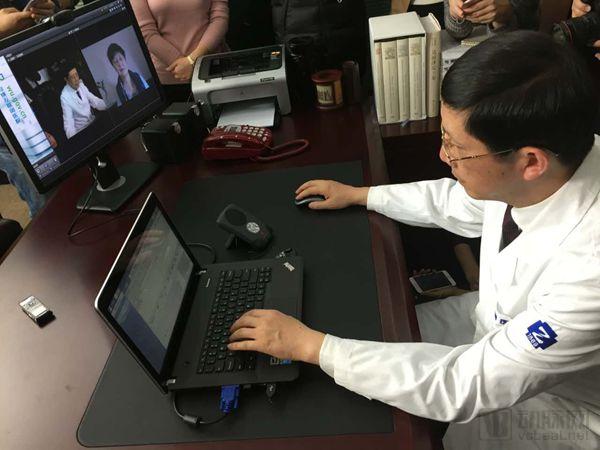
Professor Wang Jian’an Conducts Online Follow-up Consultations for His Patients (Photo Provided by the Company)
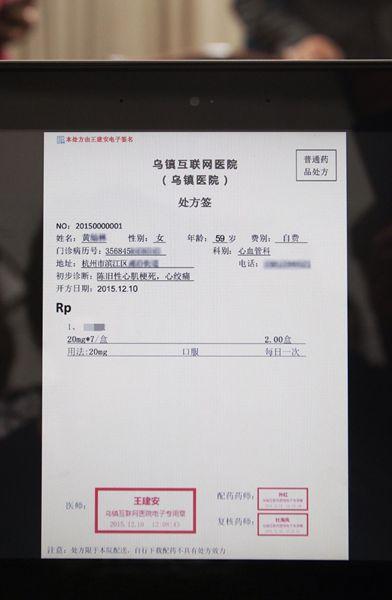
Professor Wang Jian’an’s First Electronic Prescription Issued on the Wuzhen Internet Hospital Platform (Photo Provided by the Company)
On December 7, 2015, the Wuzhen Internet Hospital, the first facility in China to bear the “Internet Hospital” name, officially opened its doors, pioneering a series of innovative service models including online prescriptions, online follow-up consultations, and remote consultations. On December 10, Professor Wang Jian’an, President of the Second Affiliated Hospital of Zhejiang University School of Medicine and a nationally renowned cardiovascular expert, issued the first online prescription via the Wuzhen Internet Hospital platform for one of his follow-up patients in Hangzhou. The prescribed medications were delivered the following day, sparking significant market reaction. This landmark scenario was even featured on that year’s CCTV Online Spring Festival Gala, becoming an iconic event symbolizing how the internet has transformed the lives of Chinese people.
“The entire doctor-patient medical model, driven by internet technology innovation, including changes in production relations with hospitals, administrative bodies, and pharmaceutical companies, will lead to a partial reconstruction of the overall healthcare ecosystem.” At the time, Tu Honggang, Chairman of MediCool and a financial writer, wrote an analytical article stating that nationwide, simple medication dispensing—including outpatient visits for certain departments dealing with straightforward symptomatic conditions—accounts for at least half of all clinical consultations in China. Internet-based medical consultations will reshape these production relations.
Evidently, the emergence of internet hospitals has “torn open” a breach in the lukewarm progress of separating prescribing from dispensing, revealing significant market opportunities. After more than 860 days and nights, the Wuzhen Internet Hospital now leverages technologies such as the internet, big data, and artificial intelligence to deeply connect hospitals, physicians, patients, and supply chain stakeholders. Built on the interconnectivity of data and services, it has successfully established a closed-loop medical service system integrating “online + offline” and “general practice + specialty care,” thereby forming an industry ecosystem for internet hospitals.
Separation of Pharmacy from Medical Services Becomes a Trend, with a Trillion-Yuan Market Awaiting Absorption
Undoubtedly, driven by the need to curb rising healthcare costs and advance policies separating prescribing from dispensing, prescription outflow has become one of the most powerful tools for achieving the separation of prescribing and dispensing.
On the same day two years ago, April 26, 2016, the General Office of the State Council issued the "Notice on Key Tasks for Deepening the Reform of the Medical and Health Care System in 2016." The notice proposed advancing the separation of prescribing from dispensing through various forms, prohibiting hospitals from restricting the outflow of prescriptions, and allowing patients to freely choose whether to purchase medications at hospital outpatient pharmacies or at retail pharmacies with a prescription.
In March 2018, the National Health Commission and nine other departments jointly issued the "Notice on Consolidating the Achievements in Abolishing Drug Markup-Based Hospital Funding and Continuously Deepening the Comprehensive Reform of Public Hospitals," which required continued control over unreasonable growth in medical expenses in 2018 by breaking down cost-control targets for each individual hospital.
Policy changes have given public hospitals greater incentive to facilitate the outflow of prescriptions. In April 2018, 14 large and medium-sized hospitals in Hainan Province jointly joined the “Hainan Provincial Prescription Sharing Platform.” This platform connects hospital prescriptions, patients, and medications with minimal intermediaries, reducing marketing costs from the previous 50%–70% to 5%–7%. Furthermore, it enables direct access to patients, thereby enhancing medication adherence and fundamentally disrupting the existing marketing model of the pharmaceutical industry.
According to a research report by Huachuang Securities, under the major trend of prescription outflow, if off-hospital sales of prescription drugs could reach the level seen in the United States—where off-hospital prescription sales account for 45% of total prescription sales—an additional RMB 300 billion in off-hospital prescription revenue would be generated. This incremental growth will primarily be absorbed by third-party platforms and end-channel retailers (such as retail pharmacies).
Industry Unites to Drive Potential Surge in Prescription Sharing
In March 2016, Wuzhen Internet Hospital announced its entry into the pharmaceutical distribution sector by launching the “Internet Hospital Pharmacy Program,” which provided partner pharmacies with services such as precise appointment scheduling, remote consultation, and electronic prescriptions. By the end of 2017, nearly 20,000 pharmacies had been integrated into the network. In 2017, Sichuan Weiyi Internet Hospital successfully enabled online medical insurance payments, allowing the province’s 82 million residents to purchase medications and pay via medical insurance cards (for reimbursement) on mobile devices.
As the market gradually expands, pharmaceutical distribution channels and internet healthcare platforms are beginning to leverage industry organizations to form synergies, with national prescription-sharing platforms already established and operational.
In April 2017, the “Smart Pharmacy” Alliance, initiated by the China Pharmaceutical Commerce Association, was officially established, with WeDoctor serving as the chairman unit. By integrating with internet hospitals, traditional pharmacies can connect upstream with pharmaceutical manufacturers and financial institutions; midstream with hospitals and physicians to handle hospital prescriptions at scale; and downstream directly with users, thereby transforming isolated offline pharmacies into integrated online-offline healthcare centers centered on user health.
On February 2, 2018, at the First National Conference on the Application of Health and Medical Big Data, the Chinese Society for Health Informatics and Medical Big Data supported and launched the National Prescription Sharing Platform. Within two months of its release, the platform was successively implemented in provinces and municipalities including Hainan, Heilongjiang, Shandong, Henan, and Sichuan. Currently, the daily volume of prescription transfers has exceeded 70,000.
Recently, at the 6th West Lake Forum, the National Prescription Sharing Platform announced its Phase I operational plan targeting hospitals, medical insurance providers, pharmaceutical companies, and chain pharmacies. The plan includes promoting the integration of hospital systems nationwide and facilitating prescription circulation, exploring connections with medical insurance systems in three to five provinces, cultivating 100 blockbuster products each generating RMB 100 million in revenue, and upgrading 10,000 designated pharmacies into “Community HMOs (Health Maintenance Organizations).”
According to an analysis by Pharmaceutical Economic News, “Internet + Healthcare” can, to a certain extent, improve the tiered diagnosis and treatment system. For pharmacies and pharmaceutical distribution companies, building software and hardware platforms enables them to sell pharmaceutical products directly or indirectly to patients after online consultations, or to integrate big data for health management, thereby completing the entire closed loop from medical services to pharmaceuticals. The gradual relaxation of policies will further sound the market call for out-of-hospital sales of prescription drugs.