

Tasly's Investee Pharnext Reports Positive Interim Results from Phase III FDA Trial of Orphan Drug PXT3003 for Charcot-Marie-Tooth Disease Type 1A
VCBeat (WeChat ID: vcbeat) has learned that Pharnext, a French new drug R&D company, recently announced that the interim analysis results of the Phase III clinical trial of its new drug PXT3003 for the treatment of Charcot-Marie-Tooth disease type 1 in the United States FDA were positive, and the progress was smooth.
Starting in 2015, PXT3003 underwent a 15-month, multicenter, randomized, double-blind, placebo-controlled Phase III clinical trial globally. To date, 323 patients with mild-to-moderate Charcot-Marie-Tooth disease type 1A (CMT1A) have been enrolled across 30 sites in Europe, the United States, and Canada. The study is scheduled for completion by the end of 2018. Two interim analyses—the blinded variability analysis and the futility analysis—have been completed as planned. The results indicate that the trial can proceed as originally designed without increasing the sample size.
In accordance with the “Opinions on Deepening the Reform of the Review and Approval System to Encourage Innovation in Drugs and Medical Devices” issued by the General Office of the State Council, PXT3003, a novel drug for Charcot-Marie-Tooth disease type 1 developed by Pharnext, falls under the category of drugs for rare diseases. It qualifies for the domestic accelerated review pathway, facilitating the initiation of simultaneous dual filings for concurrent R&D in China and abroad. The exclusive rights for the Greater China region have been fully licensed to Tasly. Charcot-Marie-Tooth disease is a rare disorder for which no effective therapeutic products are currently available on the market, and similar R&D programs by other companies worldwide remain in the preclinical stage.
The Phase III clinical trial of PXT3003 is progressing smoothly, which not only demonstrates Tasly’s sound judgment in innovative drug investment but also signifies that the company’s “four-in-one” R&D model and its dual-wheel drive strategy of “industry + capital” are continuously enriching Tasly’s product pipeline and enhancing its core competitiveness.
Pharnext’s Unique Drug Development Model Has Made It Highly Sought-After
Pharnext, fully known as Pharnext S.A., was founded by Daniel Cohen in 2007. Daniel Cohen studied under Jean Dausset, the pioneer of human genetics, who received the 1980 Nobel Prize in Physiology or Medicine for his pioneering contributions to immunology. Daniel Cohen himself has profound expertise in genetics and was the first person to map the physical map of the human genome.
Pharnext’s key strength lies in its proprietary AI-integrated drug discovery platform: PLEOTHERAPY. Rather than developing new compounds from scratch, this approach leverages the therapeutic effects of existing marketed drugs by combining them in specific ratios to harness their synergistic actions, thereby creating novel therapeutic agents. As envisioned by Pharnext, this paradigm can significantly reduce the time and capital required for R&D, while delivering safer and more effective medications at a lower cost.
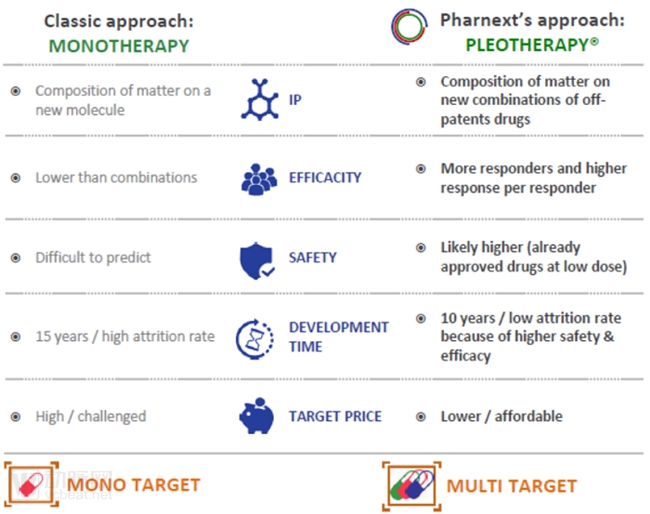
Comparison between the Traditional Drug Development Paradigm and PLEOTHERAPY. Image source: Pharnext official website
Currently, Pharnext’s primary drug candidates in development include PXT864 and PXT3003. The former is mainly indicated for the treatment of Alzheimer’s disease, while the latter is used to treat Charcot-Marie-Tooth disease type 1A (CMT1A). Charcot-Marie-Tooth disease, also known as hereditary motor and sensory neuropathy (HMSN), exhibits significant genetic heterogeneity. Its incidence in Europe and the United States ranges from 1:3,300 to 1:2,500, with CMT1A accounting for 37%–57% of all CMT cases. Epidemiological data in China are currently lacking, which underscores that PXT3003 is rightly classified as an “orphan drug.”
Pharnext’s unique drug development model has made it highly popular within the industry. Since its inception, Pharnext has secured three rounds of investment totaling $20 million and was listed on Euronext in July 2016.
Tasly strategically invested €20 million in Pharnext in May 2017, acquiring full rights to the drug PXT3003 in the Greater China region (see the Company’s Temporary Announcement 2017-027, “Announcement on Investing in Pharnext and Establishing a New Drug R&D Company in Cooperation with It”). Meanwhile, the two parties established a joint venture in Tianjin, leveraging Tasly’s existing advantages—including its biopharmaceutical R&D platform, natural botanical drug component database, and Chinese market network—to build additional disease biological network models for combination drug development and to advance the R&D of modern traditional Chinese medicines with clearly defined mechanisms of action.
Tasly’s Innovative Drug Platform Demonstrates Prominent Value
Notably, prior to the good news from Pharnext, Transgene, another French pharmaceutical company collaborating with Tasly, also achieved positive progress in new drug clinical trials.
Transgene presented the results of its Phase 1/1b clinical trial of the hepatitis B vaccine T101 in patients with chronic hepatitis B at the annual meeting of the American Association for the Study of Liver Diseases (AASLD). The trial data demonstrated that T101 was well tolerated and induced a robust, specific immune response in patients with hepatitis B virus (HBV) infection.
Previously, Tasly and Transgene had already announced in 2012 the establishment of a joint venture in China to develop four new drugs under Transgene’s portfolio, including T101, for the Chinese market.
The phased achievements in new drug development by Transgene and Pharnext have begun to highlight the value of Tasly’s strategic layout in innovative medicines.
In recent years, Tasly has actively promoted a grand biopharmaceutical strategy featuring the coordinated development of traditional Chinese medicine (TCM), biologics, and chemical drugs, thereby building an innovative drug industry platform. The dual-wheel drive of “industry + capital” and the “four-in-one” R&D mechanism constitute Tasly’s primary approach to its layout in the fields of biologics and chemical drugs.
In recent years, Tasly has successively completed the acquisitions of Shanghai Saiyuan Biotechnology and Tianjing Biotherapeutics, and established the Tasly International Gene Network Drug Innovation Center and Chuangshijie Biopharmaceutical Company, thereby enhancing its innovative drug portfolio in oncology, cardiovascular and cerebrovascular diseases, and metabolic disorders.
According to Tasly’s third-quarter report, the company has currently developed and established a pipeline of more than 60 pharmaceutical products across the fields of traditional Chinese medicine (TCM), biologics, and chemical drugs, including over 20 innovative drugs. These include Puyouke, a national Class I biologic thrombolytic novel drug; PXT3003; Anmeimu monoclonal antibody; a therapeutic hepatitis B vaccine; and the generic drug gefitinib, among others.
Tasly's Innovative Drug Pipeline
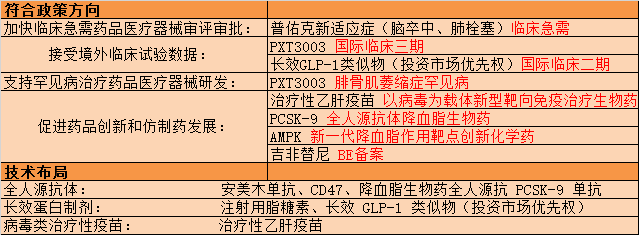
Tasly stated that, benefiting from new regulatory policies—such as accelerating the review and approval of clinically urgent drugs and medical devices, accepting overseas clinical trial data, supporting the research and development of drugs and medical devices for rare diseases, and promoting drug innovation and generic drug development—the aforementioned new drugs will be accelerated to market in China.
The orderly advancement of new drugs under development by Transgene and Pharnext signifies that Tasly’s “four-in-one” R&D model has yielded tangible results. By leveraging the R&D strengths of these foreign companies and Tasly’s capability in commercializing products within China, these two drugs hold significant potential for future growth.
It is foreseeable that, under favorable policy conditions and industrial environment, Tasly will provide long-term driving force for its continuous growth and value discovery by virtue of its sustained R&D investment and the “four-in-one” innovative R&D mechanism.