

FDA Unveils Guidance on 3D-Printed Medical Devices, Ushering in a New Era for Healthcare Additive Manufacturing
VCBeat (WeChat ID: vcbeat) has learned that on December 5, 2017, the U.S. Food and Drug Administration (FDA) issued guidance on the manufacturing of 3D-printed medical devices., providing medical device manufacturers with guidance on 3D printing technology, while also outlining the information that manufacturers must include when submitting 3D-printed medical devices for regulatory approval. This includes considerations regarding various 3D printing methods, device design, functionality, durability testing, and quality system requirements.
Undoubtedly, this move by the FDA will further promote the development of the 3D medical printing equipment industry.

In May last year, the FDA released a draft guidance on 3D printing for medical manufacturers, allowing major pharmaceutical and 3D printing companies such as Johnson & Johnson, the Advanced Medical Technology Association (AdvaMed), and Materialise to provide their feedback on the guidance in the form of official comments.
A year and a half later, the FDA has incorporated recommendations from these institutions and issued further guidance on this technology, underscoring that the agency has begun to recognize the value of 3D printing applications in the medical field.
On the day the guidance was issued, FDA Commissioner Dr. Scott Gottlieb released a statement detailing the FDA’s collaborative efforts in recent years to usher in a new era of 3D-printed medical products, and pointed outThe FDA has reviewed more than 100 3D-printing devices currently on the market, including specific implants and knee joint replacements, as well as the first 3D-printed drug.
Gottlieb stated, “Given the exponential growth of innovative research in this field, this may only be the tip of the iceberg. We anticipate thatIn the near future, burn patients will be able to receive treatment using their own new skin cells, which are directly 3D-printed onto burn wounds."Furthermore, this technology could eventually be used to develop replacement organs."
The FDA has issued new guidance providing recommendations to medical device manufacturers on 3D printing technology and advising on the specific content to include in submissions for 3D-printed medical devices.
Gottlieb explained, “This encompasses our considerations regarding various 3D printing methods, including device design, functional and durability testing, and quality system requirements. Overall, this guidance helps manufacturers bring their innovations to market more efficiently by increasing the transparency of the approval process. At the same time, it ensures that the FDA’s regulatory approach addresses the unique opportunities and challenges presented by this promising new technology.”
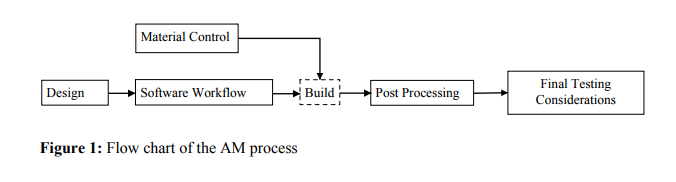
FDA Additive Manufacturing Process Flowchart
It is reported that the FDA is establishing a regulatory framework on how to apply its existing regulations for medical device manufacturing to the systems and facilities involved in 3D printing these devices. This regulatory framework, hailed as the world’s first “comprehensive technical framework,” will provide manufacturers with guidance on 3D-printed medical products.
FDA's Next Steps
The FDA also plans to review regulatory issues related to the bioprinting of biological cells and tissue products to determine whether additional guidance is needed beyond the recently released regulatory framework for regenerative medicine advanced therapies.
In the statement, Gottlieb made it clear that this new technical guidance is merely intended to provide the FDA’s perspective on 3D printing technology, and noted that any recommendations put forth by the FDA regarding 3D printing are likely to evolve as the technology advances.
Finally, Gottlieb concluded: “These measures are part of our efforts to ensure that our regulatory framework aligns with the unique attributes of the new technologies we are tasked with reviewing. 3D printing will inevitably transform the daily practice of medicine, with patients receiving treatments using medical products specifically customized for them. The FDA bears a critical mission: to help advance technology while ensuring patient safety.”
The Policy Dilemmas Facing Medical 3D Printing in China
Compared with foreign countries, China also attaches great importance to 3D printing technology.
On February 28, 2015, the Ministry of Industry and Information Technology (MIIT) released the "National Plan for Promoting the Development of the Additive Manufacturing Industry (2015–2016)," proposing that by 2016, China should initially establish a relatively complete additive manufacturing industry system, with overall technological levels keeping pace with international standards.
On May 19, 2015, the State Council issued the “Made in China 2025” plan, explicitly designating the 3D printing industry as a key area for development.
In September 2015, China’s first 3D-printed human implant—an artificial hip joint product—received registration approval from the China Food and Drug Administration, attracting widespread attention.
To date, four products have received CFDA approval in China: the 3D-printed acetabular cup developed by AK Medical in collaboration with Peking University Third Hospital, the 3D-printed artificial vertebral body, the 3D-printed spinal interbody fusion cage, and Medprin’s 3D-printed dural (spinal) patch.
However, China currently lacks adequate regulation for 3D-printed medical devices, with no established approval and certification framework in place.
Lagging Management Systems Impede the Healthy Development of the Medical 3D Industry
Since the revision of the Regulations on the Supervision and Administration of Medical Devices (hereinafter referred to as the “Regulations”) in 2014, the state has issued numerous supporting departmental rules and normative documents, initially establishing a comprehensive management system covering the entire lifecycle of medical device products. This management system centers on quality management of medical devices, with the regulatory framework and technical standards for medical devices serving as the two primary bases for oversight. However,Currently, there is essentially a regulatory vacuum regarding the management of 3D-printed medical devices.
First, regulatory authorities have accumulated very little oversight experience regarding 3D-printed medical devices manufactured using non-traditional processes, and management practices for their production, operation, and use remain inadequate. Consequently, it is difficult to issue targeted administrative regulations within a short timeframe.
Secondly, there is a severe lack of relevant technical standards. Technical standards serve as a critical basis for medical device enterprises in research and development, design, inspection and testing, production, and operations.Currently, China has not issued any targeted national or industry standards for medical devices manufactured using 3D printing technology.This not only poses significant challenges for relevant enterprises in implementing quality control for 3D-printed medical devices, but also creates substantial obstacles for regulatory authorities in conducting technical reviews of such devices.
Furthermore, certain medical device quality management regulations, such as the Good Clinical Practice for Medical Devices (Medical Device GCP), the Good Manufacturing Practice for Medical Devices (Medical Device GMP), and the Good Supply Practice for Medical Devices (Medical Device GSP), are primarily applicable to medical devices manufactured using traditional production processes.Lack of Guidance on Quality Management for 3D-Printed Medical Devices。
Technical Evaluation Constraints Impact Market Approval Progress
Currently, both enterprises and regulatory authorities face significant challenges in conducting technical evaluations of 3D-printed medical devices.
First, to regulate 3D-printed medical devices, the primary issue that must be addressed is their classification.The structural characteristics and modes of use of 3D-printed medical devices differ from those of medical devices produced by traditional manufacturing processes, making it difficult to assess product risk levels based on prior classification experience.Therefore, it is difficult to strictly classify them. Currently, the China Food and Drug Administration (CFDA) has included eight categories of products, such as custom additive manufacturing (3D-printed) orthopedic implants, in the Catalogue of Class III Medical Devices Requiring Clinical Trial Approval.
Second, from the perspective of enterprises, 3D printing equipment and the materials used are two critical factors affecting product quality. With advancements in 3D printing technology, printable materials have expanded from non-biocompatible substances to include living cells, proteins, and other extracellular matrix components. Quality control considerations vary depending on the specific printing materials employed.
Third, for regulatory authorities, the safety and efficacy of manufacturing processes and materials are the key focus of technical review for standardized medical devices produced using 3D printing technology.The technical review of 3D-printed medical devices should differ from that of traditional medical devices in terms of review methods, procedures, and key focal points; however, relevant regulations have not yet been issued.
It is evident that, due to the nascent understanding of layer-by-layer additive manufacturing—a novel production technology—there has been insufficient in-depth exploration of the full lifecycle of medical devices fabricated using this method. Furthermore, effective testing and inspection methodologies for final products remain ill-defined, while validation, verification, and release procedures for the manufacturing process are still in the exploratory phase. Consequently, both relevant enterprises and regulatory authorities face a considerable journey ahead in the technical evaluation of 3D-printed medical devices, which will inevitably impact the progress of market approval for these products.
Below are the key policies regarding medical 3D printing in recent years:
● The Ministry of Industry and Information Technology, the Ministry of Finance, and other authorities issued the National Plan for Promoting the Development of the Additive Manufacturing Industry (2015–2016), which proposed that by 2016, a relatively comprehensive additive manufacturing industrial system would be initially established, achieving rapid growth in industry sales revenue with an average annual growth rate of over 30%, and aligning overall technological standards with international levels. Among these, the development goal for the medical field was to initially become a tool for new drug research and development, clinical diagnosis, and treatment, and to establish a number of application demonstration centers or bases across China.
● On March 8, 2016, the Ministry of Science and Technology released the "Notice on Issuing the 2016 Project Application Guidelines for Key Special Programs including Precision Medicine Research under the National Key R&D Program." The guidelines explicitly listed "Precision Medicine Research" as one of the key special programs to be prioritized for launch in 2016, officially entering the implementation phase.
● On March 9, 2016, the Ministry of Science and Technology also released the “Guidelines for Project Declaration in 2016 under the Key Special Program on Research and Development of Biomedical Materials and Tissue/Organ Repair and Replacement,” designating rapid prototyping of personalized implants and interventional devices, as well as biological 3D printing technologies, as priority areas eligible for financial subsidies.
● In February 2017, the Anhui Provincial Commission of Economy and Information Technology released the "Anhui Province 13th Five-Year Plan for the Development of the Pharmaceutical Industry," in which "3D-printed medical devices" was listed as one of the four key development priorities. The most cutting-edge industry mentioned in the plan is "cell 3D printing," a medical operation at a more microscopic level. This signifies that it could grow into a new medical industry in Anhui within five years.
● On May 26, 2017, the General Office of the Ministry of Science and Technology issued the Notice on Printing and Distributing the “13th Five-Year Plan for Scientific and Technological Innovation in Medical Devices,” which pointed out that new-generation manufacturing technologies, such as robotics, additive manufacturing (3D printing), and micro-nano manufacturing, are driving medical devices toward intelligence, automation, and personalization.