

Xinhai Lianda Files IPO Prospectus: A Pioneer in Medical Dispute Informatics Led by CEO Wang Haitao
“My parents are both healthcare professionals who have now retired. In their era, doctor-patient disputes were rare, and there was a high level of trust and cooperation between doctors and patients—a stark contrast to the present day. In recent years, the frequent negative headlines about doctor-patient disputes have often left my parents reflecting deeply: What has happened to the current medical environment? Annual compensation payouts stemming from doctor-patient disputes at large tertiary Grade A hospitals have even exceeded ten million yuan, while mediation through Medical Dispute People’s Mediation Committees and litigation in courts have become commonplace, imposing a heavy burden on both hospitals and patients.”
“For many years, I have been working in the healthcare IT industry and have always wanted to contribute my modest efforts to the medical field. Guided by this original aspiration, we established close collaborations with several large Grade-A tertiary hospitals a few years ago and independently developed China’s first management information system for doctor-patient disputes. We are also committed to leveraging informatization to make meaningful improvements in doctor-patient relationships, thereby providing reassurance to both patients and physicians,” Wang Haitao, CEO of New Hailianda, told VCBeat.
Phoenix Rising from the Ashes, Breaking Free from the Cocoon to Become a Butterfly
“Getting started is always the hardest part. With strategic guidance from hospital administrators and close collaboration with medical departments, our R&D team continuously delved into critical pain points to identify optimal solutions. After years of pilot implementation and refinement at major Grade A tertiary hospitals, China’s first ‘Harmonious Doctor-Patient Comprehensive Management Platform’ has finally been launched,” said Wang Haitao with deep emotion.
The “Harmonious Doctor-Patient Integrated Management Platform” adopts a three-pronged approach—efficient response during incidents, risk prevention beforehand, and risk control afterward—to standardize doctor-patient dispute workflows, normalize data, and refine management practices. By enabling information sharing, the platform facilitates efficient inter-departmental collaboration within hospitals, shortens case resolution cycles, promptly alleviates patient concerns, and prevents the escalation of doctor-patient conflicts.
Prior to incidents, the dynamic monitoring platform for medical safety risks leverages big data analytics to proactively identify potential factors contributing to disputes, establishes a safety early-warning list, and implements a long-term early-warning mechanism. This system alerts medical departments to prioritize high-risk areas, thereby preventing risks at their source.
Post-incident, the root causes of disputes are identified using the system’s intelligent fishbone root cause analysis method. Based on big data analytics from the platform, corrective action reports are generated and regularly issued to departments for implementation. The medical affairs department conducts regular supervisory inspections, establishing a virtuous closed-loop management model for medical quality that helps hospitals enhance service quality and management standards.
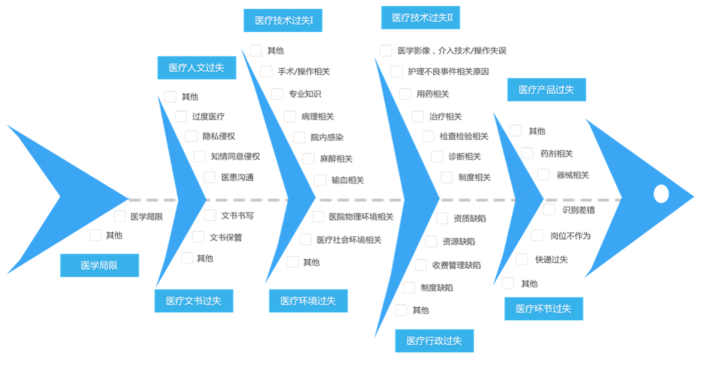
Fishbone Root Cause Analysis (Medical Error Classification Coding)
In addition to leveraging information technology, the company has integrated medical accident insurance, employing a diversified risk-sharing mechanism. Through the rapid claims settlement of surgical accident insurance, it helps hospitals and patients transfer medical risks, thereby reducing the burden on both parties.
Market Outlook: A Promising Future Ahead
Wang Haitao: As we have visited an increasing number of hospitals, we have identified a substantial market demand. Various types of hospitals remain stuck in inefficient, traditional manual workflows. We have summarized three primary reasons for this:
First, the hospital has not established a dedicated unified window for doctor-patient relationship management;
Second, no dedicated personnel are assigned for end-to-end process management;
Third, intermittent demands are typically addressed through transactional solutions.
With the implementation of the new healthcare reform, refined internal management and improved quality of medical services have become a trend in hospitals. Information management systems that can generate revenue and reduce costs for hospitals are more popular.
As of press time, Xin Hailian Da had partnered with more than 20 Grade-A tertiary hospitals and established benchmark clients in multiple provinces, demonstrating strong growth momentum.
It is reported that 93% of doctor-patient disputes in China occur in tertiary and secondary hospitals. With the total number of these two types of hospitals exceeding 10,000, the vast scale of data and the extensive market potential are self-evident.
Xin Hailian Da has continuously innovated its business model during its development, such as by collaborating with insurance companies, forensic appraisal institutions, and legal firms, indicating promising growth prospects.