

Alibaba Health Holds Confidential Summit with Over 60 Pharma and Health Companies, Unveiling 2018 Strategic Roadmap
As the year draws to a close, companies are entering their period of annual review and future outlook. On December 8, Alibaba Health held a closed-door meeting with industry peers at its Xixi Campus in Hangzhou, unveiling its key strategic priorities for development in 2018.
An attendee at the event told VCBeat (WeChat ID: vcbeat) that more than 60 senior executives, including chairmen and CEOs, from pharmaceutical and healthcare companies participated in this closed-door meeting. The attendees included representatives from Janssen Xi’an, Bayer Schering, Jianzhibao, Reckitt Benckiser, Jissbon, TerryWhite, and Swisse, among others.
According to his observations, many of the corporate representatives invited this time were CEOs and chairmen, while e-commerce directors, who were commonly seen at previous meetings, became the minority. From Alibaba Health, Chairman Wu Yongming, CEO Wang Lei, and Tmall Medicine General Manager Kang Kai all appeared at the venue. Wu Yongming and Wang Lei gave brief strategic shares, while Kang Kai analyzed key business scenarios.
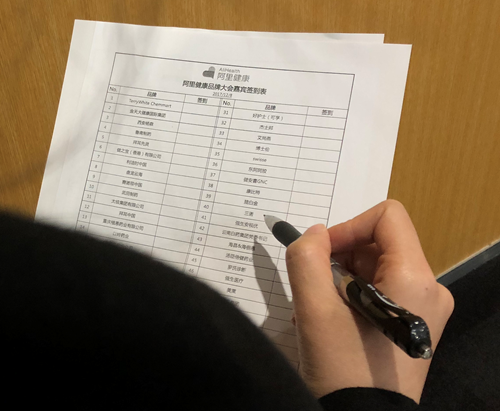
On-site Sign-in Sheet
At the conference, Kang Kai, a director of Alibaba Health, presented the core services to be provided to pharmaceutical and healthcare enterprises, including e-commerce platforms, brand building, product traceability, medical services, cross-border e-commerce, and data services, which essentially outline the key focus areas of Alibaba Health’s development this year.
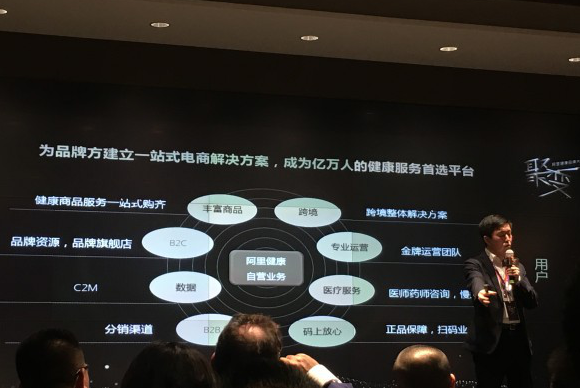
Ali Health Director Kang Kai Shares the Platform’s Core Strategy
The source also revealed that two companies, TerryWhite and Dong-E-E-Jiao, reached cooperation agreements with Alibaba Health on-site.
Data shows that TerryWhite Chemists is an Australian pharmacy brand with a 50-year history and one of the most well-known large pharmacy chains in Australia, currently operating over 165 chain stores nationwide. The partnership with TerryWhite signifies Alibaba Health’s exploratory steps in introducing overseas health products, positioning it to become a key channel for bringing international health products into the Chinese market in the future.
Alibaba Health and Dong-E-E-Jiao are deepening their collaboration. The two parties previously joined forces to launch the “Nourish China” initiative, which was the first brand strategy introduced by Tmall Medicine after its integration into the Alibaba Health ecosystem, aimed at promoting the transformation and upgrading of China’s traditional tonic industry. During this year’s Double 11 shopping festival, the Alibaba Health O2O Pioneer Alliance also introduced a free donkey-hide gelatin decoction service. It is reported that Alibaba Health and Dong-E-E-Jiao will further deepen their cooperation in supply chain management and new retail.
Major Speculations on the Development Direction of Alibaba Health
Gathering senior executives from pharmaceutical and healthcare companies, with several industry leaders personally attending, it is evident that Alibaba Health attaches great importance to this closed-door meeting. Information disclosed at the meeting also outlined some of Alibaba Health’s future development plans, such as cross-border e-commerce, one-stop e-commerce services, new retail integrating online and offline channels, and internet healthcare.
Alibaba Health was established in 2014. As the flagship platform for Alibaba’s pharmaceutical and healthcare businesses, it has gradually adjusted its business model over the three years since its inception, ultimately forming a business layout encompassing pharmaceutical e-commerce, smart healthcare, product traceability, and health management.
Alibaba Health’s interim financial report also reveals that its business layout has been largely completed, and its current empowerment of pharmaceutical companies is an inevitable outcome of the platform’s openness and strategic deployment.
As an Alibaba-affiliated enterprise, AliHealth naturally carries a strong “e-commerce” DNA.
In August last year, Alibaba Health completed the acquisition of Guangzhou Wunian Pharmaceutical Chain Co., Ltd. (later renamed Alibaba Health Pharmacy), launching its B2C pharmacy business. In September last year, Alibaba Health officially began providing full-scale outsourcing and value-added services for pharmaceutical-related categories on Tmall’s Medicine Pavilion, assisting Tmall in developing its pharmaceutical e-commerce operations and charging fees for these services. In July this year, Tmall’s “Blue Hat” health supplement business was fully integrated into Alibaba Health. Alibaba Health has now established a comprehensive health retail platform that combines self-operated B2C sales with e-commerce services.
Smart healthcare is another key focus of Alibaba Health’s development. In this business line, it connects hospitals at the upstream end, integrates a middle layer of medical artificial intelligence technologies and service providers, and reaches downstream C-end users. With internet hospitals, medical AI solutions, and health management as its core products, it establishes a complete closed-loop smart healthcare service ecosystem.
Alibaba Health has also made significant moves in the healthcare sector. This July, Alibaba Health officially launched its medical AI system, “Doctor You,” at the Wanliyun Medical Imaging Center in Beijing. The system serves as an integrated platform for “smart healthcare,” offering functionalities such as clinical research and diagnostic support, assisted medical detection, and physician training.
In August, Alibaba Health announced a pilot project with Changzhou City to integrate medical consortia with blockchain technology: Alibaba Health has applied cutting-edge blockchain technology to the underlying technical architecture of Changzhou’s medical consortium system, achieving data interoperability among certain local medical institutions.
In October, Alibaba Health signed agreements with the First Affiliated Hospital of Zhejiang University School of Medicine, the Second Affiliated Hospital of Zhejiang University School of Medicine, and Xinhua Hospital affiliated with Shanghai Jiao Tong University School of Medicine to jointly establish “Medical Artificial Intelligence Engineering Laboratories,” build a national-level “Intelligent Training Platform for Medical Professionals,” and create benchmark smart hospitals.
In late October, Alibaba Health and Bayer entered into a strategic partnership. Centered on consumer operations and powered by data, the two parties will implement a new retail model encompassing the entire value chain, all media channels, comprehensive data integration, and omnichannel distribution, thereby making Bayer’s self-care products and solutions more accessible. Reportedly, Bayer is the first pharmaceutical and consumer health company to sign a strategic cooperation memorandum with Alibaba Health Platform for omni-channel marketing and new retail.
In late November, Alibaba Health also partnered with Sanofi to launch the “Peace of Mind at Your Fingertips” initiative—a project focused on medication safety and disease management. Sanofi’s prescription drug products in China will be listed on the “Ma Shang Fang Xin” (Code for Assurance) platform. By scanning QR codes via apps such as Alibaba Health, patients can access detailed drug information and chronic disease management knowledge, marking a beneficial attempt by pharmaceutical companies to advance digital marketing and patient education.
In terms of product traceability, as of September 30, more than 7,200 enterprises had joined the “Ma Shang Fang Xin” traceability platform, with the number of registered pharmaceutical manufacturers exceeding 80% of the total number of pharmaceutical manufacturers in China. Meanwhile, the platform has expanded its services to include cross-border product traceability. Ali Health stated that, given the Chinese government’s increasing emphasis on strengthening product safety management through electronic traceability systems, there is significant potential for further growth in this business area.
At this point, Alibaba Health’s core business framework has been established. In line with Alibaba’s consistent platform-based and open strategy, the next step is to leverage its platform and capabilities to “empower” pharmaceutical and healthcare enterprises by providing them with systematic e-commerce and branding solutions.
Attendees told VCBeat that Alibaba Health’s assembly of leading figures in the pharmaceutical sector served both as a review of its past performance and as an outline of its future strategy. They noted that, while consolidating its existing businesses, Alibaba Health will provide pharmaceutical and healthcare enterprises with more diversified services—including new retail, consumer education, omnichannel marketing, and medical services—by integrating supply chain, medical care, e-commerce platforms, and health management solutions, thereby acting as a bridge between pharmaceutical and healthcare companies and consumers.