

Billion-Dollar Sleep Health Market Remains Underpenetrated: Smart Sleep Products Account for 88%, Services Only 12%

Sleepace
Intelligent Sleep Monitoring and Improvement Solution Provider
“Don’t want insomnia? Then I’ll just have to lose my job.”
According to 2016 data from the U.S. Centers for Disease Control and Prevention (CDC), sleep deprivation among working adults resulted in the loss of 1.2 million workdays annually due to absenteeism or suboptimal job performance. The resulting decline in productivity and increased risk of mortality led to economic losses amounting to $411 billion. As early as 2015, the CDC issued a stark warning: “Insufficient sleep has become a serious public health problem.”
Where there is crisis, there is opportunity; where there is demand, there is a market. Sleep disorders have become an ailment of the times, and the work-related stress faced by modern white-collar workers has made people increasingly willing to pay for better sleep.
Maria opened the first nap café in Madrid, where customers can choose to rest in armchairs (US$1.7/30 min), bunk beds (US$4–5/30 min), or private rooms (US$8/30 min). The café also provides pajamas, slippers, blankets, and a cup of coffee. There is no need to set your own alarm; waiters will gently wake you up at the designated time.
There are approximately 200 sleep technicians in Taiwan. Their job involves observing the sleep patterns of individuals with sleep disorders and recording physiological parameters such as respiration, brain waves, and limb movements. Certification from the Sleep Society is required for qualification, and most technicians come from backgrounds in nursing, medical laboratory science, or psychology. Their primary working hours span from overnight until the following morning.
These seemingly strange businesses and professions have all emerged in the “sleep economy.”
The global sleep medicine market comprises two major segments: products and services. In 2015, the total market size reached $254.09 billion, with the product segment accounting for 88% of the overall market and the service segment comprising 12%.
To observe the sleep management industry,VCBeat (WeChat: vcbeat)After interviewing several entrepreneurs, we found that sleep medicine is a complex system encompassing everything from hospital sleep centers to service providers. The market for sleep-related products is highly heterogeneous, ranging from large home appliances to small devices such as wristbands and button-sized sensors. Therefore, this article focuses only on the smart hardware and mobile applications most widely accepted by the general public for sleep management and monitoring, categorizing these products asDigital Health Sleep Products, with the aim of presenting more details about this industry.
Cognitive and Technological Advances Drive the Development of Sleep Medicine, Giving Rise to the Healthy Sleep Industry
According to statistical data from Zhiyan Consulting, North America is the largest sleep medicine market globally. The market size of the North American sleep medicine industry was USD 58.08 billion in 2010 and grew to USD 80.29 billion in 2015.
The market size of the European sleep medicine industry was USD 55.85 billion in 2010, growing to USD 76.73 billion in 2015.
South Korea’s sleep medicine industry is in the ascendant, with its market size growing from USD 9.59 billion in 2010 to USD 13.72 billion in 2015.
In Japan, the market size of the sleep medicine industry was $14.56 billion in 2010 and grew to $20.33 billion in 2015.
As early as the 1960s, sleep research had already become a hot topic in the United States. In 1953, American scientists discovered rapid eye movement (REM) sleep by monitoring electroencephalographic activity during sleep and demonstrated its association with dreaming. Subsequently, it was further established that non-rapid eye movement (NREM) sleep, which comprises four stages progressing from light to deep sleep, alternates with REM sleep in a cyclical pattern throughout the human sleep cycle.
According to the International Classification of Sleep Disorders published in 2005, there are more than 90 types of sleep disorders caused by extrinsic or intrinsic factors. Among these, the most common conditions, such as insomnia and sleep apnea syndrome (SAS), exhibit high prevalence rates among the Chinese population.According to a survey by the World Health Organization,, the prevalence of insomnia among Chinese citizens is 38%. According to data provided by Wang Jianjun, co-founder of Shanghai Mdt InfoTech Ltd, the elderly are a high-risk group for sleep apnea, with a prevalence rate of 40%, while the incidence rates among children and adults are each 20%.With the popularization of sleep medicine, rare sleep disorders such as narcolepsy are gradually being recognized.
In the early days of sleep medicine, public awareness in China was relatively low. This was evident in hospitals and at academic conferences, where sleep disorders were often dispersed across departments such as neurology and otolaryngology in many major hospitals, resulting in a poor patient experience. According to Gao Song, founder of Snail Sleep,, the development of the sleep industry is based first on cognition and second on technology,Since 2016, awareness of sleep medicine in China has advanced by leaps and bounds. “In 2015, there were approximately 12 academic conferences nationwide; this number rose to more than 50 in 2016, and exceeded 70 specialized academic conferences in 2017.”Even the Consumer Electronics Show (CES) in the United States has designated a separate “Sleep Technology” zone since 2016.
Meanwhile, sleep centers are increasingly being established as independent departments in hospitals; top-tier (Grade 3A) hospitals such as Peking Union Medical College Hospital and West China Hospital of Sichuan University have all set up sleep centers.
Currently, China’s sleep market is characterized by a complex and diverse landscape, encompassing the sleep home furnishings industry, the sleep health industry, and the sleep services industry. In addition to bedding products such as mattresses and pillows, the market also spans multiple segments, including health-oriented products designed to improve sleep quality, as well as medical products and technologies for treating sleep disorders.Among them,Health sleep products are broadly categorized into two lines: sleep improvement products and sleep monitoring products. Among sleep monitoring products, there is a further distinction between medical-grade monitoring devices and non-medical-grade devices.
According to data from China Industry Information Network, the market size for sleep-improvement products reached RMB 211.4 billion in 2015. By 2017, the overall sleep market in China (including bedding, home furnishings, etc.) had grown to RMB 1 trillion. The “sleep market” has thus become a substantial opportunity. Experts predict that sleep may emerge as the third major health topic—after diet and exercise—to drive high-profit product development.
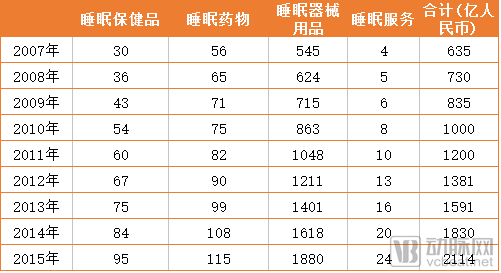
Market Size of Sub-segments in China's Sleep Improvement Products Industry, 2007–2015 (Unit: RMB 100 Million)
Data Source: China Industry Information Network
Smart Hardware + App-Based Healthy Sleep Products Dominate the Market
From VCBeat’s perspective, entrepreneurial ventures in the healthy sleep sector have previously focused predominantly on smart hardware, adopting a “hardware + app” model to conduct big data analytics on consumers and formulate personalized sleep patterns.Nowadays, sleep apps capable of recording sleep talking and providing intelligent wake-up features have also been added to consumers’ lists of sleep aids. According to incomplete statistics, there are more than 10 sleep-assistance apps in the Apple App Store, represented by Snail Sleep, Firefly Sleep, Little Sleep, and White Noise.
Similar to the smart wristbands that emerged in 2014, some apps also offer basic monitoring functions that measure sleep duration and distinguish between deep and light sleep stages by leveraging technologies such as audio collection and body temperature measurement.The difference is that a significant portion of previous smart bands estimated sleep duration and quality based on arm movements, rendering them lacking in reference value.
Health sleep products such as Sleepace utilize heart rate variability (HRV) technology and analyze indicators like respiration and body movements to assess sleep quality. These devices aim to extend continuous, long-term monitoring from hospital settings to home environments. Although widely recognized by the academic community, they have not yet reached the standard of medical-grade equipment.
In addition to traditional pharmacological sleep aids, an increasing number of smart sleep-enhancing products that leverage sound, scent, and light are joining the array of solutions for improving sleep.
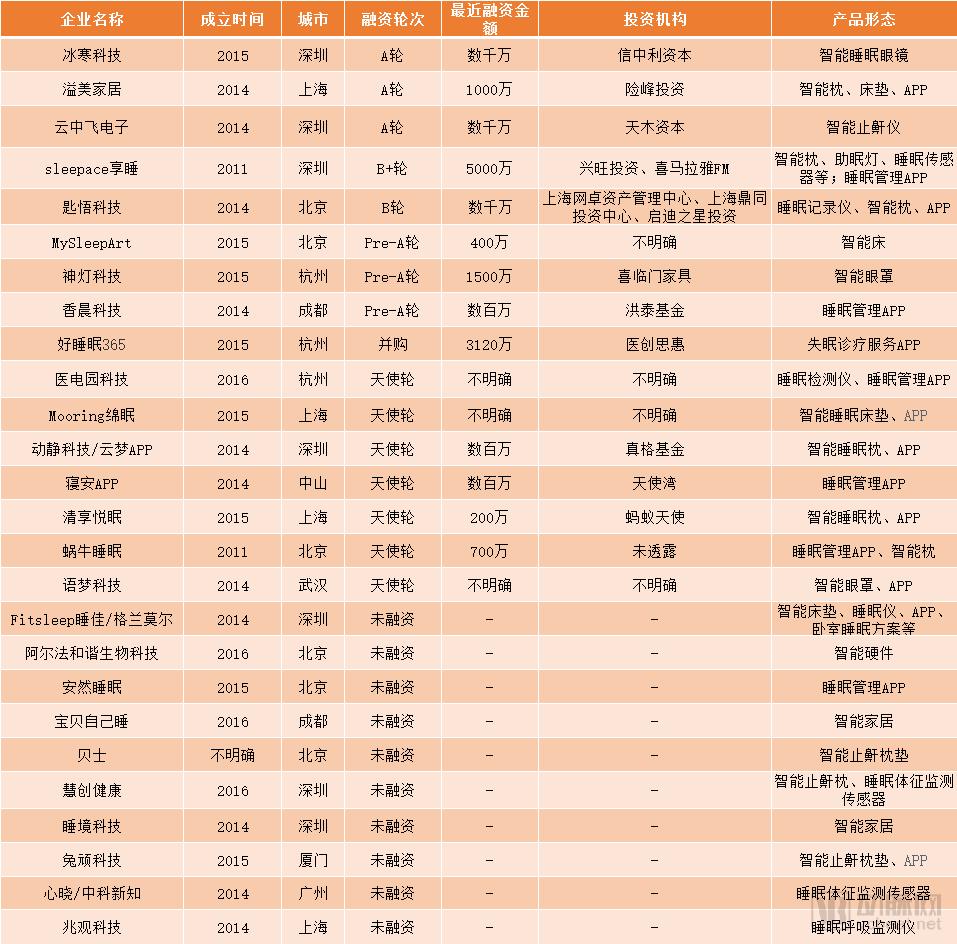
VCBeat: Selected Startups and Their Product Offerings in the Healthy Sleep Sector(Data source: VCBeat database)
Note: Companies in relevant fields not included on the list are welcome to contact VCBeat.
In the aforementioned statistics, products featuring a smart hardware + App format constitute the majority, and such products are largely categorized as consumer electronics sleep products.Among them, only Shanghai Mdt InfoTech Ltd’s “Mengjia” sleep monitor has received CFDA certification and can be used as a medical device.
Gao Song believes that Snail Sleep is positioned as a product category dedicated to popularizing general health education, with its monitoring function serving merely as an “adjunct to medical care.” “We adopt a prudent approach toward the identification of sleep disorders. Although we consider our algorithmic accuracy to be quite robust, we have not sought medical certifications from regulatory bodies such as the CFDA or the FDA. Instead, these products are positioned and recognized as tools for public science education on sleep health.”
Wang Zhong, founder of Soundario Inc., believes that most people assess their sleep quality based on subjective feelings. He views sleep monitoring merely as a tool for identifying problems, whereas consumers truly need solutions to address them. Consequently, he did not make sleep monitoring the focus of his venture. Instead, he adopted a scientific approach, combining sound-based sleep aids with a high-quality pillow to tackle sleep issues, which led to the creation of the current “Cloud Dream Pillow.”
Sleep monitoring products are trending toward home-based applications, yet only a few have received CFDA certification.
According to incomplete statistics from China Industry Information Network, there are approximately 2,000 enterprises in China’s sleep industry. Medical devices account for the largest share at 65%, followed by pharmaceuticals (approximately 16%), health supplements (15%), and sleep services (4%). Monitoring equipment within the medical device segment serves as the front end of the entire data chain and holds the most critical position in the industry value chain.
From the perspective of disciplinary distribution in the literature, sleep research encompasses more than 40 disciplines, demonstrating considerable breadth, with respiratory medicine and otorhinolaryngology being the most prominent. Therefore, monitoring products applied to apnea conditions are essentially devices within the field of sleep medicine.
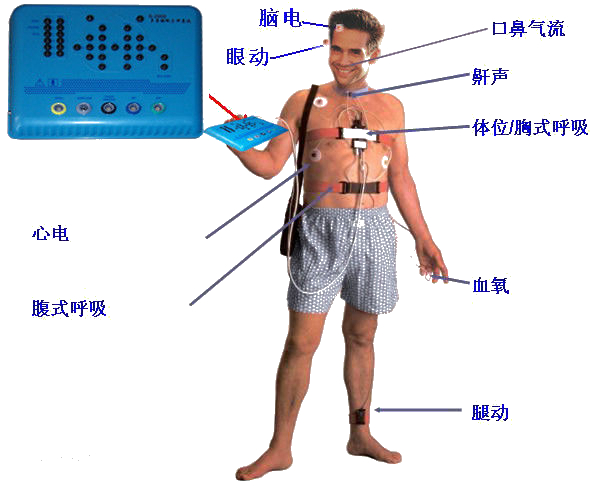
Schematic of Polysomnography (PSG) Monitoring Parameters
(Image source: Baidu Baike - Polysomnography Monitoring System entry)
Polysomnography (PSG) monitors are the most widely used devices for sleep monitoring in clinical settings.Manufacturers certified by the China Food and Drug Administration (CFDA) primarily include Beijing Yihe Jiaye Medical Technology Co., Ltd. and Jiangxi Nuocheng Electric Co., Ltd., among others. Their devices are used to diagnose sleep-related breathing disorders by attaching electrodes to the patient’s body. They monitor conditions such as sleep apnea syndrome, snoring disorder, and upper airway resistance syndrome, and also assist in the diagnosis of other sleep disorders, including narcolepsy, restless legs syndrome, and insomnia classification. The monitored parameters include electroencephalogram (EEG, for analyzing sleep architecture), electrooculogram (EOG), submental electromyogram (EMG), oronasal airflow and respiratory effort, electrocardiogram (ECG), blood oxygen saturation, snoring sounds, limb movements, and body position.
Sleep monitoring serves as the front-end entry point and a critical component of the sleep ecosystem. Polysomnography metrics include continuous nocturnal measurements of respiration, arterial oxygen saturation, electroencephalogram (EEG), electrocardiogram (ECG), and heart rate. Its advantages lie in high accuracy, while its disadvantages include high costs and extremely limited application scenarios.
Wang Jianjun believes that dedicated monitoring devices for apnea need to includeThree Key Detection Technologies:
1. There must be a sensor for measuring respiration;
2. It must have a blood oxygen sensor;
Third, there must be sensors for electroencephalogram (EEG) monitoring.
Wang Jianjun positions his company’s “Mengjia” sleep monitor as a preliminary screening device for sleep-disordered breathing. It is one of the few non-contact monitoring devices to have received certification from the China Food and Drug Administration (CFDA) and national medical device approval. Compared with traditional wearable sleep monitoring systems, this wireless data acquisition method does not disrupt sleep, cause discomfort, or induce psychological stress, thereby achieving higher accuracy.
For companies in the healthy sleep sector, data is king.
“Mengjia” has conducted long-term joint clinical trials with Grade-A tertiary hospitals to verify the reliability and accuracy of the product in detecting respiratory events. Wang Jianjun, co-founder of Shanghai Mdt InfoTech Ltd, revealed to reporters that in comparative studies combining “Mengjia” with hospital clinical practices, the accuracy rate exceeds 95%. Furthermore, certification as a national medical device and approval by the China Food and Drug Administration (CFDA) mean that “Mengjia” can be used outside of hospital settings and without the need for professional personnel. The data generated holds direct reference value for subsequent diagnosis and treatment and can serve as a basis for clinical diagnosis.
For startups, it has become quite common to collaborate with professional medical institutions to test their products, as seen in the case of Shanghai Mdt InfoTech Ltd, including consumer-grade sleep monitoring devices.
According to Huang Jinfeng, CEO of Sleepace,Enjoy SleepRestOn, a non-wearable sleep health monitor, collaborates with the Stanford Center for Sleep Sciences and Medicine and select departments of West China Hospital, Sichuan University, to monitor sleep using Sleepace’s products and jointly develop solutions for improving sleep health.
Through comparative testing with medical-grade polysomnography devices, Sleepace’s monitoring products achieve 95% accuracy in measuring respiratory rate and heart rate, comparable to that of medical equipment.
Gao Song believes, smart products are essentially data collectors; only companies with access to data can better manage sleep.“With a smaller data volume, it is impossible to achieve large-scale coverage. Data serves as the foundation for developing technologies similar to SleepAI; only with sufficient data can personalized adjustments be made for each individual. Monitoring of human sleep behaviors is entirely based on data analysis.”
Currently, Snail Sleep has 10 million users, with a daily active user (DAU) count of 600,000, meaning that the Snail Sleep app generates 600,000 sleep data records every day.
Target Market: Hardware sales target both B2B and B2C segments, with children and the elderly as key demographics.
Of the four companies interviewed by reporters, three primarily generate profits through B2C sales.
Snail Sleep’s product strategy has evolved from a mobile app to smart hardware. Its revenue streams include paid music within the app, advertising income, and sales of its smart pillows, which are priced at RMB 468 and RMB 999 respectively. According to Gao Song, approximately 1% of the app’s users are paying subscribers, while monthly sales of the smart pillows amount to several thousand units. The company achieved break-even in September 2017.
The pathway of Snail Sleep isThe social effect generated by the sleep management app has attracted a group of loyal users through interactive behaviors such as sharing records of sleep talking, and converted these users into paying customers.
Soundario Inc.’s sales model is similar to that of most hardware-centric companies, primarilySell products through online e-commerce platforms and offline retail stores.. According to Wang Zhong, the company previously spent a year building its distribution channels. Its products have now expanded globally, with the Yunmeng Pillow available at retailers such as Tsutaya Electronics in Japan and on Amazon in the United States.
SleepaceThe company’s product series accounts for approximately one-sixth of its e-commerce sales, with the remainder primarily driven by offline channels.Currently, it has established a network of 700 to 800 terminal stores in China and is sold in nearly 2,000 stores across approximately 30 countries overseas. Offline retail channels include comprehensive home appliance retailers such as Suning and Gome, as well as trend-focused boutiques, shopping malls, Apple authorized resellers, and home lifestyle stores located in venues such as airports.. It is expected to achieve a revenue of 80 million yuan in 2017.
Unlike several other companies,SleepaceThe ratio of B2B to B2C revenue stands at 6:4, with B2B accounting for the larger share. Key partners include nursing homes, hotels, and home furnishing manufacturers, as the company is committed to developing healthy sleep products that evolve from standalone items into integrated systems and ecosystem chains.
Shanghai Mdt InfoTech Ltd’s “Mengjia” sleep monitor, being a medical-grade sleep monitoring device designed primarily for home use, therefore itsCustomer acquisition channels primarily include conversions within hospital settings, targeting populations such as patients with chronic diseases, children, and the elderly.For other demographics, the product is promoted through media campaigns. Wang Jianjun stated, “Sleep apnea is highly correlated with several common chronic diseases, including hypertension, diabetes, and coronary heart disease.”
Pain Point: The Cost of Market Education and the Complexity of Solutions
The massive demographic dividend and the widespread prevalence of sleep disorders have created significant potential for the large-scale development of the sleep economy. However, due to a multitude of influencing factors, despite a general public awareness of the importance of sleep, effective solutions remain elusive, posing substantial challenges to the smooth growth of the sleep economy.
There are two factors hindering the development of this market,1. The public's attention to sleep, despite the growing prominence of health issues and major brands like Apple focusing on sleep, public awareness of sleep health remains insufficient. Huang Jinfeng believes that “although awareness of sleep products is higher than before, it is still not high enough.” Currently, market education is primarily driven by major brands; therefore, consumer acceptance of other sleep-improvement devices on the market remains limited, and market penetration has yet to reach the levels seen during the wearable device boom sparked by smart bracelets.
Second, for the human body, solutions to sleep problems involve a certain degree of complexity and typically require a multidisciplinary approach.Huang Jinfeng attributes poor sleep to four categories of factors: physiological, psychological, environmental, and lifestyle-related. In his view, improving sleep is an interdisciplinary endeavor. Currently, Sleepace’s products can enhance sleep through psychological and environmental interventions. However, addressing other contributing factors requires collaboration with service providers, such as those specializing in chronic disease management, to offer services that go beyond monitoring and help individuals resolve insomnia.“In summary, cross-disciplinary collaboration is needed; apart from sleeping pills, no single device can solve all problems.”
Tech Giants Enter Health Management: Is Sleep the Primary Entry Point?
As one of the major players in the healthy sleep sector, with products sold in more than 30 countries and regions worldwide, according to Huang Jinfeng’s observations,Major global players in the health sleep device market include Finland's Beddit, Israel's EarlySense, and France's Withings.
January 2015,Samsung Corporation, South Koreato an Israeli patient monitoring equipment companyEarlySenseA $10 million investment. Its independently developed non-contact monitoring sensors help clinicians detect early signs of patient deterioration by tracking vital signs such as heart rate, respiration, and movement, thereby preventing adverse events including emergency interventions, ICU transfers, patient falls, and pressure ulcers.
April 2016,NokiaAnnounces Plan to Acquire Digital Health Company for €170 Million (Approx. $191 Million) in CashWithings, to enter the consumer and digital health markets.
May 2017,Apple Inc.Acquired a Finnish device manufacturer specializing in sleep monitoring and managementBeddit Sleep Monitor. The device manufacturer’s app and sleep system can monitor users’ daily sleep habits via iPhone, including sleep quality, heart rate, respiration, and even snoring.
In addition, in April 2017, the sleep monitoring startup that had raised $40 million in financingHelloMassive layoffs underway as the company seeks a “fire-sale” buyer. The startup had developed a device called “Sense,” designed to help users track sleep patterns, cultivate healthy habits, and improve sleep quality. It was once valued at nearly $300 million.
In a series of acquisition events,Sleep tracking is a key niche within the broader effort by tech giants to explore health-related user scenarios.。
In this regard, Huang Jinfeng stated, “Only promising industries attract industry giants. While their entry intensifies market competition, it also accelerates consumer education in the sleep health market. Apple’s entrance serves as a significant market bellwether, indicating that bedroom behavior and sleep physiological data, as critical entry points, will play a pivotal role in the future development of smart home, AI applications, and mobile health sectors.”
In addition to digital electronics brands,Traditional home furnishing brands have long established their presence in the sleep system sector. Prominent manufacturers such as De Rucci, Mendale, and Luolai Home Textiles have entered the healthy sleep domain, and the entry of these traditional brands into the sleep market will accelerate market education and enhance consumer awareness of healthy sleep.
The rise of mobile internet and smart hardware in 2014,The Healthy Sleep Industry Is Gradually Shifting from Standalone Products to Integrated Systems and EcosystemsFrom the initial rise of wearable devices such as smart bands and smartwatches to the current development of sleep ecosystems, only by integrating products and technologies with diverse scenarios to develop applications that promote quality sleep and thereby enhance quality of life can consumers more naturally accept and purchase such devices.