

2017 China HIMSS Year-End Results Announced: Five Hospitals Achieve Stage 7, Twenty-One Reach Stage 6
“HIMSS is committed to driving healthcare optimization through information. We co-host an annual conference with the Chinese Academy of Medical Sciences and Peking Union Medical College, driven by our pursuit of healthcare quality and excellence in hospital management. With an open mindset, we share global healthcare IT advancements.” These were the opening remarks made by Liu Jilan, Vice President and Executive Director for Greater China at HIMSS.
On December 9, 2017, the special session on sharing experiences from HIMSS EMRAM Stage 6 hospitals was held as scheduled at the China National Convention Center in Beijing, with more than 1,500 participants attending this grand event.
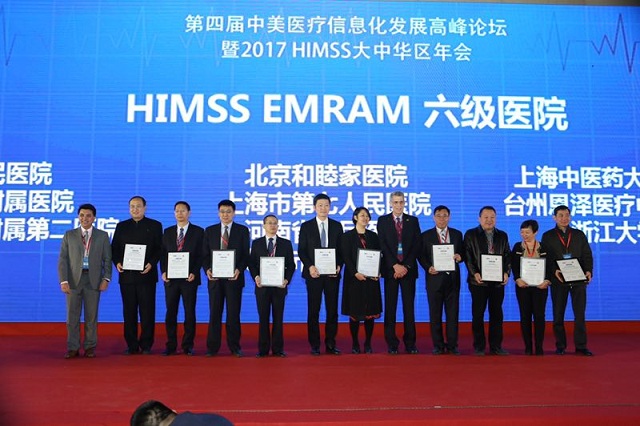
As of now, which hospitals have passed HIMSS EMRAM Stage 7 and Stage 6?
According to Wang Haitao, Dean of the School of Continuing Education at the Chinese Academy of Medical Sciences and Peking Union Medical College, and Executive Deputy Director of the Training Center of Peking Union Medical College, as of today, a total of four hospitals in the Greater China region achieved HIMSS EMRAM Stage 7 in 2017, one hospital was re-accredited at Stage 7, 19 hospitals achieved Stage 6, and two hospitals achieved Outpatient Stage 6.
Hospitals that have achieved HIMSS EMRAM Stage 7 include:
Shengjing Hospital of China Medical University, Sir Run Run Shaw Hospital of Zhejiang University, Xuanwu Hospital of Capital Medical University, the First Affiliated Hospital of Xiamen University, and Ningbo Yinzhou Second Hospital.
Hospitals that have achieved HIMSS EMRAM Stage 6 include:
Shanghai Sixth People's Hospital, Xiamen Fifth Hospital, Jiande First People's Hospital, Kunming Children's Hospital, Henan Children's Hospital, Tianmen First People's Hospital of Hubei Province, Wuxi Second People's Hospital, Huai'an First People's Hospital, Shanghai Tongren Hospital, Hebei General Hospital, Beijing United Family Hospital, Yueyang Hospital of Integrated Traditional Chinese and Western Medicine Affiliated to Shanghai University of Traditional Chinese Medicine, Affiliated Hospital of Binzhou Medical University, Shanghai Seventh People's Hospital, Taizhou Enze Medical Center (Group) Zhejiang Provincial Taizhou Hospital, The Second Affiliated Hospital of Zhejiang University School of Medicine, The First Affiliated Hospital of Zhejiang University School of Medicine, Baotou Central Hospital.
Hospitals that have achieved Level 6 outpatient services include:
The Second Hospital of Yinzhou District, Ningbo City; The First Affiliated Hospital of Xiamen University,
According to Liu Jilan, Vice President of HIMSS and Executive President for Greater China, achieving Level 6 in outpatient services signifies not only the adoption of electronic medical records (EMR) by hospitals but also the deployment of patient-facing applications that enable the sharing of diagnostic and treatment information. This facilitates communication regarding care plans and encourages patient participation in the healthcare process. This development is closely aligned with China’s promotion of tiered diagnosis and treatment systems and the regional integration of healthcare resources. Furthermore, outpatient service ratings play a significant role in enhancing patient experience.
HIMSS EMRAM Rating: Enhancing Hospital Management Standards
Chief Information Officers (CIOs) of hospitals that have passed the HIMSS EMRAM Stage 6 assessment unanimously agree that HIMSS Stage 6 plays a leading role for hospitals.
Liu Xinping, CIO and Director of Hebei General Hospital, stated, “As a management tool, HIMSS has played a significant role in reengineering hospital-wide processes and controlling quality and safety. A major milestone we have progressively achieved in our implementation efforts is ensuring that informatization covers every corner and every point of the hospital, and that medical and nursing staff accept and fully understand the information systems.”
“HIMSS has broadened our horizons, enabling us to gain a higher vantage point and see further. It has shown us how things are done globally, giving us clear goals and direction for moving forward,” said Shao Bin, Director of Medical Information System Management at United Family Healthcare Group.
Sun Xiaodong, Director of the Information Management Department at China Resources Health Group, stated, “From the perspective of hospital management, HIMSS is an excellent tool, as its framework provides support at the strategic level.”
Zheng Tao, CIO of Shanghai Tongren Hospital, stated, “The challenge HIMSS posed to us was achieving closed-loop management. The most difficult aspect during implementation was the closed-loop management of medications and critical values for various laboratory tests. However, by integrating various closed-loop management processes, we have significantly enhanced our hospital’s information systems and quality management.” Chen Ming, CIO of Shanghai Seventh People’s Hospital, remarked, “HIMSS has helped standardize clinical practices and substantially improved hospital efficiency.”
Ding Yan, CIO of Henan Provincial People’s Hospital, stated, “Through HIMSS certification, information center staff must proactively engage with clinical departments to understand their needs and provide feedback, thereby truly serving clinical practice and patients.”
Chen Lingping, CIO of Zhejiang Taizhou Hospital under the Taizhou Enze Medical Center (Group), stated, “Why pursue HIMSS accreditation? Because during our hospital leadership’s review of major information technology assessment systems, we found that HIMSS is an international standard. We leverage the evaluation process to drive development and improvement, integrating assessment with construction to enhance informatization, thereby ensuring medication safety, medical safety, and patient safety.”
HIMSS EMRAM Rating Requires Collaborative Efforts Across All Hospital Departments
Xie Jun, CIO of Xiamen Fifth Hospital, stated, “The most significant takeaway from the hospital’s HIMSS rating process is that medical staff no longer view informatization as solely the responsibility of the IT department; instead, clinical personnel have actively engaged in the process and proactively put forward their requirements.”
Zheng Xichuan, CIO of Shanghai Sixth People’s Hospital, stated, “HIMSS is a systematic engineering endeavor that requires careful planning. We mobilized the entire hospital, establishing a leadership group and specialized task forces. The leadership group conducts monthly oversight, while the specialized task forces—comprising four functional departments: Pharmacy, Blood Transfusion, Nursing, and Medical Affairs—are responsible for implementation. By adopting a problem-oriented approach and strengthening network infrastructure, the hospital’s informatization has entered a virtuous cycle.”
Wei Hongyun, CIO of Yueyang Hospital of Integrated Traditional Chinese and Western Medicine Affiliated to Shanghai University of Traditional Chinese Medicine, stated, “The HIMSS rating process requires support and coordination from hospital leadership, as well as communication and collaboration among the three major departments—the Medical Affairs Department, the Nursing Department, and the Pharmacy Department—to achieve data flow and data sharing, thereby ensuring medical quality and safety.”
Zhou Min, CIO of The First Affiliated Hospital, Zhejiang University School of Medicine, stated, “During the HIMSS evaluation process, the IT department is required to communicate extensively with clinical staff and involve physicians and nurses at an early stage, leveraging information technology to streamline clinical workflows. Meanwhile, the Clinical Decision Support System (CDSS) is tightly integrated with healthcare workflows, providing real-time decision support at the point of care, thereby reducing errors and medical mistakes in clinical decision-making.”
HIMSS EMRAM Rating Requires the Participation of Professional Health IT Companies
Zhu Mingyu, CIO of Henan Children’s Hospital: HIMSS certification can be managed as a project, with continuous supervision and improvement. Project management is conducted through grid-based oversight, monthly summaries and planning, and milestone tracking. Meanwhile, young staff members with an interest in computing are identified in each clinical department to form a team of IT liaisons. Monthly reports are submitted, during which difficult issues are discussed and resolved, goals are unified and refined, implementation is carried out on the ground, and feedback and decision-making are provided in a timely manner.
Xu Xuanwei, CIO of the Second Hospital of Yinzhou District in Ningbo, stated: “HIMSS is a philosophy. Without the support and coordination of leadership, communication and collaboration among relevant departments such as the Pharmacy Department, Medical Affairs Department, and Nursing Department, and strong support from health IT software vendors, this would be a very difficult undertaking to accomplish.”"Hospital paperless transformation is a lengthy process. Initially, it may be perceived as cumbersome by staff; however, through continuous improvement during implementation, it ultimately enhances the work efficiency of healthcare professionals and truly achieves data interconnectivity, interoperability, and sharing."
Liu Xinghuai, CIO of Huai'an First People's Hospital, stated, “In addition to strong commitment from hospital leadership, HIMSS accreditation requires selecting a capable health IT software vendor to facilitate more rapid problem resolution.”
Zhao Jing, CIO of Baotou Central Hospital, stated, “The process of informatization construction is initially difficult, then rewarding, and finally easy. ‘Initially difficult’ refers to overcoming psychological apprehension, facilitating workplace communication, and configuring hardware and software. ‘Then rewarding’ signifies engaging in dialogue with clinical departments to continuously refine information systems, thereby providing healthcare professionals with more convenient tools. ‘Finally easy’ means that any challenges encountered can be resolved through collaborative discussions between IT and clinical teams; as long as the work is approached diligently, all issues can be overcome.”
HIMSS EMRAM Rating: Not the End, but a New Beginning
As CIOs of HIMSS EMRAM Stage 6 hospitals unanimously agree, the HIMSS EMRAM rating not only brings clinical convenience and data sharing to healthcare professionals but, more importantly, enhances safety in healthcare quality. The HIMSS EMRAM rating is not an endpoint but a new starting point; the journey of hospital informatization construction is always ongoing.
