

BabyCenter Files IPO Prospectus: Pioneering Precision Advertising in Maternal & Child E-commerce
Whether for first-time mothers or families welcoming a new life for the first time, the entire journey of pregnancy and child-rearing is filled with questions, ranging from minor decisions like choosing diapers to major concerns such as fetal development and child upbringing.
VCBeat (WeChat: vcbeat) will introduce BabyCenter, the largest pregnancy and parenting resource platform in the United States. It is dedicated to providing comprehensive professional information to parents worldwide, covering topics such as preconception care, prenatal precautions, fetal development, child rearing, early childhood education, and children’s health.
BabyCenter was founded in 1997 by Matt Glickman and his Stanford Graduate School of Business classmate Mark Selcow. It is dedicated to providing users with trustworthy parenting information, along with advice and support tailored to each stage of a child’s development. Its services include a website, mobile app, online community, email series, social initiatives, print publications, and public health programs.
In the United States, 80% of expectant and new mothers visit the BabyCenter website each month. In May 2016, BabyCenter won the People’s Voice Award in the Family & Parenting category for the 13th time, the highest honor on the internet.
BabyCenter’s success lies not only in its ability to seize the opportunities presented by the growth of the internet, but also in its consistent commitment to segmenting its audience market, focusing on delivering authoritative and valuable information, gaining deep insights into its users, and thereby formulating smart marketing strategies.
Johnson & Johnson acquired BabyCenter from eToys in 2001 for $10 million. Rather than leveraging the platform to promote its own products or brands, Johnson & Johnson granted BabyCenter a high degree of independence. The company appears on the website merely as one advertiser among many, and users must carefully read BabyCenter’s corporate overview to discover that it is, in fact, a subsidiary of Johnson & Johnson.
This separation enables BabyCenter to generate revenue from advertisers, while its independence also empowers the platform to collect extensive data on new mothers, thereby facilitating the development of its marketing strategies.
Jamie Gutfreund, Chief Marketing Officer of Deep Focus, stated, “Mothers are a very special group. They have a strong desire to understand the products they purchase and maintain close connections with other mothers who are at the same stage of pregnancy. What they seek is collaboration, especially when it comes to parenting.”
BabyCenter is not shy about leveraging mothers’ data to attract advertisers. When women register on BabyCenter, they provide their email addresses and expected due dates. BabyCenter refers to this juncture as the “magic moment of information.”
From this point on, BabyCenter can provide them with a personalized experience. One way to do this is by allowing them to selectively join BabyCenter’s online birth clubs based on their due dates.
These clubs are goldmines of information. BabyCenter scrapes the comments posted by mothers in these clubs and identifies the frequency of keywords within them.
BabyCenter accomplishes this task through its proprietary tool called “The Talk Tracker.”These data can help marketers identify the optimal timing to engage customers during specific stages of the pregnancy cycle.
For example, by analyzing the context in which the term “diapers” appeared on its message boards, BabyCenter found that women discussed this topic most frequently during the postpartum period. Advertisers, such as diaper manufacturers, can leverage this insight to time their ad campaigns accordingly.
Julie Michaelson, Global Head of Sales at BabyCenter, stated that while advertisers can leverage its data, the website’s core mission remains safeguarding user identity. BabyCenter also sells native ads created in collaboration with its editorial team.
She said, “There is a very clear distinction between what we do for advertisers and what we do for consumers. It has taken us 17 years to earn the trust of mothers, and we will not break that trust under any circumstances.”
Stonyfield, a leading U.S. organic yogurt brand, once leveraged BabyCenter to determine when new mothers begin discussing the introduction of yogurt into their babies’ diets, thereby launching its infant yogurt product line. They found that this milestone occurs when infants are five months old.
Stonyfield aims to inform mothers that while it is too early to introduce whole milk powder at six months of age, feeding yogurt is perfectly acceptable. Marketers leveraged this insight to design a large-scale campaign, implementing their marketing strategy across various sections of the BabyCenter platform.
Julia Khodabandeh, Brand Manager at Stonyfield, stated, “For any new baby product, the window of opportunity to reach mothers and have them discover your product is extremely brief. As a marketer, I greatly value our partnership with BabyCenter, which allows us to tap into their community and gain insights into mothers’ misconceptions about yogurt. Their precise targeting enables us to effectively convey these messages to mothers.”
Facebook has become an important channel for engaging with parents on an emotional level,However, it cannot identify women at a specific stage of pregnancy, as BabyCenter does.
However, to stay connected with mothers in the new era, BabyCenter cannot afford to rest on its laurels; the website leverages its extensive surveys to gain comprehensive insights into its audience.
A survey on the “State of Modern Motherhood,” conducted by BabyCenter and the Internet Architecture Board, found that mothers in the mobile internet era are versatile; they prefer using smartphones over desktop computers and place great value on advice from other mothers at the same stage of parenthood.
BabyCenter adapted to mobile devices early on, with its designers specializing in the site’s mobile view rather than the desktop version, as most users accessed the platform via smartphones. After recognizing that mothers wanted fathers to be more involved in child-rearing, the website began featuring more images of dads.
BabyCenter’s blog section is an effort by BabyCenter to stay current, helping the website capture audience attention in the broader virtual world.
This section’s traffic comes from mothers seeking information on fetal development, childbirth, feeding, and toilet training. At times, the blog content can even rival articles written by the website’s editors.
The blog also covers topics related to celebrity mothers, but these posts adopt a serious and supportive tone rather than a gossipy one.
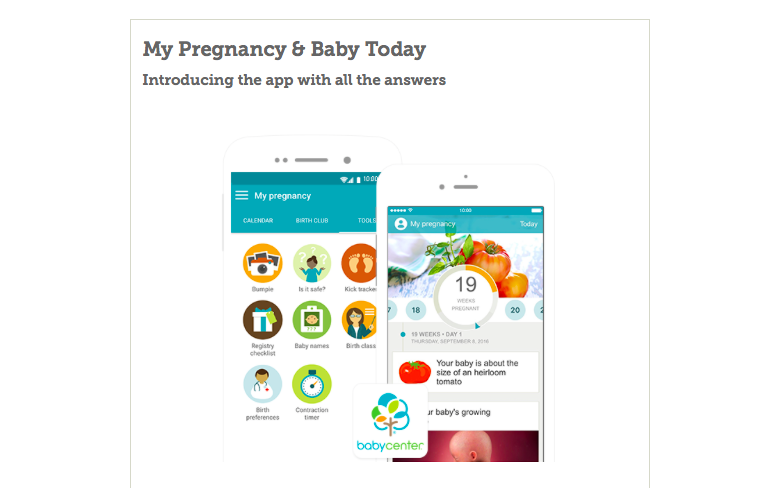
BabyCenter’s survey found that 60% of expectant mothers are interested in pregnancy-tracking apps, while 92% of mothers claim to carry mobile devices with them at all times; consequently, the company launched the pregnancy management app “My Pregnancy Today.”
Like several other BabyCenter tools, My Pregnancy Today is designed to help women track their pregnancy progress by calculating their due date. Users can access information on fetal development, nutritional tips, and recommendations for safe activities during pregnancy.
Additionally, mothers can use the app to access the BabyCenter community and connect with other expectant mothers who are at the same stage of pregnancy. Currently, BabyCenter has integrated its pregnancy tracking and baby growth recording features into a single application called Pregnancy Tracker & Baby App.
Last year, BabyCenter launched its first Amazon Alexa voice skill for expectant mothers, titled “My Pregnancy.”
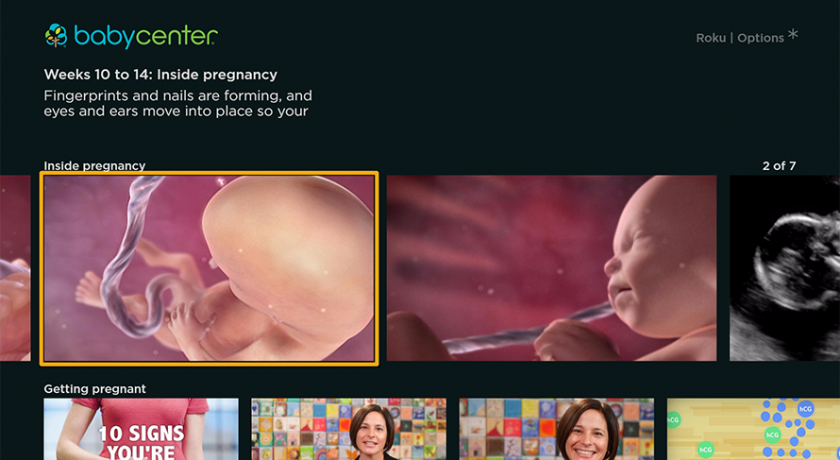
This October, as a member of the Johnson & Johnson family, the company launched its own channel on the Roku platform. Viewers using Roku devices can access more than 200 videos from BabyCenter, covering topics such as fetal development (3D animations), childbirth, and newborn care.
A BabyCenter user survey shows that 32% of mothers have canceled their cable TV subscriptions, as they prefer to watch programs according to their own needs.
The survey also reveals that mothers particularly enjoy using streaming services to relax while their children are asleep. Over the past 12 months, approximately 65% of mothers watched a full movie via internet-connected TV, with about 39% doing so on smartphones or tablets.
Meanwhile, the survey results indicate that discussions on streaming-related topics within the BabyCenter community have surpassed all previous levels, prompting the company to select Roku as the appropriate platform for reaching its target audience.
Linda Murray, Senior Vice President of BabyCenter, stated, “BabyCenter’s goal is to ensure that new and expectant parents can always easily access expert-approved information whenever they need it, regardless of their location or the device they are using. By leveraging internet TV channels such as Roku, we are able to present this content in a manner that resonates with today’s young families.”
From the authoritative content established at its inception to its bold entry into e-commerce when the sector was still in its infancy, BabyCenter has always been the savvy player of the internet age.
At the inception of its content section, the two founders established a clear positioning for the website’s information, aiming to ensure that all content was produced by professionals. Consequently, when assembling the initial editorial team, they turned to *Parenting* magazine in the United States to recruit talent.
Among those who joined BabyCenter at the time was Deb Mignucci, Deputy Publisher of Parenting, who later became Vice President of Advertising at Glickman and Selcow.
The two founders also recruited Clare Ellis, an experienced editor-in-chief, from Disney’s Family Fun magazine. In addition, they hired Andrew Neuschatz, founder of Infobahn, one of the earliest web development companies, to serve as Chief Technology Officer. Finally, they brought on Jonathon Tuttle from Parenting Inc. as Design Director, ultimately enabling the launch of the BabyCenter website.
Glickman and Selcow also assembled an advisory board of pediatricians, midwives, and consultants to ensure the accuracy of information on the BabyCenter website.
As early as 1998, BabyCenter secured $10 million in investment. The funding came from U.S.-based Bessemer Venture Partners, which had previously invested in early-stage technology, retail, and healthcare companies; Intel Corporation; and Trinity Ventures, the latter being renowned for its successful support of retail enterprises such as Starbucks and Jamba Juice.
The two founders decided to allocate the new funding specifically toward expanding their e-commerce operations. Prior to this, BabyCenter.com had reinvested profits generated from advertisers such as Procter & Gamble, Johnson & Johnson, and Kimberly-Clark into enhancing the website’s content. However, the decision to develop an e-commerce platform opened new avenues for the company’s profitability.
BabyCenter’s early days were not smooth sailing. At that time, e-commerce was far from being as prevalent as it is today. However, the two founders stuck to their vision and leveraged favorable market data to support their nascent business.
Glickman said, “This is what we truly want to do, and it makes sense for our audience. We aim to provide parents with answers to the thousands of questions on their minds, while also offering them a convenient shopping platform.”

According to Glickman, at that time, the parents of the four million babies born annually in the United States spent approximately $7,000 per year on car seats, rattles, teething rings, and other baby gear. More than 35% of parents were using the Internet, and this proportion was poised to rise rapidly as home computers continued to penetrate every household.
This is why, in 1998, Glickman and SelcowLeveraging their new funding to launch the BabyCenter online store, a brand-new e-commerce hub for parents offering a wide range of products from diapers and toys to clothing.. Everything you need to welcome your new baby can be found here.
The online store began operations in October 1998, and the website’s content production also provides detailed product guides and reviews.
As publishers rack their brains to attract new-era consumers, BabyCenter has already secured an enviable position, yet it still needs to keep pace with the times.
BabyCenter, which was founded in the late 20th century, is already a veteran in the internet space. The explosive growth of social media has changed people’s media consumption habits, while more trendy online communities such as Bump and CafeMom are proliferating, and websites like What to Expect and PopSugar Moms are growing at an even faster pace.
BabyCenter: 80% of traffic comes from smartphones, but small screens make it difficult to retain users on the site. BabyCenter began adapting to mobile devices early on and designed its interface based on the reading habits of small-screen users.
However, users who visit the website today find it hard to believe that the company once invested tremendous effort; the current site appears visually sparse and relies heavily on stock imagery.
BabyCenter has indeed established a practical platform for users seeking information on pregnancy and parenting, but given its current interface design and user experience, it is difficult for BabyCenter to retain these users in the long term.
Danielle Wiley, CEO of the marketing firm Sway Group, said, “People are no longer ceding monopoly power to platforms that provide social connectivity. You can easily find others who are at the same stage of pregnancy as you, but if you want to connect with them, you actually have many options. You can go to Facebook or Instagram.”BabyCenter remains a great place to connect with others, but users no longer need the platform to stay in touch. The company will need to make considerable efforts to win back its user base.”
The BabyCenter website appears somewhat outdated due to its heavy reliance on generic artwork and should incorporate more videos and visual elements.
Linda Murray, Global Editor and Senior Vice President of BabyCenter, stated that she has recognized that BabyCenter is no longer a newcomer in the field, and the website must keep pace with the times.
She said, “Last year, one of our community leaders told us that the first generation of babies born under the BabyCenter banner may now have children of their own. It was truly an eye-opener. We must keep pace with the times.”
References:
https://digiday.com/media/babycenter-blues-massive-millennial-publisher-growing-pains/
https://www.prnewswire.com/news-releases/babycenter-wins-the-esteemed-webby-peoples-voice-award-300272242.html
http://www.adweek.com/tv-video/digital-parenting-resource-babycenter-is-launching-its-own-roku-channel/
https://digiday.com/media/babycenter-blues-massive-millennial-publisher-growing-pains/
http://www.va-interactive.com/inbusiness/editorial/biztech/articles/babycenter.html
http://www.adweek.com/brand-marketing/babycenter-launches-app-107714/