

Pioneering Achievements of Fujian and Jiangsu as First National Pilots in Health Medical Big Data Centers
On the afternoon of December 12, the launch ceremony for the second batch of national pilot programs for Health and Medical Big Data Centers was held in Jinan. According to the deployment plan, the second batch of national pilots will be carried out in Shandong, Anhui, and Guizhou provinces. Industry insiders revealed that the previously planned “1+7+X” model—comprising one national data center, seven regional data centers, and X application development centers—has been adjusted to a “1+5+X” model.
Geographically, the first batch of pilot regional centers was located in East China, while the second batch expanded to include both East and Southwest China. These pilot regional centers have worked in tandem, like two hands joining forces, to roll out the network for healthcare big data.
On October 21, 2016, a national teleconference convened by the National Health and Family Planning Commission in Beijing designated Fujian Province, Jiangsu Province, and the cities of Fuzhou, Xiamen, Nanjing, and Changzhou as the first batch of pilot regions. From that point on, China’s health and medical big data officially entered the phase of practical implementation.
Over the past year, Fujian Province and Jiangsu Province, as “pioneers” of the National Health and Medical Big Data Centers, have leveraged their respective advantages to develop distinct models. In this article, VCBeat will examine the latest developments in these major models and analyze their differences and commonalities.
On November 26, 2016, the pilot project for the construction of the National Health and Medical Big Data Center and Industrial Park was officially unveiled at the Digital Fujian (Changle) Industrial Park. On November 27, 2016, the unveiling ceremony for the National Health and Medical Big Data Center and Industrial Park Construction Pilot Project (Fuzhou Park) was held in Changle.
This pilot project (Fuzhou Park) covers a planned land area of 1,000 mu, with 60 mu allocated for the National Health and Medical Big Data Center. The project leader stated that the initiative aims to establish one center, one industrial park, two bases, and four major application domains.
“One center” refers to the “Health and Medical Big Data Center” being built in Changle City, which includes the construction of a central server room, the establishment of a health and medical data catalog repository, and the development of a central platform; “one industrial park” involves the layout of four specialized industrial zones within the park: the Health Services Zone, Precision Medicine Zone, Biopharmaceuticals Zone, and Technology Finance Zone.
The two bases serve as the operational hub for the Healthy City Strategy and the international exchange center for health humanities. The four application domains leverage the advantages of “preventive care,” “Health Cloud,” “VR industry,” and “medical consortiums” to promote applications in “health wellness,” “precision medicine,” “smart health,” and “tiered diagnosis and treatment.”
It is reported that the project’s development goals are as follows: by the end of 2017, information resources from various healthcare sectors in Fuzhou will be consolidated into the Health Big Data Center, attracting or cultivating 50–100 health big data enterprises to settle in the industrial park, including 1–3 leading companies. By the end of 2020, the initiative will drive the development of the broader health industry chain, with the industrial park’s total output value from industry, trade, and technology reaching RMB 100 billion. By 2025, the Fuzhou Health and Medical Big Data Industrial Park will be established as the largest big data center in the Pan-Pearl River Delta region.
In January 2017, media reporters visited the construction site for an on-site investigation. According to the findings, the hexagonal building houses a “super brain” composed of rows of server units, a “large battery” capable of ensuring uninterrupted power supply, and an isolation layer designed to withstand magnitude-8 earthquakes.
On March 23, 2017, Changle City held a centralized groundbreaking ceremony to advance the construction of key projects. At the construction site of the National Health and Medical Big Data Center project, excavators and bulldozers shuttled back and forth for earthmoving, while dump trucks loaded with sand and soil moved in and out, presenting a bustling scene.
According to the head of the Changle Municipal Health and Family Planning Commission, the National Health and Medical Big Data Center project covers an initial area of 60 mu. The first phase plans to deploy 100–150 server racks and establish four data resource repositories—namely, the interface repository, integration repository, thematic repository, and sharing repository—by December this year.
This project will become a health and medical big data center based in Fujian Province and serving the entire country, achieving the aggregation and backup of health and medical data from various medical institutions and relevant government entities across the province, as well as enabling organic interconnection and coordinated scheduling among platforms. The total investment in the construction of the center’s platform is estimated at RMB 140 million. In addition, following Berry Genomics and Non-invasive ECG, Shenzhen Pingsheng Medical Research Institute has also confirmed its relocation to the center.
In April 2017, Fuzhou took the lead in China by launching “one regulation and two major platforms,” namely the Interim Measures for the Management of Health and Medical Big Data Resources in Fuzhou City, the National Health and Medical Big Data Platform (Fuzhou), and the National Health and Medical Big Data Security Service Platform (Fuzhou). This marked a significant breakthrough in the national pilot project for health and medical big data.
Fuzhou has taken the lead in launching “Two Major Platforms,” which aggregate nearly tens of billions of data records, including public health data, clinical data, genomics data, and Internet of Things (IoT) data. With security as the top priority and strict privacy protection, the platforms will provide external services in five areas: data, applications, scientific research, ecosystem, and security.
As of April 21, the “Two Major Platforms” have completed the collection of health and medical big data from 13 municipal hospitals, 24 county-level hospitals, and other medical institutions across the city.
Following Fuzhou, Xiamen also commenced the construction of its Health and Medical Big Data Center. On November 29, 2016, the Xiamen Park of the National Pilot Project for the Construction of Health and Medical Big Data Centers and Industrial Parks was unveiled in Xiamen City, Fujian Province.
By the end of February 2017, the city plans to finalize the relevant schemes and supporting policies for the pilot project in the Xiaman Park, and fully launch the construction of the Health and Medical Big Data Center and Industrial Park. By the end of 2017, the Xiamen Health and Medical Big Data Center will be established as the provincial big data center, fostering a batch of industrial demonstration projects for the development and application of health and medical big data. By the end of 2018, the Xiamen Health and Medical Big Data Center will be developed into the Southeast Health Big Data Center, with a comprehensive health and medical industry system basically established, covering the entire life cycle, featuring a rational structure and complete functions. By the end of 2020, efforts will be made to establish a National Health and Medical Big Data Center and form a replicable and scalable “Xiamen Model,” with the output value of the health industry reaching RMB 120 billion.
With the implementation of pilot projects, Xiamen City will establish a series of demonstration projects for “Internet + Healthcare” services. These initiatives include further improving the citywide appointment platform for medical consultations; enabling real-time interconnection between wearable device data and residents’ health records; promoting the use of electronic social security cards for medical insurance and mobile payments; integrating genetic testing with healthcare data to effectively enhance the level of precision medicine; and establishing branch institutes of the National Health and Medical Big Data Research Center as well as branch campuses of the National Open University in the health and medical field. Additionally, demonstration centers for clinical medical data—focusing on cardiovascular, cerebrovascular, and oncological diseases—will be developed to build a clinical decision support system.
In addition, Xiamen City will develop a batch of information security projects to drive the growth of information security services such as cyberspace security, electronic data supervision, and electronic data forensics; it will also foster new service sectors including chronic disease management, smart health and elderly care, health and medical tourism, health insurance, remote health management consulting, remote home care, and health foods.
In October 2016, the National Health and Family Planning Commission approved the pilot construction of the National Health and Medical Big Data Center and Industrial Park in the Nanjing Jiangbei New Area.
On October 21, 2016, the National Health and Medical Big Data Center and Industrial Park Construction Pilot Project (Nanjing Park) was officially unveiled.
It is understood that the National Health and Medical Big Data Center and Industrial Park Construction Pilot Project (Nanjing Campus) is located in the central area of Jiangbei New Area. It is planned to have four functional zones under the framework of “One Center, Three Application Bases,” namely the Health and Medical Big Data Storage Center, the International Health Services Community, Nanjing Bio-Medicine Valley, and the Health Technology Industrial Park, with a total planned land area of approximately 17.3 square kilometers.
The “One Center” will establish a unified, authoritative, and interoperable population health and medical information platform, while fostering new business models in “Internet-based healthcare.” The “Three Bases” are respectively positioned as: a comprehensive service application base for healthcare big data in areas such as medical care, wellness, elderly care, and training; an application base for biomedical research and development; and an application base for the research and development of advanced medical technologies. The life and health industry is one of the leading industries in the Nanjing Jiangbei New Area.
On October 28, 2017, the National Health and Medical Big Data Exhibition Center, invested in and constructed by Nanjing Yangzi Group, officially opened in the Nanjing Jiangbei New Area. Covering an area of approximately 2,300 square meters, the exhibition center is divided into three thematic sections, comprising nine zones including the Preface Hall, Health Cube, Gene Exploration, and Future Prospects. The opening of the National Health and Medical Big Data Exhibition Center marks the successful completion of Phase I of the National Health and Medical Big Data Center.
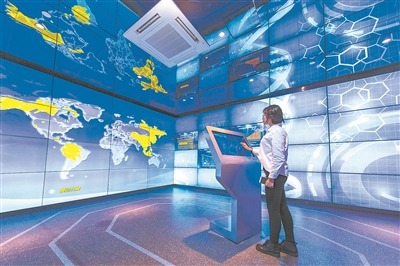
“Exploring the Secrets of Genes”
Over the past year, Nanjing Yangzi State-owned Assets Investment Group, as the specific implementing entity for the pilot project, has focused on accelerating the construction of the pilot engineering around the “One Center, Three Bases” framework. The total investment reached RMB 6 billion, with significant progress made in the development of the Health and Medical Big Data Storage Center, Application Center, and Exhibition Center.
The first phase of the Storage Center was fully completed by the end of September 2017, with a storage capacity of 52 PB and supercomputing equipment configured at 2,340 TFLOPS. In the near future, health and medical big data—including personal health records and electronic medical records for Jiangsu Province’s 80 million residents, as well as imaging data from all 174 tertiary hospitals across the province—will be centrally stored in this center.
Furthermore, the Application Center is distinguished by its focus on gene sequencing. It has procured 50 gene testing instruments, including some of the world’s first NovaSeq 6000 and PacBio Sequel systems. The center has attracted leading gene sequencing companies such as Novogene, Yunjiankang Gene, and Geneseeq to establish operations there, while also recruiting a cohort of high-caliber talent from both domestic and international markets. Currently, it stands as the largest gene sequencing base in Asia, with an annual sequencing capacity of 400,000 to 500,000 samples.
According to Cai Long, Chairman of Yangzi Group, the center will collaborate with Southeast University and Nanjing Medical University to launch the “China Million-Person Whole Genome Sequencing Initiative,” establishing the largest DNA sequencing platform in China, a big data analytics center for omics, and a genetic information database specific to the Chinese population, thereby providing data support for the prevention, environmental intervention, early diagnosis, and treatment of major diseases.
On December 8, 2017, the National Symposium on the Application and Development of Health and Medical Big Data, co-hosted by the Jiangsu Provincial Health and Family Planning Commission and the Changzhou Municipal People’s Government, was held in Changzhou, Jiangsu Province. The Changzhou Center for National Health and Medical Big Data was officially launched. The Changzhou Municipal Government and relevant units and departments signed the first batch of agreements covering seven major categories with a number of well-known domestic institutions engaged in the research, development, and operation of health and medical big data.
On December 9, 2017, the National Health and Medical Big Data (Changzhou) Center was officially launched.
Currently, Changzhou has preliminarily established a health and medical big data framework characterized by “One Center, Multiple Parks.” The “One Center” refers to the National Health and Medical Big Data (Changzhou) Center. The “Multiple Parks” include Jiangsu Zhongguancun Science and Technology Industrial Park, Maoshan Health and Elderly Care Industrial Park, Changzhou Xitaihu International Medical Industrial Park, Changzhou Life and Health Industrial Park, and the Changzhou Health and Elderly Care Service Cluster, among others.
Changzhou has established a city-county integrated population health information platform, achieving interconnectivity and data sharing/exchange among all public medical institutions, and forming relatively comprehensive databases for the total population, electronic medical records (EMRs), and electronic personal health records (EHRs). In 2016, Changzhou ranked first in the provincial graded evaluation of regional health information platforms.
After organizing the four models across four regions, VCBeat has produced the following chart:
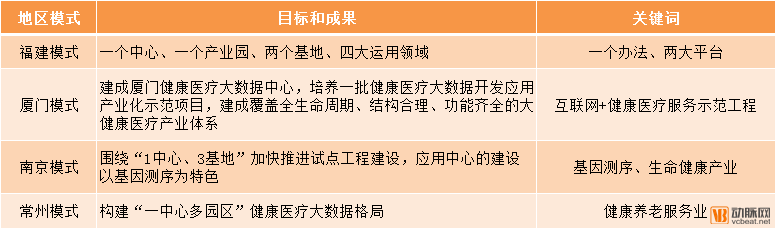
As shown in the figure, the development model of “one central hub with multiple industrial parks or bases” has become a consensus across various regions, and corresponding management regulations have been issued.
VCBeat believes that the advantages of this top-level architectural model lie in: driving and extending the industrial chain through a central hub, guiding upstream and downstream industrial chain aggregation through government leadership and market coordination, achieving intensive resource utilization, fostering competitive industries and well-known brands, and building specialized industrial parks, thereby realizing a win-win situation for the government, industrial parks, and enterprises.
From the perspective of their respective focuses, the Fuzhou Model demonstrates strong momentum in the construction of the national health and medical big data platform. With an investment of 140 million yuan, it has currently achieved the collection of health and medical big data from dozens of municipal hospitals, county-level hospitals, and other medical institutions across the city.
Although journalists have not identified the most recent achievements of the Xiamen Model, its development goals indicate that the “Internet + Healthcare” Service Demonstration Project is a key focus of its construction. These demonstration projects are closely linked to livelihood initiatives, such as residents’ health and medical insurance payments. As a result, residents can experience the convenience brought by the development of healthcare big data within a relatively short period.
As the life and health industry is one of the pillar industries in Nanjing Jiangbei New Area, the current focus of the “Nanjing Model” has been placed on the gene sequencing sector. The Application Center has not only procured a batch of advanced gene detection equipment but also attracted leading domestic gene sequencing companies and high-end talent from both China and abroad to establish their presence. It has now become the largest gene sequencing base in Asia.
As the Changzhou model has only recently launched its pilot construction, there are no significant results at this stage. However, given its “multi-park” architecture, the elderly care service sector accounts for a substantial proportion. Therefore, VCBeat believes that the integrated medical and elderly care industry is likely to become the focal point of the Changzhou Health and Medical Big Data Center’s development.
Regarding the overall outcomes of regional models, Jin Xiaotao, Deputy Director of the National Health and Family Planning Commission, mentioned in June this year four areas of progress currently achieved in national health and medical big data:
1. The top-level design for the construction of regional centers in pilot provinces has been implemented, and the practical progress in these provinces has injected new momentum into the new healthcare reform;
2. Applying big data to improve the quality of health and medical management services can effectively enhance the public’s sense of gain;
3. Pilot provinces actively carry out innovation and entrepreneurship initiatives, strengthening the development of health and medical technology and culture industrial parks;
4. The pilot provinces took the lead in China by promulgating a batch of policies, regulations, and institutional frameworks, actively demonstrating their implementation and providing practical experience for safeguarding the security of national strategic basic resources and strengthening privacy protection.
The establishment of national pilot health and medical big data centers requires not only promotion and guidance by local governments, but also the assumption of construction responsibilities by enterprises. In response, the National Health and Family Planning Commission took the lead in establishing three enterprises known within the industry as the “National Team.”
With the announcement in June 2017 by China Health and Medical Big Data Co., Ltd. regarding its establishment, together with the previously planned China Health and Medical Big Data Industry Development Group Co., Ltd. and China Health and Medical Big Data Technology Development Group Co., Ltd., China has initially formed a landscape in the health and medical big data sector dominated by three major “national team” groups.
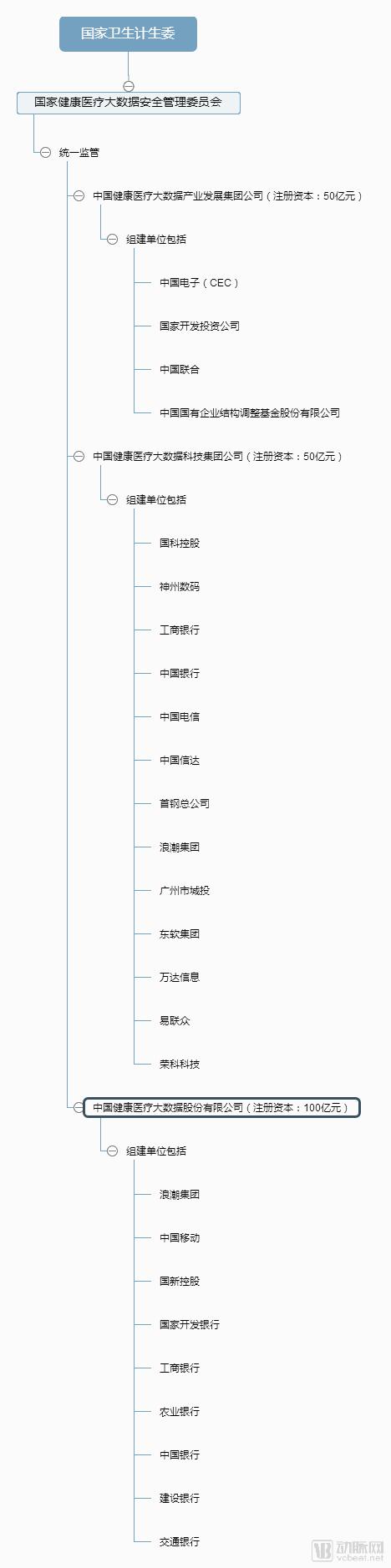
Organizational Structure of the Three Major Group Companies
From the perspective of development objectives, the responsibilities of the three major group companies mainly include the following four aspects:
1. Undertake the construction of the National Health and Medical Big Data Center, regional centers, and application development centers, as well as the economic development and operational management of health and medical technology and culture industrial parks;
2. Promote the decentralization of high-quality medical resources to grassroots populations through the application of big data in health and healthcare, striving to enhance people’s sense of gain;
3. Leverage big data in health and medical care to support the coordinated development of medical treatment, health insurance, and pharmaceutical supply; tiered diagnosis and treatment; cross-regional settlement; and telemedicine services, thereby injecting new momentum into the deepening of healthcare reform;
4. By advancing the application of big data in healthcare, innovate new forms of health services, develop health technology products, promote the development of a comprehensive health industry chain covering the primary, secondary, and tertiary sectors, and foster the digital economy to inject new momentum into the national economy.
As can be seen, while the three major groups share a consistent overall objective in their construction mandates, each exhibits distinct regional characteristics and development features, thereby forming cluster advantages. Furthermore, these three groups are not closed systems; they are open to incorporating diverse forces into the national key project construction, health industry, and digital economy development teams, achieving co-construction, sharing, and mutual benefit. Therefore, the so-called “national team” does not refer exclusively to state-owned enterprises in an absolute sense, but rather to comprehensive corporate groups that integrate both private and state capital.
VCBeat predicts that, with the national pilot program for health and medical big data centers entering its second phase, the establishment of three major groups, and the readiness of various supporting conditions, 2018 is expected to be a year of concentrated breakthroughs in China’s health and medical big data achievements.