

WeDoctor Unveils Integrated Smart Family Doctor Contracting Service Solution at China Family Health Conference
December 16–17, the Second China Family Health Conference was held in Beijing. Leaders such as Jin Xiaotao, Deputy Director of the National Health and Family Planning Commission; Mao Qunan, Director of the Bureau of Disease Control and Prevention; and Feng Wen, Director of the Population Culture Development Center, attended the conference alongside experts including Fan Daiming, Academician of the Chinese Academy of Engineering, and Sun Guangrong, a National Medical Master. Nearly 2,000 attendees, including administrators from medical and health departments across China, hospital directors, and primary healthcare supervisors, participated in the event.
At the conference, Liao Jieyuan, founder of WeDoctor and Vice Chair of the Family Health Professional Committee under the Chinese Society for Health Informatics and Medical Big Data, unveiled WeDoctor’s big data-driven “Cloud, Intelligence, and Endpoint” health strategy. The company’s “Integrated Smart Solution for Family Doctor Contract Services” was also showcased at the event. As the official application of the National Family Health Service Platform, this solution provides convenient, proactive, and comprehensive family medical services to hundreds of millions of families and users.
In May this year, the National Health and Family Planning Commission and the State Council’s Office of Healthcare Reform issued the “Notice on Effectively Implementing Family Doctor Contract Services in 2017,” explicitly setting targets for family doctor contract service coverage to reach ≥30% overall and ≥60% among priority populations. The “China Family Health Big Data Report 2017,” released at the conference, indicated that managing health at the household level has become a widespread consensus across the population, with families emerging as a key setting for national health services.
Currently, family doctor contract services across various regions still face challenges such as “difficulty in delivering post-contract services and difficulty in dynamic supervision of service delivery.” Unveiled at the conference, WeDoctor’s “Six-in-One” Intelligent Integrated Solution for Family Doctor Contract Services addresses these issues by enabling health authorities to achieve real-time, dynamic oversight of family doctor contracting within their jurisdictions. The solution encompasses six key dimensions: planning, platform, operations, hardware, resource integration, and model development. It has already been implemented in multiple cities, including Tongxiang (Zhejiang Province), Jinan (Shandong Province), Hohhot (Inner Mongolia Autonomous Region), Chengdu (Sichuan Province), and Ganzhou (Jiangxi Province). Through the Family Doctor Contract Service Platform, more than 300 family doctor teams are providing contracted services to millions of residents within their respective catchment areas.
This innovative family doctor contracting service solution is supported by WeDoctor’s “Cloud, Intelligence, and Endpoint” ecosystem. Currently, the WeDoctor platform connects a healthcare service network comprising more than 2,400 key hospitals across China, over 100 internet-based medical consortia and WeDoctor General Practice Centers, as well as 18,000 primary care institutions and pharmacies, along with more than 260,000 specialist physicians. By leveraging cloud-based platform resources, family doctors and specialists can share resources and data and coordinate their workflows, thereby providing residents with integrated “general practice plus specialty care” services.
Building on its cloud-based infrastructure, WeDoctor has partnered with institutions such as Zhejiang University to launch two major medical AI products: Ruiyi Intelligent Doctor and Huatuo Intelligent Doctor. These intelligent doctors serve not only as “assistants” to specialists but also as “coaches” for primary care physicians and family doctors. Ruiyi Intelligent Doctor has achieved significant breakthroughs in the research and development of AI applications across more than ten areas, including diabetic retinopathy, pulmonary nodules, general practice, bone age assessment, and cervical cancer screening. Huatuo Intelligent Doctor has been integrated into over 300 traditional Chinese medicine (TCM) clinics across 11 cities nationwide, cumulatively assisting in the issuance of more than 1.7 million TCM prescriptions.
Smart health terminals serve as the scenario-based entry point for WeDoctor’s family doctor subscription services. Leveraging the WeDoctor Cloud Platform, family doctors can establish cloud-based health records and electronic medical records (EMRs) for users, enabling real-time synchronization of user health data. Through these health terminals, users can instantly connect with their dedicated family doctors anytime and anywhere with a single click, gaining access to comprehensive, synchronized services including online consultations, online medication purchases, and online medical insurance processing.
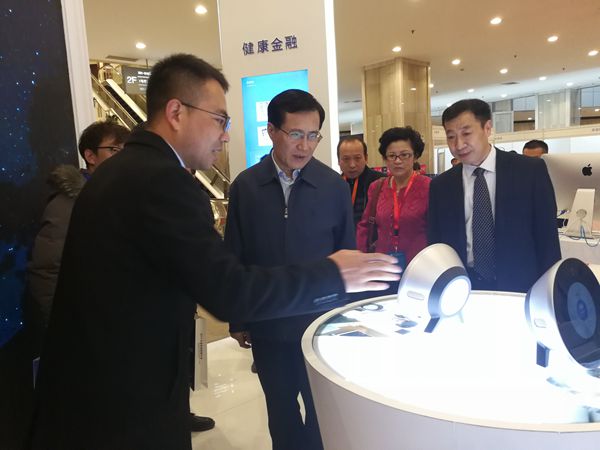
At the China Family Health Conference, the WeDoctor Smart Health Terminal attracted numerous attendees to experience it upon its debut. During his visit to the WeDoctor booth, Jin Xiaotao, Deputy Director of the National Health and Family Planning Commission, learned that the health terminal offers convenient features such as one-click doctor consultations and one-click appointment registration, and that more than 600,000 units were sold within just one month. Jin Xiaotao stated that the growing societal demand for medical and healthcare services demonstrates the strong popularity of internet-based products among the public.
WeDoctor’s family doctor subscription service platform is efficiently empowering primary healthcare institutions and grassroots physicians in China. At the press conference, WeDoctor founder Liao Jieyuan stated that while meeting the nationwide demands for advancing tiered diagnosis and treatment, coordinated reform of medical services, health insurance, and pharmaceutical supply (the “Three-Medical Linkage”), poverty alleviation through healthcare, and integrated medical and elderly care, WeDoctor will also leverage big data, artificial intelligence, and other technologies. By building upon universal electronic health records and electronic medical records, the company aims to provide users with smarter family doctor services, helping the public transition from “passive medical care” to “proactive health management.”