

Medical Device Industry Enters an Era of Consolidation: Policy Alignment and Market Pain Points Addressed at the 2017 Future Healthcare 100 Forum
“2017 Top 100 Future Healthcare” Forum, themed “The Era of Species Explosion,” was held at the Beijing Marriott Hotel from December 15 to 17, 2017.
At the Medical Device Sub-forum held on the afternoon of December 15, the following experts and executives attended: Jiang Haihong, Director of the Medical Device Regulatory Program at Shanghai University of Medicine & Health Sciences; Feng Lei, Partner at Huagai Capital’s Healthcare Fund; Huan Dandan, Vice President and Board Secretary at Anhan Medical; Zhong Daidi, Professor at Chongqing University and Chairman of the International Standards Committee for Personal Health Devices; Antonio Curci, CEO of the Scientific Laboratory at Otohub, a renowned Italian hearing technology company; Ji Heyong, Vice President of Greater China at Impulse Dynamics, a German medical device company; Ding Haibo, CEO of Beden Medical; and Song Longtao, Managing Director at Fortune Venture Capital.
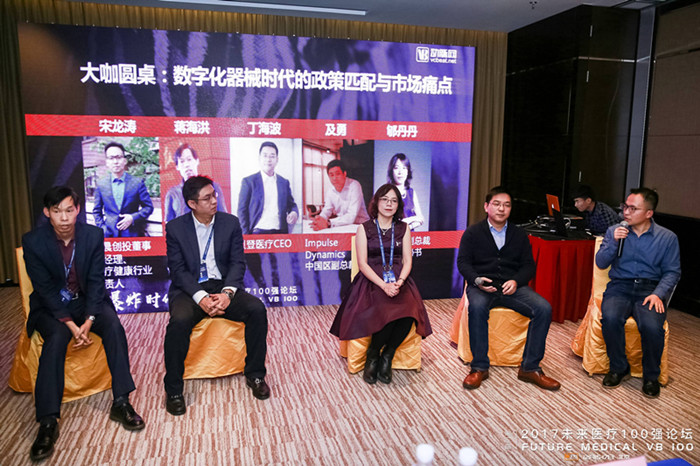
Guests delivered insightful presentations and engaged in a spirited roundtable discussion on key issues such as policy trends, channel transformation, and market pain points in the medical device sector. VCBeat (WeChat ID: vcbeat) has compiled the speakers’ viewpoints.
Jiang Haihong: Key Points and Opportunities of the Third Revision of the Regulations on the Supervision and Administration of Medical Devices

Jiang Haihong, Director of the Medical Device Regulation Program at Shanghai University of Medicine and Health Sciences
The first regulation promulgated in 2000 established the legal foundation for the medical device industry; the first revision in 2014 brought about a qualitative leap in medical device regulation; two further revisions were made in May and October 2017.
Key Points of the Third Revision:
Article 9 (Added): Medical device registrants or filers that market products under their own name shall possess corresponding capabilities in quality management, risk prevention and control, continuous research, and liability compensation; ensure the authenticity, completeness, and traceability of submitted research data and clinical trial data; and bear legal liability for the full life cycle of the medical devices.
Article 10 (New): Where the registrant or filer of a medical device is located outside China, it shall establish a representative office within China or designate a corporate legal person within China that possesses corresponding capabilities in quality management, risk prevention and control, and liability compensation to act as its agent.
Article 11 (New): Medical device registrants or filers may manufacture or sell medical devices on their own, or they may entrust the manufacturing or sale of medical devices to medical device manufacturers or distributors that comply with the provisions of these Regulations and meet the corresponding conditions. Where a medical device registrant entrusts another party with manufacturing or sales, it shall enter into a contract with the entrusted medical device manufacturer or distributor to specify the rights, obligations, and liabilities of both parties, and ensure that the manufacturing and distribution activities of the entrusted enterprise comply with the requirements set forth in these Regulations.
Opportunities Brought by the Third Revision of the “Regulations on the Supervision and Administration of Medical Devices”:
● Pre-market approval timelines expected to shorten
● Abolishing registration testing spurs the growth of the third-party testing market
● Enhanced efficiency in clinical trial reviews and accelerated market launch of urgently needed products
● Strengthening requirements for overseas corporate agents, driving demand for intermediary services
● High-quality overseas products are accelerating their entry into the domestic market
Feng Lei: The Spring of Localization for High-End Medical Devices in China Has Arrived

Feng Lei, Partner at Huagai Capital Medical Fund
I. Current Status of the Medical Device Industry
The global medical device market exhibits steady growth, a high degree of concentration, and prominent leading sub-sectors;
China’s medical device market is growing rapidly, per capita consumption remains low, and there is significant potential for development;
The Chinese medical device industry is characterized by low market concentration, insufficient R&D investment, and severe product homogenization;
Domestic medical device manufacturers exhibit a significant clustering effect;
The Wave of Domestication of Chinese Medical Devices Is Unstoppable.
II. Investment and Financing in Healthcare Enterprises
Based on the financing data from 2016 and the first half of 2017, both the number of financing deals and the total amounts raised in the industry experienced significant growth. Meanwhile, mergers and acquisitions (M&A) remained active, showing a trend toward larger-scale transactions, with prominent hotspots in specific sectors, primarily in vitro diagnostics, medical imaging, orthopedics, and surgery.
Furthermore, an analysis of the financial data of listed medical device companies reveals that their average operating revenue steadily increased from 2014 to 2016, rising from RMB 803 million to RMB 1.127 billion, with a compound annual growth rate (CAGR) of 18.5%. Average profits also rose year by year, achieving a CAGR of 12.8%, while the average net profit margin remained stable at approximately 17%–20%.
III. Outlook on the Development of China's Medical Device Industry
With population aging and rising consumer spending, overall healthcare demand is growing rapidly, and the share of medical devices is expected to increase. Furthermore, guided by policy, the cost-effectiveness of domestically produced medical devices has become increasingly apparent, with the trend of import substitution becoming more pronounced each year. China’s medical device industry is exhibiting the following four major trends:
1. Mergers and acquisitions integration will become an inevitable trend for increasing industry concentration and breaking through revenue barriers.
2. Product manufacturers must transition toward a service-oriented model.
3. Transition from sales-driven to technology-driven enterprise.
4. Artificial intelligence, big data, and the Internet of Things are accelerating their penetration into medical devices.
Huan Dandan: Intelligent Capsule Gastroscopy Robots Stem from Innovation

Huan Dandan, Vice President and Board Secretary of Anhan Medical
In China, there are 680,000 new cases of gastric cancer and 580,000 deaths annually. Moreover, 90% of patients are diagnosed at an intermediate or advanced stage, with a five-year survival rate of less than 30%. Traditional gastroscopy is highly uncomfortable; consequently, individuals generally avoid undergoing the procedure if they have no apparent gastrointestinal abnormalities, while early-stage gastric cancer often presents with subtle or nonspecific symptoms. Therefore, there is a need for more comfortable diagnostic approaches.
To achieve universal healthcare coverage for the population, it is essential to address the bottleneck in medical resources. China has 26,203 gastroenterologists specializing in endoscopy, which translates to 19 such specialists per million people. However, with 140 million individuals requiring gastroscopic examinations, the existing endoscopic medical resources fall far short of meeting public demand.
To address these core pain points, Anhan Medical has developed a comfortable and easy-to-use capsule gastroscope.Unlike traditional invasive examinations, capsule gastroscopy is a low-risk medical device that is painless, non-invasive, and carries no risk of cross-infection. Patients simply swallow the capsule with water, enabling a comprehensive 360-degree visualization of the gastric lumen. The entire procedure takes approximately 15 minutes. Subsequently, the capsule proceeds into the small intestine for further examination and is ultimately excreted naturally with feces.
Anhan Medical collaborated with seven top-tier centers, including Shanghai Changhai Hospital, to conduct a large-scale, double-blind, controlled trial involving 350 subjects. The results demonstrated that capsule gastroscopy is consistent with traditional gastroscopy in diagnostic accuracy.
Furthermore,Anhan Medical has also pioneered a new model of local examination and remote diagnosis and treatment.Expand coverage through the cloud platform by integrating all diagnostic institutions and physicians. Regardless of where examinations are performed, physicians can interpret images and provide diagnoses for patients as long as internet connectivity is available.
Anhan is strategically positioning itself across the entire gastrointestinal (GI) tract value chain, aiming to create an integrated continuum from prevention to treatment. Its new product portfolio includes GI manometry and pH monitoring, minimally invasive surgical capsules, autonomous long-duration diagnostic capsules, esophageal capsules, colon capsules, and vibratory capsules.
To address the shortage of medical resources, Anhan Medical has also adopted artificial intelligence for assisted diagnosis. On April 20, 2014, Anhan partnered with IBM to leverage its advanced technologies in image cognitive analysis, jointly building an AI-assisted diagnostic system. Through the AI platform, over 30,000 images are filtered down to dozens, which are then reviewed by physicians. The resulting reports are delivered to both the examining institutions and the patients. The system now achieves an accuracy rate of over 95%.
Zhong Daidi: International Standards in the Field of Personal Connected Health

Zhong Daidi, Professor at Chongqing University and Chairman of the International Standards Committee on Personal Health Devices
Personal Connected Health: The key term in its English translation lies in “Connected.” It refers to the interconnection of hardware devices and information platforms, establishing an informational infrastructure that enables service providers—particularly those in health management—to connect individuals.
There are six major issues in personal health connectivity:Device interfaces, end-to-end data exchange, costs and computing resources, alignment between device data capabilities and clinical operational needs, qualifications of service providers, and legal liabilities and risk management across all stages.
The vast majority of these issues may need to be addressed throughInteroperability Standardsto be addressed. Currently, the FDA has issued policies related to interoperability standards, and the European Union has introduced the new Medical Device Regulation (MDR), which states that if software has the function of monitoring physiological processes, it is by default classified as Class IIa amid widespread business controversies. The China Food and Drug Administration’s new policy includes updated product classification for medical software, the Guiding Principles for Technical Review of Registration for Cybersecurity of Medical Devices, and the Guiding Principles for Technical Review of Registration for Mobile Medical Devices (Draft for Comment).
Benefits of Establishing Interoperability Standards:
● Reduce the risks associated with medical device use caused by interoperability issues, ensuring user safety
● Capable of advancing medical theory through big data analytics
● Enhancing Healthcare Service Capacity
● Promote the improvement of people's health levels
● Diversification of procurement options leads to reduced procurement costs
● Reduced registration costs for medical device products
● Will drive the development of multiple related industries
Abtonio: The Application of AI in Hearing Health Management

Antonio Curci, CEO of Otohub Srl, a renowned Italian hearing technology company
Globally, 360 million people suffer from hearing loss, with the number continuing to rise annually. Approximately 380 million individuals have not received any intervention or treatment, primarily due to a lack of hearing care services, or because such services are limited by equipment availability and cost.
Otohub is an Italian hearing technology company dedicated to entering the hearing care market through devices and cost-effective solutions, providing patients with revolutionary hearing test technologies. The diagnostic accuracy of its products can fully match or even replace the expensive equipment, valued at hundreds of thousands, currently used in major hospitals.
Currently, most hearing healthcare service models are quite similar: patients visit a hospital to consult a physician, who then uses complex, large-scale medical equipment to perform a diagnostic evaluation. Otohub delivers equivalent hearing tests and assessments remotely via mobile and smart devices. It even leverages AI to assist patients in conducting self-administered tests.
The company has currently developed three hearing assessment products—OtoPad, OtoKiosk, and OtoRemote—and one hearing aid product, OtoHearing. OtoHub essentially provides users with a comprehensive solution, or an end-to-end hearing care service. Therefore, OtoHub is not merely software or hardware in the traditional sense; it is a hearing health management platform.
Otohub has the potential to reshape the existing landscape of the hearing healthcare industry and is poised to become a future trend. Therefore, Aier Times has partnered with Otohub to establish a joint venture in China, aiming to facilitate the localization and implementation of the Otohub model in the Chinese market.
Ji Yong: Innovation in Novel Medical Devices for Chronic Heart Failure

German Medical Device Company | Impulse Dynamics Vice President for China, Ji Yong
Heart failure is an irreversible chronic disease with a very high mortality rate. Once diagnosed, patients experience a severe decline in quality of life, significant suffering, and rapid disease progression.
There are currently over 26 million heart failure patients worldwide, and the number of cases continues to rise due to the increased use of “upstream” therapies (such as stents or statins).
The international classification standard for heart failure comprises four stages. Currently, approximately 30% of patients are at Stage I, 35% at Stage II, 30% at Stage III, and 5% at Stage IV. Patients at Stage I exhibit mild symptoms that can be alleviated with medication. However, pharmacological interventions become less effective as the disease progresses to Stages II and III. By Stage IV, treatment options are severely limited, with heart transplantation being the only viable solution. The progression from Stage I to Stage IV typically occurs within three to five years, indicating a rapid deterioration of the condition.
The device currently available to improve patients' myocardial function is CRT., namely cardiac resynchronization therapy (CRT). However, it is effective in only 30% of patients, while the remaining 70% are not suitable candidates. These 30% of patients drove the device's annual output value to RMB 3.5 billion in 2015. Therefore, this market is substantial, with robust demand.For patients with stage II or III heart failure who remain symptomatic despite optimal medical therapy, cardiac resynchronization therapy (CRT) may be used. However, if the patient’s ejection fraction (EF) is less than 35%, CRT is not suitable, and cardiac contractility modulation (CCM) therapy should be selected instead.
CCM therapy, an innovative treatment for heart failure invented by Impulse Dynamics, delivers non-excitatory electrical signals to the heart to modulate cardiac contractility, similar to a pacemaker. The system primarily consists of a pulse generator, a central control unit, and a programmer. Over 60 papers on CCM therapy have been published in leading global medical journals. Clinical data from 2006 demonstrated that CCM therapy effectively improves exercise capacity and quality of life while reducing mortality.
Over the past decade, more than 800 patients have been enrolled in clinical trials by Impulse Dynamics, while an additional 2,500 patients opted for Cardiac Contractility Modulation (CCM) therapy under open-label product registration or commercial use conditions. Clinically, patients demonstrated significant improvements in exercise tolerance, quality of life, and peak oxygen consumption.
Ding Haibo: Insights from Platform Data Reveal Shifts in Medical Device Marketing Channels

Ding Haibo, CEO of Beden Medical
Medical devices represent one of the most promising markets in China over the next decade, butChina’s medical device industry chain is highly fragmented at both upstream and downstream levels, characterized by a large number of small, scattered, and disorganized players, which results in extremely low efficiency in the traditional distributor-centric distribution model.
In recent years, the entire healthcare distribution industry has undergone significant changes. Intensified market competition, the rise of primary care and private healthcare institutions, coupled with policy drivers such as the “Two-Invoice System” and transparent procurement, have placed substantial pressure on manufacturers to transform their sales channels, necessitating a comprehensive restructuring of their marketing channel systems.
Chinese medical device companies are relationship-driven, with relatively weak professional capabilities, technical support capacities, and financial strength. Consequently, it is difficult for them to drive transformation across the entire distribution channel during the procurement upgrade process at healthcare institutions. As a result, traditional distributors face immense pressure to transform and upgrade; they struggle to meet manufacturers’ requirements for channel reform as well as healthcare institutions’ new procurement demands, making widespread industry consolidation inevitable.
In recent years, emerging private medical institutions with diversified development models—such as third-party medical service providers, physician groups, specialized chain clinics, and health examination centers—have experienced rapid growth. When procuring goods and services, these new types of medical institutions have raised higher demands on suppliers across various aspects, including financial services, information technology solutions, and after-sales support. Consequently, the upgrading of medical institutions has led to elevated expectations for their suppliers.
How Should Medical Device Manufacturers Transform Their Marketing Channels in the Face of Numerous Emerging Healthcare Markets?
Beideng Medical is China’s largest B2B e-commerce platform for medical devices, establishing a new type of B2B distribution network by integrating upstream and downstream supply chains. As of October 2017, it had over 100,000 distributor members, more than 10,000 partner distributors, and over 3,000 partnered private healthcare institutions, covering more than 300 prefecture-level cities across China, with a coverage rate exceeding 90%.
Beideng has been committed to driving healthcare transformation through technology and data. Beideng is a sales platform similar to JD.com’s self-operated model, aggregating more than 300 renowned medical device manufacturers. By building a comprehensive database ecosystem—spanning product, manufacturer, distributor, and end-user databases—with nearly 500,000 entries, Beideng leverages big data on medical distribution to enable precision marketing, enhance transaction efficiency, and reduce transaction costs for the industry.
Song Longtao: Channel Transformation and Response Strategies for Medical Devices under the Two-Invoice System

Song Longtao, Managing Director of Fortune Capital
The transformation of the medical device industry is determined by three major factors: the market, policy, and natural laws. The superposition and resonance of these three factors lead to integration, transformation, and extension.
Market dynamics are a controllable factor; only by avoiding product homogenization can companies demonstrate competitive advantages during the bidding process. Currently, the “Two-Invoice System” is being leveraged to combat corruption within the healthcare system, making policy the most significant variable. Natural factors also play a role; for instance, as the previous generation of distributors exits the industry, succession issues inevitably arise.
The first trend is industry-wide consolidation. For instance, leading R&D firms and large medical enterprises are acquiring smaller companies, while some smaller firms are choosing to delist voluntarily. The second trend is transformation. Under the pressure of consolidation, many distributors and manufacturers face survival challenges, necessitating mergers and acquisitions to drive industrial transformation. The ultimate outcome of this transformation is extension; for example, manufacturing companies like Baolite are pursuing downstream vertical integration.
The ultimate manifestation of this expansion is that companies originally not engaged in distribution have begun to enter the distribution sector, while those previously not involved in manufacturing have started production activities. The final outcome is mergers and acquisitions, followed by mutual expansion, upgrading, and transformation.
What Opportunities Have Been Brought by Channel Transformation?
Policies have a dual nature: while they eliminate certain opportunities, they also give rise to new business models. The internet has exerted a significant influence not only in healthcare but across various sectors, including e-commerce. It plays a particularly crucial role in the medical device industry, especially in the B2B segment. Companies that rely solely on offline channels may find themselves with no viable future.
The second opportunity lies in emerging third-party medical logistics companies. In particular, the distribution of large-scale equipment must be handled by professional logistics firms, presenting a significant investment opportunity.
Furthermore, listed companies have many additional opportunities. China’s medical device industry has now entered a phase of “the big fish eating the small fish.” Listed companies can leverage their financial strength to integrate upstream and downstream segments. Manufacturing enterprises can merge with distribution-focused companies; after going public, distribution-focused companies can acquire R&D and manufacturing enterprises. Moreover, if they have sufficient resources, they can also engage in strategic marketing efforts targeting key hospitals—all of which are entirely feasible.