

Liang Qi, CEO of Aier Times: "In the Niche Hearing Impairment Market, an International Strategy Is a Critical Breakthrough!" | 2017 Future Healthcare 100
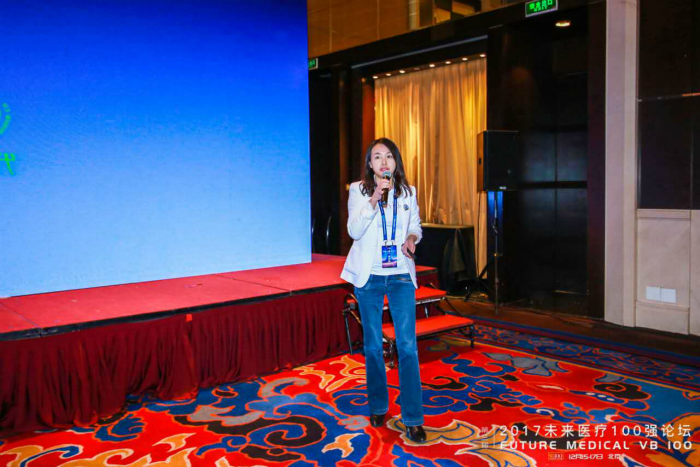
“Top 100 Future Healthcare Companies 2017” Forum, themed “The Era of Species Explosion,” was held at the Beijing Marriott Hotel from December 15 to 17, 2017.
At the Maternal and Infant Health Sub-Forum on December 16, Liang Qi, CEO of Aier Shidai Medical Technology (Beijing) Co., Ltd., delivered a speech on the theme of “Exploration of Corporate Internationalization Strategy.” VCBeat (WeChat ID: vcbeat) has summarized the guest’s viewpoints.
Guest Introduction
Dr. Qi Liang holds a Doctor of Audiology (AuD) from the United States, a Master of Science in Audiology (MSc) from Canada, and a Master of Business Administration (MBA). She is a North American certified practicing audiologist [Aud(C)]. Dr. Liang previously served at West China Hospital of Sichuan University and held executive positions at the world’s largest hearing implant company. She has nearly two decades of professional experience in the medical audiology industry.
Aier Shidai, which she founded in Beijing in 2013, is an international medical service platform dedicated to hearing health. By integrating top global resources in otology and audiology, it is committed to providing Chinese families with hearing healthcare services that meet international standards.
Speech Content
Niche Industry: Hoping for No Hearing-Impaired Children in China
When starting a business, venturing into niche markets can be a lonely journey, as there is limited experience to draw from others, requiring us to explore on our own. We aspire to be pioneers, not martyrs.
What I’d like to share with you is a more niche sector—the hearing healthcare industry, which remains poorly understood by many.
Exploring Globalization Strategies for Startups: This is a broad topic. Why are startups discussing globalization so early? Shouldn’t they first solidify their local markets before entering the Chinese market? Because we live in an era of innovation, it is not necessary to follow the paths blazed by predecessors; instead, new and distinct pathways can be forged.
In addition to founding Aier Shidai, I am also an audiologist, although this professional title does not actually exist in China.
I earned my Doctor of Audiology (AuD) degree in the United States, which qualifies me to practice independently and establish an audiology clinic. My responsibilities include conducting hearing screenings, examinations, and diagnoses for children with hearing issues or individuals with hearing needs, as well as providing appropriate interventions.
“I am often asked whether I am a physician. We do not hold medical licenses, as we work in a peripheral discipline of medicine; however, we collaborate very closely with physicians.”
Our closest collaborators are otologists, who address hearing interventions from a surgical perspective. However, approximately 90% of hearing issues cannot be resolved through surgery and instead require rehabilitation and non-surgical interventions. This constitutes the unique background of the hearing healthcare industry.
The most widely recognized form of hearing impairment is deaf-mutism. Our professional mission is to eliminate deaf-mutism in the future. We hope that in 20 years, there will be no children with hearing impairments in China.
Given current medical capabilities, combined with international standards and intervention protocols, if a child is born, screening can be performed at one month of age to identify hearing loss. By three months of age, a diagnostic evaluation can be conducted to confirm the type and severity of hearing loss—whether it is profound, severe, or mild to moderate.
If a child has profound hearing loss or lesions in the brainstem, we can provide cochlear implants or even auditory brainstem implants. Through these different interventions, we help these children escape the silent world and enable them to reintegrate into mainstream society, just like their peers.
They can forgo learning sign language, listen normally, and develop speech capabilities in a typical manner. This is the focus of our work, serving as a brief overview of the industry background.
The market is not small; identify the pain points.
Why is this industry so niche, with few people entering the field? Is it because the market is too small, or are there other reasons?
When considering the relationship between supply and demand, hearing impairment is not a niche market. In fact, there are over 100 million people in China with hearing health issues; however, the key challenge is that the general public does not perceive hearing impairment as a significant concern.
During our presentations, everyone emphasizes the importance of vision, and many people are working in ophthalmology.
Approximately 90% of household expenditures in China are allocated to children. Our primary client base consists of 3 million children, a substantial population among which many have not received adequate assistance and support. Furthermore, similar needs exist among other demographics, including the elderly and adults.
In China, 1 to 3 out of every 1,000 newborns are born with hearing impairment. Currently, there is no effective method for intervention and prevention, resulting in approximately 30,000 children with hearing impairment being born nationwide each year. These children are the focus of our services; we provide them with interventions and strive to offer the utmost assistance.
Aier Shidai is committed to undertaking such initiatives, addressing the pain points we have identified in China: niche industry, low consumer awareness, and a shortage of professionals.
Every startup ponders whether its actions are worthwhile and whether they will make society a better place; this is our original aspiration.
One-Stop Global Healthcare Service Platform
Our hearing-impaired patients often endure a great deal of hassle. For instance, they may undergo testing at a Tier 3 Grade A hospital, only to find that no audiologist is available to provide a diagnosis. After an otologist issues a referral, the patient seeks diagnostic confirmation in the outpatient clinic, but their immediate reaction is often one of rejection: “I don’t trust the diagnostic results.” They end up visiting multiple Tier 3 Grade A hospitals in Beijing, sometimes even receiving conflicting results from different institutions.
The issue arising throughout the entire medical consultation process is the absence of a one-stop service platform to help patients resolve all their problems.
We are also aware of the challenges facing Grade A tertiary hospitals. It is well known among all entrepreneurs in the healthcare industry that these hospitals are extremely overcrowded. In this context, patients’ anxiety, tension, and unease are heightened. However, due to the exceptionally heavy workload borne by physicians, they are unable to devote sufficient time to providing humanistic care.
However, for individuals with hearing impairments and their parents, any issues concerning their children can cause significant anxiety and fear. Therefore, when treating pediatric patients, providing compassionate care is a crucial component.
What is the positioning of Aier Shidai? We are a global healthcare platform dedicated to providing solutions for individuals with hearing impairment. Our team comprises experts from Europe, Australia, Singapore, and Hong Kong. Our mission is to help patients with hearing loss reintegrate into mainstream society by delivering world-class products and services. This constitutes our core ecosystem strategy.
How to Launch a Globalization Strategy?
We currently offer several core services. In partnership with Otohub, a renowned Italian hearing technology company, we have established Otohub China to deliver Otohub’s services. For children requiring cochlear implant intervention, we provide surgical centers that facilitate one-stop comprehensive care.
We are also advancing audiology education. A major obstacle to the rapid development of this industry is the shortage of professionals. There is a lack of qualified personnel entering this field, and there are significant shortages in hearing clinics, surgical centers, hearing products, and audiology education. Therefore, we are continuously and concurrently making strides in all these areas.
When did we begin exploring our globalization strategy, and what does “globalization” mean in the current context? More accurately, it refers to the integration of resources on a global scale, followed by the provision of products and services to both global and Chinese markets. This is the approach Aier Shidai Medical Technology (Beijing) Co., Ltd. adopts for its global expansion.
Not limited to the Chinese market, I believe that future companies will undoubtedly be those with a global perspective, as many advanced technologies and standards in the medical field actually originate from abroad.
In contrast, China now boasts robust resources. With consumption upgrading and substantial household wealth, coupled with abundant capital, the Chinese market is characterized by its immense potential and large population base.
These are areas where foreign markets cannot compete, but they possess valuable experience and well-established standards and systems. Aier Shidai Medical Technology (Beijing) Co., Ltd. aims to integrate resources across the global market and match them with the appropriate regions.
Our medical team has essentially achieved global coverage, with offices in Beijing, Chengdu, and Hong Kong. We also have partners in Australia. Aier Shidai Medical Technology (Beijing) Co., Ltd. adopted a model of global cooperation at an early stage.
Globalization Strategy: Key Insights from Our Development Journey—Collaboration, Sharing, and Innovation Are Paramount. The traditional model of developing products in China and then attempting to export them abroad is time-consuming and no longer viable.
"As a startup, it is difficult for us to recruit a large number of talents in the short term. Therefore, we need to take an unconventional approach by collaborating with partners and reaching a consensus with them."
Furthermore, a current hot topic is how we can achieve resource sharing, avoid waste, and create an open-sharing model.
In Australia, we established two joint ventures this year. One is Attune, the largest hearing care chain in Australia, which is owned by 22 ENT specialists and operates more than 70 hearing clinics across the country.
This year, we have reached a cooperation agreement with this company to establish a joint venture in China. Through this partnership, we aim to introduce Australia’s well-established advanced international standards to the Chinese market.
Audiology is highly developed in Australia, where much early research originated and many acoustic standards were established. We will introduce more of these standards, as well as talent, to China.
What is our greatest challenge? It remains talent acquisition. When we seek to hire top-tier professionals, convincing them to join and ensuring their retention are practical challenges we face. Meanwhile, by recruiting in China, we offer them opportunities to enhance their capabilities through our overseas projects. This approach helps us attract more high-caliber talent, which is one of the key benefits of pursuing partnerships or an internationalization strategy.
Three Major Benefits of a Global Perspective
This year, we have successfully established four major international collaborations. One of these is a strategic partnership with four companies in Austria. Through this collaboration, we will facilitate the two-way flow of patients by sending Chinese patients to Austria and bringing Austrian doctors to China. This marks the first of the four initiatives.
Why are patients being sent abroad? Because the approval process for medical products in China takes a relatively long time, approximately three years.
For children, time is the most precious resource. Parents always strive to provide their children with the best products, which is why we choose to send them abroad to access a wider range of options. Currently, a significant number of families are traveling overseas to undergo auditory implant surgery.
Regarding innovation, we are also seeking new hearing products and partners. China faces a significant shortage of hearing healthcare professionals, and it is difficult to train a large number of audiologists in the short term. In the future, we hope to leverage AI-assisted hearing technologies to facilitate hearing screening and enable remote data management.
To summarize, what are the benefits of globalization? I have three personal insights.
First, it helps enhance the corporate brand and image. For startups, especially those in the medical industry, building a company’s image and brand requires considerable time. Through international cooperation, such benefits can be achieved in the short term, both in terms of publicity and patient attraction.
Second, it facilitates synergies. We are not limited to local procurement; under China’s tax policies and regulations governing distribution channels in the healthcare industry, locally sourced products tend to be priced relatively high. By adopting a global procurement strategy, we can select products that offer both high quality and moderate pricing.
Third, it helps attract talent.
Is globalization rather challenging? From my own experience, the first step is to approach it with intentionality, which requires setting specific goals and starting from a single focal point. As we embark on this endeavor, we should already have a clear vision of the objectives we aim to achieve, strategically seeking out optimal products and technologies, as well as identifying better partners.
Certainly, we must adopt an international mindset, recognize linguistic and cultural differences, and maintain an open and trusting attitude, which is also crucial. In our initial discussions with partners, we emphasized trust rather than focusing extensively on maximizing benefits.
We must maintain an open mindset and recognize cultural differences, while acknowledging that our core values are aligned. We aspire to contribute positively to society and elevate the hearing healthcare industry to new heights; this is our shared value orientation.
Therefore, I believe the difficulty of globalization lies not in its inherent complexity, but in maintaining an open mindset and the determination to embrace the world. We aspire to connect the world through emotion and love.
Note: VCBeat has made additions and deletions without altering the original intent of the speakers.