

Siemens Healthineers Announces Major Strategic Restructuring Ahead of IPO, Strengthening Integrated Diagnosis and Therapy Leadership
VCBeat (WeChat ID: vcbeat) has learned, following the selection of the Frankfurt Stock Exchange for its IPO on November 29, Siemens Healthineers recently announced significant strategic adjustments, primarily involving changes to its business regions and organizational structure.

As the Group’s most profitable business, Siemens Healthineers must prepare for its IPO by sustaining profit growth, reducing costs, and focusing on its core operations.
Siemens Board Member Michael Sen once said: “Siemens Healthineers is poised to become a publicly listed company, and our starting point will be exceptionally high. “High” not only reflects our performance in previous fiscal years but also signifies our leading position across many industries.“This reveals the ambitions of Menzi Medical following its IPO.”
This global strategic adjustment primarily targets two aspects: business regions and business structure.
Business regions streamlined into three major areas: the Americas, Europe, and Asia-Pacific.
In terms of business regions, Siemens Healthineers’ global operations were previously divided into eight regions: Asia-Pacific, North America, Latin America, Central Europe, the Middle East, Africa, Northeast Asia, and Western Europe and West Africa. Following this strategic adjustment, these eight regions will be consolidated into three major regions:Americas, Europe, and Asia-Pacific, with the Asia-Pacific region being the most striking.
Structural changes also bring about personnel adjustments. Siemens Healthineers has previously replaced its global CFO and the CFO for China. Following this adjustment, there may be further changes in senior management. It is reported that Elisabeth Staudinger Leibrecht, former President of the Asia-Pacific region, will be responsible for the newly adjusted Asia-Pacific region.
At Siemens Healthineers’ internal meeting this October, CEO Bernd Montag emphasized, “We must maintain our ambition and drive, have the courage to step out of our comfort zone, and rethink the company’s processes and structures.” This recent major strategic adjustment by Siemens serves to validate his viewpoint.
Business segments streamlined to four: Imaging Diagnostics, Ultrasound, Advanced Therapy, and Diagnostics
In addition, Siemens Healthineers has made significant adjustments to its business structure. Previously, Siemens Healthineers’ operations were divided into six segments: Diagnostic Imaging, Laboratory Diagnostics, Clinical Therapy, Point-of-Care Diagnostics, Ultrasound, and Integrated Services.
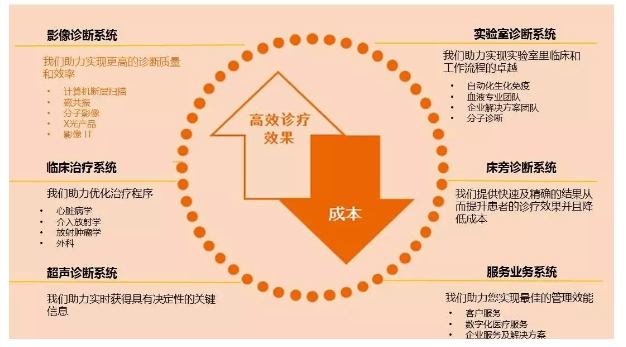
Image source: Medtrend
This major restructuring streamlines and focuses the six business units into four segments, namely:Imaging Diagnosis, Ultrasound, Advanced Therapy and Diagnosis.
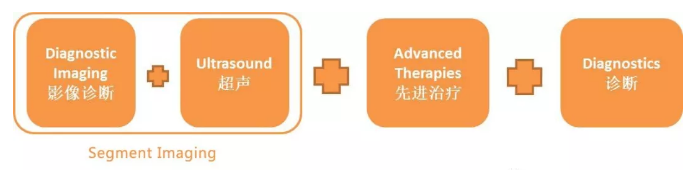
Imaging Business
Moreover, Siemens Healthineers has specifically elevated both imaging diagnostics and ultrasound diagnostics to core components of its Imaging business. While Siemens Healthineers has long maintained a leading position in imaging diagnostics, its ultrasound segment has historically experienced strategic uncertainty. This realignment reintegrates the ultrasound business as a key business unit, fostering synergy with traditional imaging operations, thereby underscoring Siemens Healthineers’ strong commitment to its Imaging portfolio.
Advanced Therapies
In recent years, medical giants have been emphasizing the development of "integrated diagnosis and therapy." Siemens Healthineers has primarily focused its clinical treatment efforts on the cardiovascular and oncology sectors; however, its current product portfolio in these areas remains limited. By highlighting advanced therapies as a distinct focus, Siemens likely signals its intention to strengthen its therapeutic division in the future, potentially leading to increased asset investment.
Diagnostic Business
Although the diagnostics business is not as large as the imaging segment, its overall industry growth rate is significantly higher. Since 2016, Siemens has been increasing its investment in the diagnostics sector, which had not seen any major mergers or acquisitions since the completion of its acquisition of Dade Behring in 2007. With this move, Siemens has reclassified point-of-care testing and other related businesses back into its diagnostics division.
Siemens Healthineers itself possesses unparalleled advantages in the fields of diagnostic imaging and in vitro diagnostics compared to other medical companies. If the diagnostic and therapeutic sectors are elevated to a position of strength comparable to that of imaging, the new business model of integrated disease prevention and treatment solutions will become increasingly clear.
Siemens Healthineers is poised to become a pioneer in integrated diagnosis and treatment, potentially breaking free from the constraints of the traditional “GPS” imaging triopoly and emerging as the next “aircraft carrier” in the healthcare industry.
Meanwhile, GE Healthcare, Siemens Healthineers’ biggest current competitor, is also undergoing strategic transformation. Immunotherapy products represent a significant new growth driver for the company. On November 14, GE announced major restructuring measures, spinning off its traditional businesses to focus on its three core strengths: healthcare, power, and aviation.For details, please refer to VCBeat’s previous reports.