

After Securing RMB 400 Million Series C Funding, Medlinker CEO Wang Shirui Unveils Commercialization Strategy for Doctor Platform | 2017 Future Healthcare 100
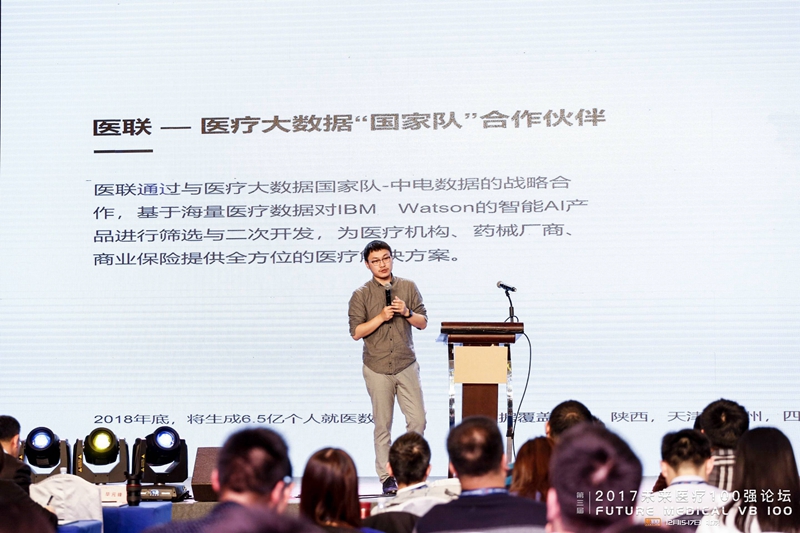
"Top 100 Future Healthcare Companies 2017" Forum, themed "The Era of Species Explosion," was held at the Beijing Marriott Hotel from December 15 to 17, 2017.
The camel’s long march, the cheetah’s energy, the wildebeest’s trail, the elephant’s turn, and the crocodile’s strike—these animals, seemingly worlds apart from the healthcare industry, are closely intertwined with the keynote speeches of this forum.
At the “Unicorn Parallel Forum,” there was a guest who drew this praise from Forbes magazine: “In China, where high-quality medical talent is scarce, you can either train more doctors or make existing physicians more efficient. Wang Shirui’s Medlinker project is moving toward the latter.”
He isFounder of Medlinker and Penguin Doctor, andCEO Wang Shirui,The presentation was titled “Exploring the Commercialization of Doctor Platforms.” VCBeat (WeChat ID: vcbeat) has compiled the guest speaker’s insights.
Guest Introduction
Wang Shirui pursued an eight-year integrated Bachelor’s, Master’s, and Doctoral program at the West China School of Stomatology, Sichuan University, from 2006 to 2014. During this period, he received numerous institutional and university-level honors and scholarships, published multiple academic papers, and contributed as a co-editor to several books and textbooks. From July 2013 to May 2014, he served as a research scholar at Harvard University before returning to China to found Medlinker.
Speech Content
Indeed, on December 6, 2017, we just secured RMB 400 million in Series C financing, with strategic investment from CE Health Fund, and participation from China Renaissance New Economy Fund, as well as existing shareholders Tencent and Sequoia Capital.
In fact, I also participated in last year’s Future Healthcare 100 Forum. At that time, my idea was to leverage physicians’ platforms to integrate the upstream and downstream segments of the healthcare industry chain.
After more than a year of exploration and development, despite encountering numerous challenges, we have gained valuable insights into viable business models.
China's Leading Real-Name Doctor Platform
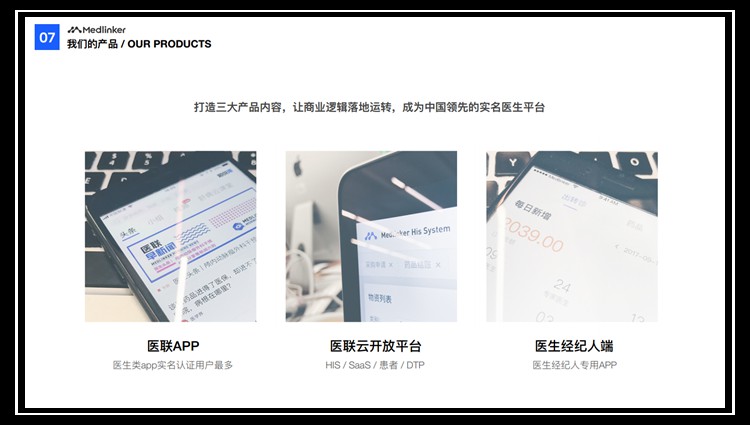
In China, the term “physician platform” is a relatively new concept. Wang Shirui has worked tirelessly to clarify the description and sharpen the positioning of the Yilian Physician Platform. For such a platform, our goal is to repackage the available time of physicians engaged in independent practice as a secondary service offering, connecting them with healthcare institutions, pharmaceutical companies, and insurance providers that require physician services. This was our strategic plan for last year.
A year has passed, and we have identified a number of high-quality physicians. We primarily serve companies on the supply side, undertaking a wide range of tasks for private hospitals, primary care institutions, pharmaceutical companies, medical consumables suppliers, and even insurance providers.
Regarding physician data, we still have 430,000 real-name verified physicians. Why has there been no growth?
During the initial phase of rapid expansion, our offline team comprised over 300 members, and we acquired 30,000 new physician users with verified real-name identities each month. Although we conducted one-on-one visits, we later observed significant churn among these physician users, a problem that was never effectively resolved.
Later, we halted the acquisition of new physician users and moved away from the traditional internet traffic-driven business model. Instead, we began treating physicians as merchants, similar to how Meituan onboarded offline merchants one by one. Likewise, physicians should not be viewed solely through a consumer-facing (C-end) lens; the key lies in understanding how to activate their potential and unlock their specific professional skills.
This shift is tantamount to completely leaving yesterday’s developments behind and focusing on cultivating a new core metric: the number of contracted physicians. If we can generate several thousand yuan in additional income for each contracted physician, the platform would collectively create tens of millions of yuan in monthly revenue for doctors, making it the largest online physician group in China.
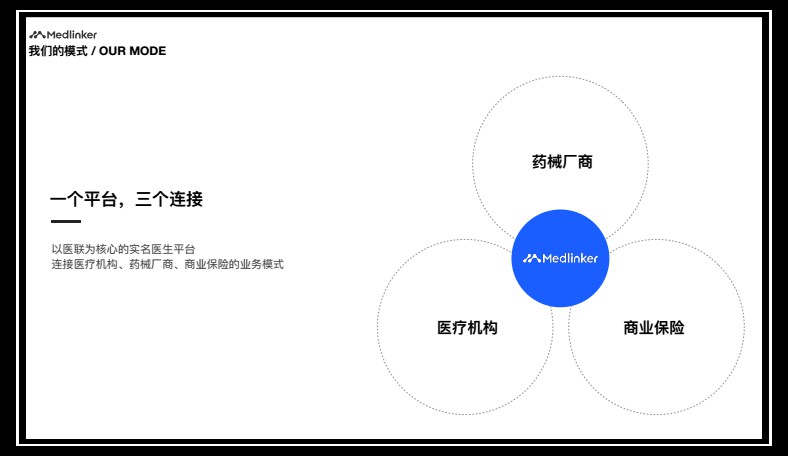
One Platform, Three Connections
The Medlink APP is divided into two major modules. One focuses on building a professional practice platform. In addition to providing traditional online services, we offer numerous O2O (Online-to-Offline) services for physicians. Through our platform, doctors can perform surgeries, access prescription solutions, and even integrate comprehensive hospital infrastructure. We enable physicians to maintain the experience of operating an online hospital, even after they have left their physical institution.
Secondly, for physicians, the content on the Yilian Academic Platform must not be neglected. In this process, we have identified significant potential for physicians to monetize their expertise. Of the several thousand yuan in physicians’ income, nearly half comes from knowledge monetization. By enabling physicians to share case studies, professional insights, or recent research data, we can help them identify monetization channels and build their personal brand (IP).
As healthcare reform deepens, we are observing an increasing shift of in-hospital prescriptions to external channels. This presents a significant opportunity to build a comprehensive online platform. By connecting with chain pharmacies and clinics, while simultaneously developing our own clinic network (Penguin Doctor), we aim to facilitate the migration of more prescriptions to out-of-hospital settings.
Doctor agent teams are essentially the same as celebrity talent agents. They help physicians analyze patient volume on a monthly basis, determine which activities to conduct online versus offline, and handle all legal and financial arrangements, allowing doctors to focus on their professional engagements.
So, where do our brokers come from? Most are pharmaceutical sales representatives, including those from multinational corporations, as well as medical device distributors.
How exactly can monetization be achieved? Pharmaceutical manufacturers and commercial insurance institutions, as well as healthcare providers, generate minimal profits or even operate at a loss. Although commercial insurance can yield some profits, its market volume remains limited.
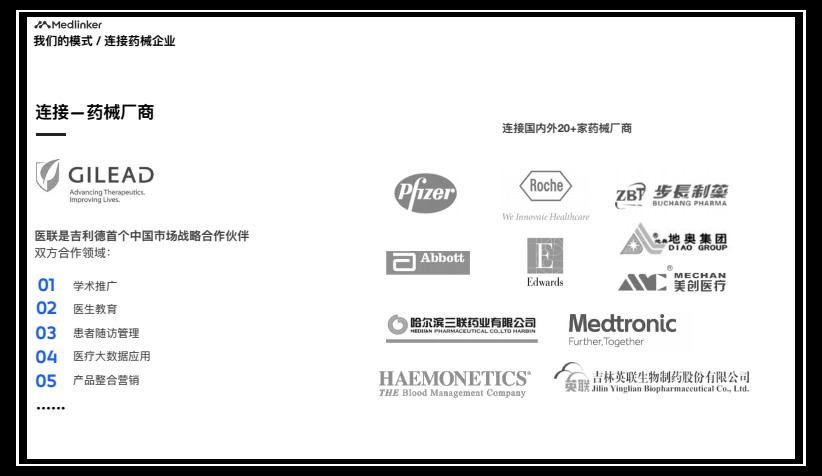
We have entered into a partnership with pharmaceutical manufacturers:
Another monetization strategy involves leveraging big data. We will become a key strategic partner with China Electronics Data in the big data sector, jointly exploring the commercial application of medical data. This initiative involves collecting fragmented data from various hospitals—including prescriptions, disease management records, and patient health archives—structuring this information, and utilizing it for commercial purposes.
We observe that IBM Watson’s full product portfolio comprises 170 products, far exceeding the number of its well-known offerings deployed in China. These 170-plus products are applied across various touchpoints, including those for physicians, patients, healthcare institutions, public hospitals, private hospitals, community clinics, pharmacies, and even pharmaceutical distribution companies. IBM has established connectivity across the entire industry chain at these touchpoints, enabling seamless data flow. Whether focused on single disease conditions or regional applications, the iteration speed of their products far surpasses ours.
If data cannot be shared, the products housed within it remain inert—lacking vitality—and their connectivity to the internet becomes a false premise. Currently, we possess both data assets and access to overseas solutions. By applying these superior international solutions to the Chinese market and deploying them across our various offline-connected touchpoints, we can explore whether new business opportunities emerge.
With improved efficiency, our connectivity has expanded; each month, we facilitate over 20,000 surgeries across more than 5,000 partner hospitals, clinics, and healthcare institutions.
Next is a more lucrative business—the advertising model. However, this advertising model is not so straightforward. If an advertising campaign achieves an annual scale of RMB 1 billion or even RMB 2 billion, it is no longer just simple advertising; we effectively transform into a marketing agency or a provider of full-platform solutions for pharmaceutical manufacturers.
Collaboration with pharmaceutical and medical device manufacturers. Taking the partnership with Gilead Sciences, a global leader, as an example, the company holds a leading, even monopolistic, position in the therapeutic areas of hepatitis C, hepatitis B, fatty liver disease, and HIV/AIDS.
In this context, our goal is to help them rapidly enter the Chinese market. How can they achieve this? The first strategy involves academic promotion of pharmaceuticals, for which we will establish both online and offline channels for academic marketing. This constitutes the first service offering under consideration.
The second is physician education. Our platform will establish a continuing education academy for each disease category within every medical specialty.
Next is our collaboration with commercial insurance. Last year, we made a bold claim, hoping that 20% of our revenue would come from commercial insurance. Although the current figure is not that high, we have taken the first step, as claims for surgical accident insurance have been successfully settled.
Our surgical accident insurance is sold to patients. If a patient is concerned about potential risks, such as disability or death, prior to surgery, they can purchase this insurance. In November of this year, a patient experienced an adverse event during surgery and subsequently passed away due to postoperative complications. The patient had paid a premium of over RMB 400, and we provided a compensation payout of tens of thousands of yuan, which has already been credited to the beneficiary’s account.
These represent our commercial experiments to date. This year, we have indeed achieved break-even across all business lines, recouping all prior cash burn. Our strategy is to refine and mature each business model before scaling up.
This year, I would rate both myself and Medlinker at 80 out of 100, with our revenue reaching approximately RMB 600–700 million. We hope to present an even stronger performance by this time next year. See you next year! Thank you.