

Renren Lab Files Prospectus: Unlocking Scientific Instrument Sharing and Distributing RMB 24 Million Innovation Vouchers for SMEs
The rise of the sharing economy has permeated various sectors, including transportation, housing, and office spaces; a sharing economy model has also emerged in the field of scientific research.
Renren Experiment (Beijing) Technology Co., Ltd. provides comprehensive scientific and technological resource services to enterprises and individuals by building a platform for sharing technological resources, integrating instruments, equipment, and research service capabilities from universities, research institutions, and enterprises, and aligning with societal demands. This model not only addresses the issues of low utilization rates of research instruments and information asymmetry but also substantially reduces corporate investment in R&D costs, representing a beneficial attempt to apply the “sharing” concept in the field of technological innovation.
Recently, VCBeat (WeChat ID: vcbeat) interviewed Ding Baisuo, COO of Renren Lab. He provided a detailed overview of the company’s development history and operational metrics, as well as its future strategic plans.

Ding Baisuo, COO of Renren Lab
Establish a Technology Resource Sharing Platform
Renren Experiment is positioned as a platform for sharing scientific and technological resources. It is primarily dedicated to addressing issues such as the imbalance between supply and demand of scientific and technological resources, information asymmetry, and imperfect standards.
Ding Baisuo introduced to VCBeat that Renren Lab was invested and established by Beijing Changping Science Park Development Co., Ltd. The company was registered and founded in October 2015, and officially began operations in 2016.
“The rationale for establishing a shared platform for scientific and technological resources stems from our recognition that, within the realms of technological innovation and R&D activities, there are persistent issues such as limited availability of information on instrument and equipment sharing, cumbersome borrowing procedures, and a lack of standardized services. In practice, many small enterprises cannot afford large-scale scientific research equipment, remain unaware of the availability of shared scientific instrument resources, and consequently face prohibitively high R&D costs.”
Therefore, the first step for Renren Lab is to address the integration of information on scientific research instrument resources, informing users with specific needs where to locate instruments capable of performing experiments and what types of experiments can be conducted.
“Many instruments at universities and research institutes are used infrequently. While these institutions are willing to share their equipment, the lack of a dedicated platform, standardized procedures, and benefit-sharing mechanisms has led to the underutilization and waste of scientific research instrument resources.”
In addition, in recent years, the Chinese government has promoted “mass entrepreneurship” and “innovation for all,” leading to the emergence of numerous small and micro technology-based enterprises, which in turn has spurred demand for shared access to scientific research instruments.
Taking Changping District, where Renren Lab is located, as an example, the district has a strong economic foundation in biopharmaceuticals and intelligent manufacturing, with a large number of related micro, small, and medium-sized enterprises (MSMEs) that have an urgent demand for scientific research instrument resources. Therefore, Changping Science Park Development Co., Ltd., under the State-owned Assets Supervision and Administration Commission of Changping District, provided funding to establish the Renren Lab Technology Resource Sharing Platform.
“The Changping District Government aims to establish a technology resource sharing platform to provide technology resource sharing services for enterprises aligned with the direction of regional economic development, facilitating smoother flow of technology resource information and serving micro, small, and medium-sized enterprises.”
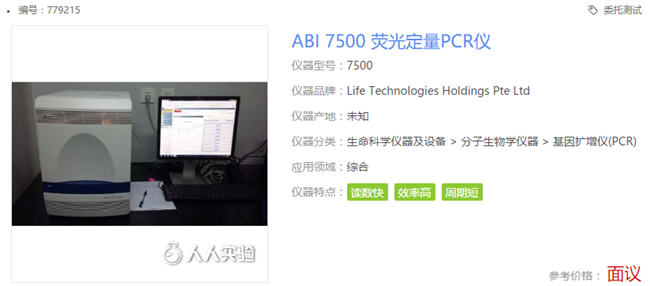
Instruments and Equipment Shared via the Renren Experiment Platform
Renren Shiyan’s state-owned background has endowed it with greater “credibility” in expanding its network of instrument and equipment suppliers. Within a very short period, it gained access to top-tier research centers such as the National Center for Protein Sciences, the National Institute of Biological Sciences, Beijing, and the China Pharmaceutical Research and Development Center, integrating information on their shared instrument resources.
Ding Baisuo cited the example of a medical device company in the Changping Science and Technology Park, which previously could only conduct electromagnetic compatibility (EMC) testing for its products at the laboratory of the Tianjin Institute for Drug Control. Renren Shiyan has integrated five professional EMC laboratories within Changping District, facilitating matches through its platform to enable these companies to conduct relevant tests locally. This has significantly reduced the time and economic costs for enterprises while substantially increasing the equipment utilization rate of state-owned research institutes.
Sharing of scientific research instruments is merely the first step. During its operations, Renren Lab also recognized that many small and micro enterprises and individual researchers lack the capability to design and execute research workflows. In response, it established a dedicated team to provide services such as research workflow design and experimental analysis breakdown for these users, covering areas including pharmaceutical physicochemical analysis, pharmacokinetics, and animal studies.
Currently, Renren Lab primarily operates two core business segments: one is the matching of scientific research instrument information; the other is comprehensive research services, whereby relevant enterprises and individuals submit experimental requirements to Renren Lab, which then designs the experimental protocols or commissions professional institutions to design and conduct the experiments, with results returned upon completion.
According to Ding Baisuo, as of now, Renren Lab has integrated more than 4,000 research service providers, including top universities such as Tsinghua University and Peking University, as well as research institutions like the Chinese Academy of Sciences. Over 500,000 instruments and equipment are shared through the Renren Lab platform. The platform currently has over 50,000 registered users, with 12,000 active users, and sees hundreds of new organic sign-ups daily. Its user base primarily consists of researchers, laboratory managers, and R&D and management personnel from small, medium, and micro enterprises.
Renren Lab has now covered research equipment resources in 262 cities across China, with cumulative services exceeding 5,500 instances and nearly 1,300 corporate clients served.
Ding Baisuo predicts that the platform revenue of Renren Experiment in 2017 will exceed 15 million yuan.
24 Million in Policy “Red Packets”
While providing scientific research resource services, Renren Experiment also undertakes the management of the “Changping District Urban Demonstration Special Fund for Entrepreneurship and Innovation Bases for Micro and Small Enterprises,” and has accordingly launched the “Renren Innovation Voucher” to provide targeted support for technological innovation activities conducted by micro and small enterprises.
The special fund provides support of up to RMB 24 million, disbursed over three years, with Renren Lab primarily responsible for management, evaluation, audit, and related tasks.
Ding Baisuo introduced that the special fund is open to small and micro enterprises across China, with a certain preference given to enterprises in Changping District in terms of subsidy proportion and total amount. The eligible recipients are small and micro enterprises and innovation and entrepreneurship teams that have a registered capital of no more than RMB 30 million, no more than 100 full-time employees, annual operating revenues below RMB 10 million in each of the past two years, and no record of bad faith.
The specific process is as follows: After obtaining user qualification, relevant enterprises submit project applications. Upon approval by Renren Experiment, the projects enter the implementation phase. After project completion, innovation vouchers can be redeemed by submitting materials such as transaction contracts, invoices, and project deliverables.
“By the end of 2017, more than 200 high-quality micro and small enterprises will receive subsidy support for shared access to scientific and technological resources through the Renren Experiment Platform. This initiative not only benefits micro and small enterprises but also explores a new model for the utilization of government science and technology support funds, leveraging internet tools and big data credit systems to make such funding more precise and efficient,” said Ding Baisuo.
From a policy perspective, the sharing of scientific research instruments and equipment is also a direction encouraged for technological innovation. For instance, the "Special Plan for the Construction of National Science and Technology Innovation Bases and Condition Guarantee Capabilities during the 13th Five-Year Plan," released in October 2017, pointed out the need to comprehensively promote the open sharing and efficient utilization of scientific and technological resources, improve the construction of the national network management platform for research facilities and instruments, and establish a cross-departmental, multi-level network management service system.
The “Opinions of the State Council on Opening National Major Scientific Research Infrastructure and Large-Scale Scientific Research Instruments to the Public,” issued in January 2015, pointed out the need to accelerate the opening of scientific research facilities and instruments to social users such as universities, research institutes, enterprises, and social R&D organizations, so as to achieve open sharing of resources.
Ding Baisuo also stated, “China’s highest-quality scientific research resources remain concentrated within the state sector. Through its past endeavors, Renren Lab aims to provide resource owners with fresh perspectives and proven models, thereby fostering the development of technological innovation.”
Renren Lab’s next phase of development will focus on regions with concentrated research resources and demand, including the Yangtze River Delta, the Pearl River Delta, and Central China. By collaborating with local regulatory authorities and owners of research resources, Renren Lab aims to explore more efficient models for sharing scientific research resources.
“The social significance of the Renren Experimental Platform lies more in its impact on industrial innovation than in its commercial value. Our goal is to facilitate more efficient flow and sharing of research resources, making technological innovation simpler and more accessible, thereby supporting the development of China’s tech innovation industry,” Ding Baisuo concluded.