

Xingbei Yunlian Files IPO Prospectus: China's First Blockchain-Based Supply Chain Finance Platform Focused on the Health Industry
VCBeat (WeChat ID: vcbeat) reports. Recently, Guangdong Youbei, Tencent, and Huaxia Bank held a strategic cooperation launch event to introduce the “Xingbei Cloud Chain” supply chain finance service platform.
Xingbei Cloud Chain is a supply chain finance service platform built on Tencent’s blockchain technology, resulting from the tripartite strategic cooperation among Guangdong Youbei, Tencent, and Huaxia Bank. It is China’s first blockchain-based supply chain finance platform co-developed through a strategic partnership with a bank, as well as the nation’s first supply chain finance platform constructed around the big health industry.
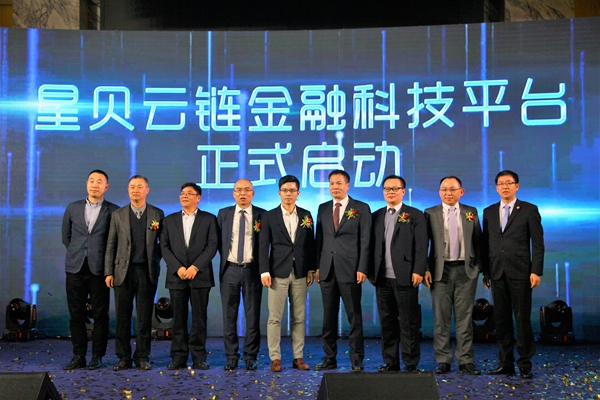
Launch Ceremony of the Xingbei Cloud Chain Fintech Platform
Three Industry Leaders Join Forces to Build a Supply Chain Finance Platform
This collaboration represents a powerful alliance, with the three parties pooling their respective advantageous resources to integrate the technology side, asset side, and platform of supply chain finance.
Xingbei Cloud Chain was initiated by Guangdong Youbei Information Technology Co., Ltd. Its parent company, Yibang Holdings, is an experienced supply chain management enterprise focusing on supply chain services for the big health industry. Its business covers lean supply chain operations, supply chain management consulting, logistics technology and equipment, comprehensive supply chain finance, and real estate development for the big health industry.
“Guangdong Youbei’s greatest advantage in entering the supply chain finance sector lies in its proprietary accumulation of industry data, efficient external data sharing, abundant industry resources, and extensive accumulation of transaction scenario data,” revealed Niu Yongjie, Chairman and President of Yibang Holdings Group.
For Tencent Blockchain, the focus is on leveraging the most cutting-edge blockchain technology to engage in deep cooperation with Xingbei Cloud Chain, thereby building a more efficient supply chain finance circulation system. Cai Yige, General Manager of Tencent Blockchain, revealed, “By utilizing Tencent Blockchain’s shared ledger and smart contract capabilities, we ensure that fund flows are traceable, information is open and transparent, and data is shared among multiple parties.” In the context of big data trading and credit scenarios, blockchain plays a pivotal role in supply chain transactions by facilitating asset ownership confirmation, transaction verification, bookkeeping, reconciliation, and clearing. Meanwhile, the tamper-proof nature of blockchain technology effectively mitigates the risk of fraud. In its collaboration with Youbei, Tencent Blockchain recognizes the strategic value of Youbei’s platform in the broader health sector. Yibang Logistics’ extensive experience in warehousing and logistics within the health industry has enabled the creation of a supply chain finance system that covers the entire process of supply chain logistics reliant on the health industry.
“Banks all hope to leverage industrial chains to pioneer proactive and prudent supply chain finance service models, thereby better allocating financial resources to promising industries.” From the perspective of Huaxia Bank, on one hand, Yibang Holdings possesses extensive experience in supply chain management within the big health industry; on the other hand, Xingbei Cloud Chain, built upon blockchain technology, has reconstructed the credit foundation of supply chain finance, ensuring the authenticity of supply chain finance transactions.
Huaxia Bank also expressed its intention to deepen cooperation with Xingbei Cloud Chain in the future, leveraging its expertise and advantages in specialized services such as account management and payments. The two parties will jointly explore innovative directions in supply chain finance, delivering secure and efficient services that genuinely support the development of the real economy within the broader health industry. Notably, Xingbei Cloud Chain is China’s first blockchain-based supply chain finance platform established through a strategic partnership with a bank.
Smart Supply Chain Finance Takes Center Stage as the Industry Enters the 4.0 Era
In fact, supply chain finance had already gained significant momentum prior to the advent of “Xingbei Cloud Chain.”
In October this year, the General Office of the State Council issued the "Guiding Opinions on Actively Promoting Supply Chain Innovation and Application," to promote supply chain finance services for the real economy, encouraging commercial banks, core enterprises in the supply chain, etc., to establish supply chain financial service platforms, providing efficient and convenient financing channels for small and medium-sized enterprises upstream and downstream in the supply chain.
According to the “2017–2022 China Supply Chain Finance Market Outlook and Investment Strategy Planning Analysis Report” released by Qianzhan Industry Research Institute, the scale of China’s supply chain finance market is expected to approach RMB 15 trillion by 2020.
To date, supply chain finance has gradually completed its evolution from version 1.0 to 4.0.
Phase 1.0 is a financing model in which funders or service providers, relying on Core Enterprise 1, provide financing to N small and medium-sized enterprises (SMEs). Phase 2.0 features an online “1+N” model based on direct system integration with core enterprises, enabling online financing for funders, service providers, core enterprises, and their upstream and downstream partners. Phase 3.0 establishes an “N+1+N” model by building a supply chain finance service platform that connects various wealth management sources, supply chain service providers, and the upstream and downstream segments of core enterprises’ industrial chains.
Currently, supply chain finance has gradually entered the 4.0 stage. Building on the online, socialized collaboration of Stage 3.0 and integrating blockchain technology embedded within platforms, it has evolved into an online, collaborative, and intelligent form of supply chain finance. Leveraging big data, it addresses the most fundamental issue of transactional trust in the business world. Through intelligent system analysis and proactive supplementation of liquidity shortages within the industrial chain, it enhances the circulation efficiency of the industrial chain via optimized financial allocation.
Song Hua, Vice Dean of the Business School at Renmin University of China and President of the Beijing Modern Management Research Association, once stated that the extension of supply chains and supply chain finance toward intelligence is not merely a combination of industry and finance, but also an integration of industrial finance and technology. Coordinated and integrated fintech will become the driving force behind intelligent supply chain finance.
Xingbei Cloud Chain targets the field of smart supply chain finance.
At the press conference, Liu Huangfeng, General Manager of Xingbei Cloud Chain, pointed out that “Xingbei Cloud Chain,” deeply integrated with Tencent’s blockchain technology, will connect commercial flows, information flows, logistics, and capital flows within the broader health industry chain. This integration aims to eliminate information asymmetry in the supply chain, truly ensuring the authenticity and validity of data across these four flows, achieving a closed-loop operational model, enabling automatic risk assessment, and facilitating intelligent post-loan management by the system.
“Based on the reconstruction of the supply chain credit value chain, Xingbei Cloud Chain aims to achieve full-process online and intelligent supply chain finance, efficiently breaking down the barriers between finance and industry,” said Liu Huangfeng.
Seizing the Leading Position in Supply Chain Finance
Despite the considerable market potential of current supply chain finance, as an emerging trend, it has yet to witness the emergence of highly mature business models or industry unicorns.
Niu Yongjie of Yibang Holdings candidly acknowledged that the supply chain finance model is still being explored by the industry; how to enter the market and what size of share can be captured depend on each platform’s own capabilities.
In recent years, the big health industry has frequently received policy support. Notably, the Outline of the “Healthy China 2030” Plan issued by the State Council explicitly elevated “Healthy China” to a national development strategy. Following the internet industry, the big health sector has emerged as a new engine for China’s economic growth. According to relevant forecasts, the market size of China’s big health industry was projected to approach RMB 13 trillion by 2021. Amidst this vast market, Xingbei Cloud Chain possesses distinct competitive advantages. Leveraging the substantial resource advantages accumulated by its parent company, Yibang Holdings Group, in supply chain and big health industry resources, Xingbei Cloud Chain provides credit support based on data related to procurement, logistics, sales, and capital flows. This support targets industry leaders in the big health sector, along with their suppliers, distributors, agents, dealers, and end-users at all levels.
At the press conference, StarBe Cloud Chain garnered widespread recognition and secured several strategic partnerships upon its debut, leveraging its robust technical capabilities and leading credit lines. Tasly Pharmaceutical Marketing Group Co., Ltd. from Tianjin and Qingdao Shaohaihui Enterprise Management Consulting Co., Ltd. signed strategic cooperation agreements with StarBe Cloud Chain on site.
“With the support of Xingbei Cloud Chain, Tasly has greater potential for development in the pharmaceutical commercial distribution sector and is better positioned to ensure organic synergy across the upstream and downstream ecosystem of the entire industrial supply chain,” said Mr. Xiao Zuohong, Deputy General Manager of the Office at Tasly Pharmaceutical Marketing Group Co., Ltd., expressing strong confidence in the partnership.
Liu Huangfeng pointed out that supply chain finance, a sector poised to become a major trend with a future market size of RMB 15 trillion, currently faces numerous formidable barriers in terms of policy, technology, and capital. In particular, the lack of specific application scenarios would cause supply chain finance platforms to lose their competitive edge. In this regard, Xingbei Cloud Chain boasts strong backing. Liu Huangfeng stated, “Yibang Holding Group, the parent company of Guangdong Youbei, has long focused on strategic layout in the big health industry and maintained deep cooperation with core enterprises for many years. It possesses unparalleled advantages in industry understanding, transaction structures, and transaction scenarios, providing Xingbei Cloud Chain with abundant industrial resources as scenario support.”
Currently, Xingbei Cloud Chain offers a diverse range of financing models. These include property right pledge and warehouse receipt pledge financing models based on the liquidity of physical goods in the supply chain, as well as various credit-based financing models such as order pledge and confirmed warehouse financing, which are built upon the credit momentum and stability of the supply chain.
However, the ambitions of “Xingbei Cloud Chain” clearly extend far beyond this. According to Niu Yongjie’s strategic plan, Xingbei Cloud Chain will align with national policy directions, integrate with industrial economic development trends, and analyze the competitive landscape of the broader health industry. It aims to innovatively develop a more diverse range of supply chain finance products while increasing investment in R&D and talent. In alignment with the group’s overall strategic layout, the supply chain finance division may also pursue financing opportunities to accelerate the expansion of “Xingbei Cloud Chain.”
Niu Yongjie stated that the goal of Xingbei Cloud Chain is to join forces with Tencent Blockchain to establish a national benchmark for supply chain finance platforms. Leveraging the broader healthcare industry, the platform will fully tap into customer resources across its upstream and downstream sectors, creating a financial service platform anchored by core enterprises and serving small and medium-sized enterprises (SMEs) within the supply chain, thereby driving the upgrading and development of the entire industrial chain.