

Investors Must Be Prepared to Lose Everything: Odds of Hitting a Unicorn Are Below 20% | 2017 Future Healthcare 100
“Top 100 Future Healthcare Companies 2017” Forum, themed “The Era of Species Explosion,” was held at the Beijing Marriott Hotel from December 15 to 17, 2017.
From 2014, the inaugural year of internet healthcare, to the present, the sector has undergone three years of rapid development. Several companies have joined the billion-dollar valuation club, emerging as unicorns in the innovation landscape. Unicorns serve as bellwethers for future corporate development and are poised to become leaders in future innovation. How will these unicorn enterprises grow? How will their strategies and actions shape the future trajectory of the entire industry? And where will the next unicorn emerge? At the VCBeat Future Healthcare Top 100 Unicorn Forum, numerous top-tier industry investors provided their insights.
Guests participating in this forum include:Li Yishi, Executive Director of Haoyue Capital (Host)、Yang Yunxia, Managing Director at Sequoia Capital,Zhao Qun, Partner at Yuanhe Origin,Gao Yi, Partner at Yuanyi Capital,Wang Jianfei, Executive Director of Legend Capital Healthcare Fund。
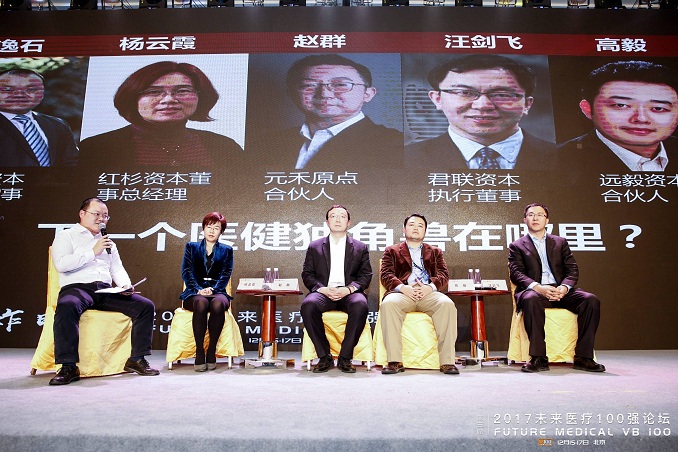
Li Yishi: As 2017 draws to a close, several sectors within the private equity industry have emerged as significant hotspots, including healthcare big data, artificial intelligence, genomics, and new drug development. Which sectors are likely to produce unicorns in 2018?
Yang Yunxia:Throughout 2017, Sequoia Capital made significant investments in the pharmaceutical industry. We had already detected certain industry shifts last year, encompassing two key aspects: First, from the perspective of emerging technologies, the direction of tumor immunotherapy has been validated. Although China lags behind the United States in pace, it is imperative to implement a systematic strategic layout at this current juncture.
Another area involves changes at the policy level. We can clearly perceive that the landscape of the gene industry has taken shape. The entire sector related to tumor immunity is predominantly led by pharmaceutical companies. We have conducted a systematic review and strategic layout for cell therapy, gene therapy, and tumor immunotherapy drugs, which constitutes our key focus this year.
Zhao Qun:China has a large patient population, and the efficiency in question primarily refers to hospital efficiency. Drug approval in China is not an efficient process. Coupled with the relatively low cost of CROs, there has been a significant return of talent involved in new drug development and medical device innovation. Therefore, we have made strategic investments in this area.
In 2017, building on our existing portfolio, we focused on companies integrating artificial intelligence and big data with healthcare. Our goal is for these products to achieve market commercialization and integrate seamlessly with healthcare services. Additionally, we have made strategic investments and pilot initiatives in response to evolving trends in healthcare delivery.
Gao Yi:The healthcare industry is largely technology-intensive, with technology serving as the driving force, including changes in diagnostic and therapeutic methods.
Healthcare remains a heavily regulated industry, so any shift in the policy landscape can directly reshape an entire sector. We place greater emphasis on precision medicine. We have invested in a gene testing company, as well as diagnostic firms specializing in microbiomics, proteomics, and metabolomics.
From a medical perspective, clinical diagnosis is essentially a process of hypothesis testing, where physicians assess the patient’s condition based on pathological findings or chief complaints. Therefore, advancements in diagnostic technologies will inevitably drive the development of the entire healthcare industry.
Second, medical policy: The General Office of the CPC Central Committee and the General Office of the State Council recently issued the “Opinions on Deepening the Reform of the Review and Approval System to Encourage Innovation in Drugs and Medical Devices.” This not only lowers the threshold for clinical trial institutions but also accepts overseas clinical trial data, thereby creating a significant market opportunity.
In addition, we are closely monitoring the healthcare services sector. One key area is primary care; the rationale for focusing on primary care is straightforward: medical insurance funds are insufficient. To provide coverage for such a large population, resources must be directed toward the grassroots level. We are optimistic about the nursing care service sector, including platforms like HuLianWang, which we believe will present significant opportunities in the future.
Wang Jianfei:Biologics may gradually fade into history. From the perspective of national policy, among the current 4,000 to 5,000 pharmaceutical manufacturers, about half may shut down, while some companies will consolidate existing assets and expand new capacity.
Over the years, China has accumulated a substantial amount of private capital. While these enterprises have achieved considerable business success, they still face deficiencies in management and capital structure. Addressing these gaps presents a significant opportunity. In 2018, we may increase our investment in this area.
From the perspective of optimizing the supply side of public hospitals, major specialized departments are continuously being spun off from public hospitals. We have selected several areas in which we seek to achieve breakthroughs.
Driven by policy and public capital, a large number of doctors will leave the public system in the future. Private medical services in China, which previously accounted for only 11% to 12% of the market, could surpass public hospitals in certain specialized departments if their market share rises to 30% or 40%.
Li Yishi: How can a good company give talent the opportunity to grow into a unicorn?
Wang Jianfei:Our view remains focused on services. Superior enterprises often operate within a favorable macroeconomic backdrop and environment. Certain broad macroeconomic trends can drive the expansion of demand across the entire industry.
Ultimately, it boils down to this: you must be a grounded startup CEO and entrepreneur. If you feel confident in your hiring decision at the moment of selection, the subsequent pressure will be significantly reduced.
Our investment in Kangda Medical, a company that started as a distributor, is based on its strategy of partnering with foreign firms and leveraging their technologies—such as overseas OEM manufacturing—to deepen its understanding of the industry.
"In China, the medical device sector is still predominantly focused on in vitro diagnostics and diagnostic imaging. Following industry consolidation, we aim for Kangda to rank among the top three players in the sector."
Gao Yi:I believe several factors are critical. In terms of business model, innovation and exploration are essential; this is the first key factor that could enable a company to become a unicorn.
Second is the team. The companies we invest in will see different talents join as they reach certain stages of growth. This poses a challenge to founders and their teams. As managers, you must possess sufficient management capabilities to attract talent.
Third, this relates to fundraising capability, with the most critical factor being an entrepreneur’s ability to deploy capital effectively. Entrepreneurs naturally prefer to raise as much funding as possible; however, rational investors will not be easily misled. Investors always aim to allocate capital to the most promising enterprises. A company’s development strategy reflects its underlying quality and competence. Therefore, raising excessive and unnecessary funds, or misallocating capital, may lead to irreversible problems.
Early-stage companies generally have modest valuations; raising excessive capital leads to greater equity dilution. I recommend that they engage an investment advisor to determine the optimal amount of funding required.
Li Yishi: Due to policy changes, some new business models have emerged. After enterprises benefit from policy dividends, how can they ensure sustainable long-term development?
Gao Yi:I believe that policy serves as a catalyst and should not become a vehicle for corporate speculation. Overall, the market should be the driving force. Given that healthcare is a heavily regulated industry, I think policies should be viewed as dividends and catalysts.
Zhao Qun:From a macro perspective, there are still policy-driven market opportunities for investing in new drugs. China’s recent policies have been highly favorable to innovative pharmaceuticals, and the approval process for overseas new drugs entering the Chinese market has significantly accelerated.
Listed pharmaceutical companies are predominantly focused on generic drugs, resulting in very low gross profit margins, while Phase II and Phase III drug development is extremely costly. Many innovative drug companies rely on investor funding to advance, leading to the continuous emergence of unicorns, with numerous firms valued at or approaching $1 billion. From a macroeconomic perspective, I am highly optimistic about innovation in new drug development.
The landscape for new drugs is constantly evolving. We have observed that many companies are thriving in various fields, such as oncology, diabetes, and certain areas of anti-infective therapy.
Four or five years ago, we placed greater emphasis on the team’s comprehensive management capabilities. Today, with a focus on the international market and spanning clinical science, biology, chemistry, and marketing and sales, we are prioritizing Angel and Series A rounds, with particular attention to capabilities in biology and chemistry.
Li Yishi: With the “wolves” at the door abroad, what is your view on investment in new drugs within China?
Zhao Qun:In the United States, Series A investments in new drugs typically amount to tens of millions of US dollars, whereas in China, they are in the range of tens of millions of RMB, reflecting a relatively cautious approach. This caution is particularly evident in two areas. First, early-stage projects targeting high-risk therapeutic targets struggle to secure funding. Second, regarding leading domestic companies, I believe that having a bubble is preferable to having none; entrepreneurial teams should be adept at leveraging market bubbles or investors’ cyclical behavior.
Yang Yunxia:In summary, investors essentially focus on three things: selecting the right direction, choosing the right people, and timing the market. If you can master these three aspects, you are ready to invest. However, if you fail to make the right choices in these areas, even a promising project could result in a total loss of capital.
I believe every investor must be prepared for the possibility of losing their entire investment in a deal. It is fortunate to invest in a unicorn; if calculated by percentage, the probability of a company becoming a unicorn is approximately 10%–20%.
Therefore, identifying the right direction, partnering with the right people, and investing at the appropriate juncture are critical; if the timing is off, profitability is unattainable. This summarizes our investment philosophy.