

160 Health Announces New Strategy to Build China's Largest Integrated Healthcare Services Marketplace Amid Surging Internet Revenue
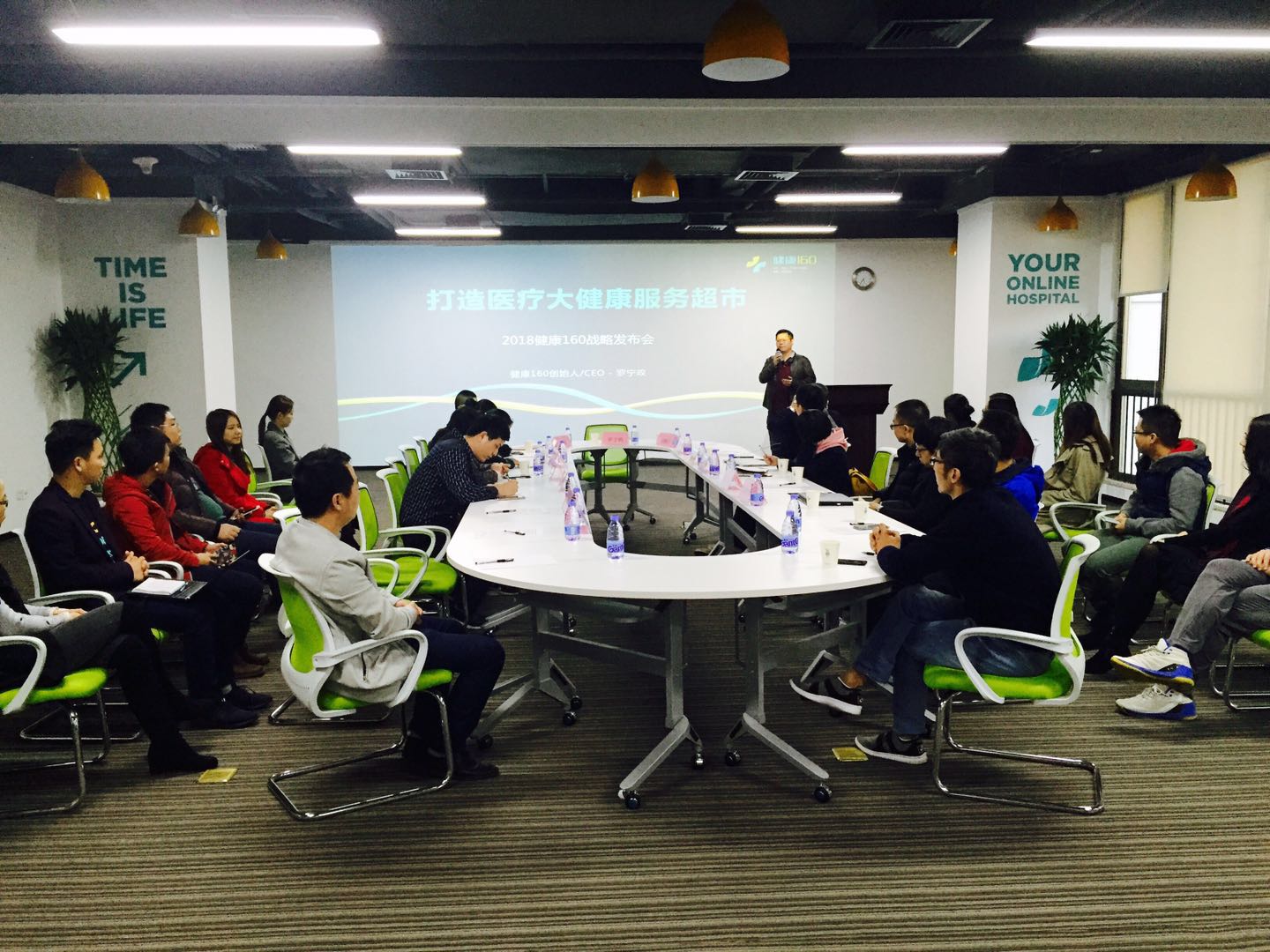
At the milestone of doubling its internet revenue and achieving annual revenues exceeding RMB 100 million, Health 160 unveiled its 2018 new strategy at its Shenzhen headquarters on the 20th: connecting the B-side (institutions), D-side (doctors), and C-side (users) to provide comprehensive healthcare services ranging from health checkups and medical consultations to pharmaceuticals, medical devices, and medical aesthetics, with the aim of becoming China’s largest supermarket for healthcare and wellness services.
“JD.com and Tmall provide online product services to users, enhancing their shopping experience. We aim to transform users’ health services and medical care experience through internet-based approaches. The difference is that JD.com sells products, whereas in addition to pharmaceuticals and medical devices, we primarily offer ‘services’—specifically, services in the field of healthcare and wellness,” said Luo Ningzheng, CEO of Health 160.
The Health 160 platform will continue to provide high-quality medical and healthcare services, standardizing industry practices through user reviews. In the future, the platform will gradually establish service standards to guide industry behavior. In a sense, it is somewhat analogous to Meituan-Dianping in the lifestyle services sector or Ctrip in the travel services sector.
By accessing the Health 160 WeChat account or mobile app, users can discover a comprehensive suite of health and wellness services. The platform hosts over 10,000 medical and healthcare institutions, ranging from large public hospitals to private facilities; from renowned international hospitals to community clinics; from medical service providers to physical examination centers; and covering products from pharmaceuticals to medical devices.
Take an ordinary user as an example: they can purchase a health checkup service for 160 yuan. The biggest pain point of such services is the lack of pre-examination guidance; many users are unclear about which tests they should undergo. Furthermore, after the examination, the reports are often shelved and ignored. Faced with a pile of test results that they cannot interpret, users are unsure how to proceed. This reduces health checkups to a mere formality, preventing them from effectively facilitating health management.
160 Health Checkup Services address this pain point by offering professional services provided by dedicated physicians. The 160 Health Checkup platform employs a full-time team of doctors and hosts hundreds of thousands of affiliated physicians who provide one-on-one pre- and post-examination services to users. Through the platform, personalized health checkup packages can be customized. After the examination, the platform also offers post-checkup consultation services. Users simply need to upload their health checkup reports, and the affiliated physicians will provide detailed interpretations of the results and offer precise guidance for subsequent medical actions.
After the health checkup, users can identify the most suitable hospitals and doctors offering the best services based on their own results and reviews from other users. Subsequently, they can schedule appointments online through the 160 platform; during their hospital visits, they can also make payments and access test reports via the platform.
After leaving the hospital, if you have further questions, you can consult with affiliated physicians on the online platform; if medications are needed, partner pharmacies can deliver them to your door.
Platform users can also purchase relevant insurance products based on their individual circumstances, or avail themselves of services such as oral healthcare and postpartum rehabilitation.
Health 160 has also recently launched medical aesthetic services. Leveraging the platform’s strong user stickiness and high-quality resources, its medical aesthetics business has experienced rapid growth since its inception. The onboarding of many renowned plastic and cosmetic surgeons from large public hospitals has further ensured the quality of services offered on the platform.
“Health 160 has become the first internet company in China to fully integrate online and offline services, achieving a closed-loop healthcare ecosystem,” said Luo Ningzheng.
Building a platform is challenging; due to the complexity of the healthcare system, creating a comprehensive medical and health platform is even more difficult. The core advantages that have enabled Health 160 to establish itself as a platform in the medical and health services sector are its data assets and user traffic.
Data and traffic are the core competencies of mobile health platform companies, and possessing both simultaneously is no easy feat. In China, many enterprises can access in-hospital data; most Hospital Information System (HIS) vendors—computer application systems used for information management and online operations in hospital administration and medical activities—indeed have the capability to integrate with in-hospital data. However, these vendors lack user traffic and do not possess internet operational capabilities. Conversely, many mobile health companies with strong internet capabilities are often inept at integrating with hospitals, making it difficult for them to achieve data connectivity. Health 160, however, excels in both areas.
Data connectivity capabilities are the key competitive advantage that sets the 160 team apart from other mobile healthcare teams. Under the 160 umbrella is a wholly-owned subsidiary, Blue Dragonfly, which specializes in hospital infection control software. As the leading provider of such solutions in China, it currently serves thousands of hospitals. While integrating hundreds of millions of patient inpatient medical records and health archives, the company ensures effective data protection.
In terms of traffic, Health 160 has connected with over 3,000 hospitals across China, onboarded more than 500,000 physicians, served over 2 million users daily, and accumulated 150 million registered users with real-name verification.
In addition to appointment registration and viewing test reports, in-clinic payments also surged in 2017. The daily payment volume on the 160 platform has approached RMB 6 million. For the full year of 2017, the total payment amount reached nearly RMB 2 billion, representing a tenfold year-on-year increase. In 2018, the payment volume is expected to surpass the RMB 10 billion mark.
What sets the Health 160 team apart is its dual expertise in both internet technology and healthcare services. This unique DNA has enabled Health 160 to advance steadily and carve out its own distinct path. This distinctive foundation stems from the founder’s background: Luo Ningzheng, a computer science graduate, was among the earliest pioneers in China to engage with the internet during the 1990s, while also serving for many years as the Director of the Hospital Information Department.
The greatest challenge of the industrial internet lies in transforming the supply side. Hospitals, as a critical entry point, were once akin to fortified compounds largely inaccessible to the internet industry. However, for Luo Ningzheng, this was not overly difficult, given his deep understanding of hospitals’ pain points. The 160 platform began by providing appointment registration tools for hospitals, gradually expanding to develop payment solutions and post-consultation services, thereby successfully closing the loop between online and offline medical services. It has since further extended its reach into the broader health and wellness sector.
Luo Ningzheng stated that building a platform is a long-term and arduous challenge, and Health 160’s ability to persist until today is attributable to the team’s twelve years of dedication and accumulation. He said that the company will remain true to its original mission, will not operate clinics, and will not engage in offline services. It will adhere to an open-platform strategy, leveraging its traffic and data advantages in connecting the B (business), D (doctor), and C (consumer) ends to excel as a medical and general health service platform.
The enrichment and enhancement of services on the Health 160 platform have driven comprehensive revenue growth. The 160 Health Checkup service, launched in June this year, generated nearly RMB 2 million in monthly revenue within less than six months. Meanwhile, the 160 Pharmaceutical business, operating for one year, now achieves nearly RMB 10 million in monthly revenue.
“Full-year revenue in 2017 will definitely exceed RMB 100 million, with internet-related income more than doubling compared to the previous year. By June 2017, Health 160 had already reached break-even,” said Luo Ningzheng.
As revenue and profitability reach a turning point, a renewed IPO has been placed on the agenda. “Both the ChiNext Board and Hong Kong are possibilities,” said Luo Ningzheng.
As for timing, Luo Ningzheng stated that the mobile health industry has just emerged from a harsh winter and is beginning to sense the arrival of spring, but it will still take time for the sector to fully enter this phase. “It is difficult for companies in the mobile health industry to go public within a short term (one year); it will take at least two to three years.”
Luo Ningzheng believes that only truly leading enterprises will stand out in two to three years. The window for explosive growth in the entire mobile health industry will also emerge in three years.
Luo Ningzheng stated that with the implementation of the “Healthy China” policy and the continued advancement of consumption upgrades, mobile healthcare will resume rapid growth after experiencing significant volatility. “The current situation is that while individual players are small in scale, the market is sufficiently large, offering substantial room for future industry expansion.”