

China Medical Aesthetics Safety Alliance Launched with Meili App's Big Data Driving National Quality Evaluation System
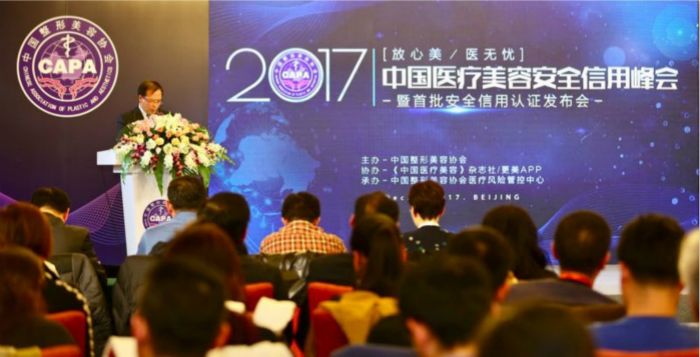
VCBeat (WeChat ID: vcbeat) learned that on December 21, the China Medical Aesthetics Safety and Credit Summit was held at the Liaoning Building in Beijing. The event was hosted by the Chinese Association of Plastics and Aesthetics, co-organized by the Editorial Office of Chinese Journal of Medical Aesthetics and Gengmei App, and undertaken by the Medical Risk Control Center of the Chinese Association of Plastics and Aesthetics.
Guo Yanhong, Deputy Director of the Medical Administration and Hospital Management Bureau under the National Health and Family Planning Commission; Zhang Bin, President of the Chinese Association of Plastics and Aesthetics; Liu Di, Founder and CEO of Gengmei App; Chen Minliang, Director of the Department of Burns and Plastic Surgery at the First Affiliated Hospital of the PLA General Hospital; Li Bin, Chairman of United Lige; Wang Biao, Assistant General Manager of the Beijing Branch of Fosun Group’s Health Insurance Division; and other leaders and experts attended the conference.
At the summit, China’s first medical aesthetics credit alliance—the Safety Alliance of the Chinese Association of Plastics and Aesthetics—was officially established, announcing the first batch of 105 safety credit-certified institutions and 91 safety credit-certified physicians.
The Safety Alliance was established to strengthen self-regulation within the medical aesthetics industry, foster a standardized and orderly market for cosmetic surgery and dermatology, enhance the overall creditworthiness of the sector, and develop a third-party risk assessment and safety credit evaluation certification system for distinguished physicians and high-quality medical institutions, thereby promoting the healthy and orderly development of the cosmetic surgery and dermatology industry.
Illegal Medical Aesthetics: The Biggest Obstacle to Industry Development; Safety and Credit Evaluation System Anticipated by Multiple Stakeholders

In 2015, China’s medical aesthetics market trailed Brazil by a narrow margin of just 0.8%. As the industry entered a “fast lane” of development, China saw a growth rate exceeding 40% in 2017, with the total number of procedures surpassing 10 million. This milestone marked China’s overtaking of Brazil to officially become the world’s second-largest medical aesthetics market, after the United States. The Chinese medical aesthetics market is projected to exceed RMB 1 trillion in 2019. The plastic surgery and aesthetic medicine sector has also emerged as the fourth-largest service industry, following real estate, automotive, and tourism.
However, with the rapid development of China’s medical aesthetics market in recent years, substantial profits have attracted a large number of unlicensed and illegal medical aesthetics institutions to take risks in pursuit of high returns. Safety is the primary factor in consumer decision-making, and illegal medical aesthetics practices have become the greatest obstacle to the development of China’s medical aesthetics industry.
According to statistics from the “2017 Black Book of China’s Medical Aesthetics Industry” released by the Gengmei App in December 2017, the number of unlicensed clinics in China has exceeded 60,000, six times that of licensed clinics. The annual number of surgical procedures performed at unlicensed clinics is 2.5 times that of licensed clinics, surpassing 25 million cases. Approximately 40,000 medical malpractice incidents occur annually at unlicensed clinics, with issues such as postoperative infections and severe scarring being all too common.
Industry chaos has become a dark cloud hanging over the medical aesthetics sector, giving rise to numerous misconceptions among the public. Addressing such disorder is not something that can be achieved independently by individual medical aesthetics institutions, physicians, or patients; rather, it requires all industry practitioners to establish a reasonable and widely accepted mechanism to resolve these issues at the systemic level.
Guo Yanhong, Deputy Director of the Bureau of Medical Administration and Hospital Management under the National Health and Family Planning Commission, stated in her address at the conference that quality and safety are the lifeline of the healthcare industry. “For the medical aesthetics industry, safeguarding the physical and mental well-being of clients and ensuring the quality and safety of medical services are not only crucial to protecting the public’s health rights and interests, but also essential for promoting the healthy and sustainable development of the medical aesthetics sector.”
The National Health and Family Planning Commission has attached great importance to the standardized and sustainable development of the medical aesthetics industry. It has promulgated and implemented the Administrative Measures for Medical Aesthetic Services, along with a series of related standards and technical specifications. The Administrative Measures for Medical Quality, also promulgated and implemented in 2016, provides a regulatory framework for quality and safety management in medical aesthetic institutions. Meanwhile, these measures emphasize the responsibilities of government health administrative departments in quality management and further clarify the role of third-party institutions in providing technical support and promoting industry self-regulation.
Guo Yanhong stated, “Only through the combined efforts of government regulation, institutional self-governance, industry self-discipline, and public oversight can a co-governance framework be established to effectively carry out interim and ex-post regulatory functions.”
Chen Minliang, Director of the Department of Burn and Plastic Surgery at the First Affiliated Hospital of the Chinese PLA General Hospital, analyzed the risks associated with medical aesthetic institutions in his address. He stated that the medical aesthetics industry faces not only risks for clients seeking aesthetic improvements but also potential risks for institutions, including surgical outcomes, disputes over transactions, authenticity of medical aesthetic products, and professional training and competence of practitioners. Therefore, medical aesthetic institutions must also implement effective risk prevention measures. A robust and effective quality assessment system for China’s medical aesthetics industry is highly anticipated by these institutions.
The Safety and Credit Alliance of the Chinese Association of Plastics and Aesthetics Is Officially Established, Announcing the First Batch of Certified Institutions and Physicians
At the conference, Zhao Zhenmin, Secretary-General of the Chinese Association of Plastics and Aesthetics (CAPA), along with guests Chen Minliang, Li Bin, Han Yan, Gao Zhanwei, Liu Di, and Zhu Meiru, took the stage to jointly launch the establishment ceremony of the CAPA Safety and Credit Alliance. The event also announced the first batch of 105 safety-and-credit-certified institutions and 91 safety-and-credit-certified physicians, followed by a plaque-awarding ceremony.
The establishment of the Safety Alliance of the Chinese Association of Plastics and Aesthetics aims to strengthen self-regulation within the medical aesthetics industry, establish a standardized and orderly market order for plastic and aesthetic surgery, enhance the overall credit level of the industry, build a third-party risk assessment and safety credit evaluation certification system for outstanding physicians and high-quality medical institutions, and promote the healthy and orderly development of the plastic and aesthetic surgery industry.
Zhao Zhenmin stated, “As a national first-tier industry association, the Chinese Association of Plastics and Aesthetics recognizes that addressing chaos in the medical aesthetics industry is not something that individual medical aesthetic institutions, doctors, or consumers can achieve independently. It requires all industry practitioners to establish a reasonable and widely recognized mechanism. Today, leading figures from across the industry have gathered to jointly promote the establishment of the China Medical Aesthetics Safety and Credit Alliance.”
As a professional industry association, the Chinese Association of Plastics and Aesthetics will actively promote the expansion of the alliance. Leveraging the big data resources of Gengmei App, the leading medical aesthetics platform, it will establish a safety and credit evaluation system for medical aesthetics based on nine dimensions: physicians’ educational background, scientific research capabilities, surgical skills, industry honors, areas of expertise, professional reputation, consumer reviews, postoperative outcomes, and price trends. This initiative aims to gradually implement a tiered safety credit rating system for physicians, providing aesthetic seekers with reliable criteria for making informed decisions in their future medical aesthetics consumption.
Leveraging Big Data in Medical Aesthetics to Drive the Establishment of a Quality Evaluation System for China’s Medical Aesthetics Industry
China’s big data ecosystem for medical aesthetics encompasses traditional search engines represented by Baidu, social media platforms represented by WeChat, specialized medical aesthetics platforms represented by the Gengmei App, serious healthcare platforms represented by Haodf Online, and hospital management systems for plastic surgery clinics represented by Hongmai.
Liu Di, founder and CEO of the Gengmei app, stated, “Such professional medical aesthetics platforms represent a force that cannot be overlooked, and they are best positioned to facilitate the establishment of a safety and credit evaluation system for the medical aesthetics industry. Search engines fail to create a closed-loop ecosystem; lacking transaction data, they can only rely on paid ranking, which prevents Baidu from developing an authentic evaluation system based on user word-of-mouth. While social media platforms like WeChat have accumulated extensive user reviews, these insights lack curation by professionals. Traditional healthcare platforms do not specialize in medical aesthetics, and hospital management systems for plastic surgery institutions fail to cover all medical aesthetics providers. These factors position specialized medical aesthetics platforms as the true enablers of a comprehensive quality evaluation system for China’s medical aesthetics industry.”

As early as three years ago, the Gengmei App had already begun establishing a quality evaluation system for China’s medical aesthetics industry. First, Gengmei conducts comprehensive quality reviews of all medical aesthetic institutions and physicians onboarding its platform. Second, with 22 million users, the Gengmei platform leverages consumer data stored in its cloud database, where professional data analysts create exclusive competency quadrant analyses for each physician based on this consumption data.
Gengmei will apply the results of these capability quadrant analyses to the presentation of physicians within its app. Ultimately, Gengmei will continuously refine its database based on spot checks and follow-up visits conducted at medical institutions, with the displayed information updated accordingly as the database evolves. Liu Di stated that the dimensions of the physician capability quadrants serve as the precursor to China’s quality evaluation system for medical aesthetics.