

Duan Tao, Founder of Chuntian Healthcare Management: True Innovation in Maternal and Child Health Is Rare – Great Products Must Fulfill Three Key Criteria
,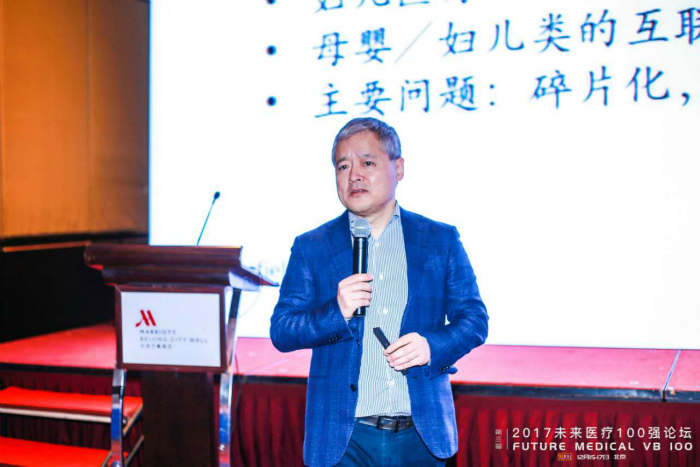
"Top 100 Future Healthcare Companies 2017" Forum, themed "The Era of Species Explosion," was held at the Beijing Marriott Hotel from December 15 to 17, 2017.
At the Maternal and Child Health Sub-forum on December 16, Duan Tao, founder of Chuntian Medical Management, delivered a speech on the theme “Pathways to Industrializing Innovation in the Maternal and Child Health Sector.” VCBeat (WeChat ID: vcbeat) has compiled the guest’s key insights.
Guest Introduction
Duan Tao, Professor, Chief Physician, and Doctoral Supervisor; Council Member of the World Association of Perinatal Medicine; Honorary Chairman of the Chinese Society of Perinatal Medicine; Member of the WHO Expert Committee on Obstetrics; Member of the FIGO (International Federation of Gynecology and Obstetrics) Expert Committee; Chairman of the Asia-Pacific Alliance for Maternal-Fetal Medicine.
A renowned expert in obstetrics and gynecology, a national disciplinary leader, a hospital administrator, and an internet pioneer. On January 25, 2017, Duan Tao stepped down as the President of Shanghai First Maternity and Infant Hospital. During his tenure, Shanghai First Maternity and Infant Hospital was the hospital with the highest delivery volume in China for four consecutive years and the most proactive in embracing the internet.
In June 2017, the venture was announced with the establishment of Shanghai Chuntian Hospital Management Co., Ltd. Composed of renowned clinical experts and hospital management specialists from both China and abroad, Chuntian Medical Management focuses on the investment, construction, operation, and management of obstetrics, gynecology, and pediatric medical institutions. It is committed to becoming the most valuable medical management group in this field, serving the transformation and upgrading of healthcare in China.
Speech Content
Innovation in the maternal and infant sector is a broad proposition, centered on two key themes: innovation and industrialization. Let us examine the current landscape.
Current Status: Few True Innovations
I am an obstetrician-gynecologist and still perform surgeries. Some time ago, I co-founded an investment fund, Fuyou Fund, with partners, and we are also engaged in design work related to hospital management.
Having worked in the maternal and child health sector for many years and evaluated numerous projects, I have observed that while perspectives may differ among doctors, public hospital directors, clinic managers, and investors, there is a prevailing sense of regret: truly meaningful innovations remain scarce within the maternal and child health industry.
What’s more? I often discuss this with some people: it’s fine to follow a “Me too” strategy (Editor’s note: replicating business models), but you must outperform competitors by offering something distinct.
Entrepreneurs should not always focus on direct competition with public hospitals and existing enterprises, as some of these entities have already established barriers. Your starting point should be to offer services that differ from existing ones; survival is possible through complementarity. If you engage in competition from the outset, survival is possible, but the cost will be substantial, requiring you to possess core competitive advantages.
I have also reviewed many platform-based projects, but the era of building platforms and chasing traffic has passed. Of course, you can enter through niche segments, but you must provide additional value. For instance, will doctors actually use your products and services? Doctors are extremely busy; senior physicians spend their days attending conferences. I rarely see them in person, often only encountering them via WeChat Moments or at airports.
It is difficult to bind physicians, whether prominent or junior, by relying on tools and platforms that offer suboptimal user experiences and consume their valuable time. Therefore, you must address the fundamental issues of commercializing products or services and clearly define the essential characteristics of a truly innovative product or service.
When I was still serving as the president of a public hospital, I helped many private enterprises with incubation, free of charge. The hospital provides access to two consumer-facing groups: we have a large number of doctors and nurses. Additionally, last year our hospital had the highest delivery volume (Editor’s note: Shanghai First Maternity and Infant Hospital), with 33,900 newborns. What can we offer to startup companies? A vast pool of patients and physicians.
For such a large demographic, what are their genuine needs and the pain points in real-life scenarios? If male entrepreneurs were to develop menstrual care products for women, would they have taken the time to understand how mothers care for their children or experienced women’s dysmenorrhea firsthand? Do they know the solutions? We need to address these pain points.
Characteristics of a Good Innovative Product or Service
Beyond addressing "pain points," it is also advisable to fully demonstrate three additional key strengths.
First, there must be “highlights.” Merely addressing pain points is insufficient; without highlights that make it “sexy,” a product or service will struggle to sustain long-term interest and will be easily replicated. If a product or service remains bulky, crude, and unrefined, female users will not adopt it.
Second, it must hit consumers’ “G-spot” and make them scream.
Third, it is essential to tap into consumers’ emotional triggers. A balanced approach combining soft and hard marketing elements should be adopted to generate buzz and encourage sharing on social media. Mothers, particularly young mothers who have grown up in the social media era, are keen on sharing. Beyond venting about their mothers-in-law or husbands on maternal and infant forums, they have numerous other topics to share and a strong need for emotional expression.
Women are not driven by logic; they seek emotional release. Only when your products and services resonate with them emotionally will you foster engagement and evoke tears on social media, prompting them to share their stories. In this way, your products will be readily accepted, liked, and even widely disseminated.
If you have these elements in place, discussing industrialization becomes easier; however, if none of the above conditions are met, talking about industrialization is far too premature.
Commercialization Pathway
If one aims to develop and industrialize a product in the maternal and infant sector, what path should be taken? In this field, products and services fall into two major categories. The first category comprises medical-related products used directly in hospital settings. The second category includes products designed for non-hospital environments. However, there is now a trend of cross-over applications, where products are suitable for both B-end hospital use and home-based care.
The Path to Industrializing Maternal and Infant Innovative Products in Hospital Settings Must Satisfy Four Key Elements: Scientific Solution, Technical Solution, Clinical Solution, and Commercial Solution.
First is the scientific proposal, which means whether it can be justified in scientific theory and whether it is advanced. I will give an example. If you develop a new instrument for use in hospitals that relies on previous-generation technology, lacks internet connectivity and digital capabilities, and fails to digitize and structure all consultation data, it will have no viable application scenarios.
There was a period when I asked my colleagues to inspect the imaging and laboratory equipment in hospitals to identify devices that lacked data interfaces and structured, standardized output. The results showed that 9% of the equipment still had no data interfaces.
At that time, I told my colleagues that from then on, any medical equipment would not be allowed into the hospital if it lacked data interfaces or did not permit data export. This is because patients in our public hospitals have long been able to use WeChat and Alipay to view imaging reports, laboratory results, and clinical data simultaneously with their physicians. If the equipment is not advanced, it should not be admitted.
Second is the technical proposal. With a scientific foundation in place, it is also necessary to assess technical feasibility. While there may be a sound scientific theory, it must still be translatable into products and technologies; therefore, technical viability remains essential.
Third, clinical protocols: even when technical feasibility and reliability are established, it is essential to assess whether the product or service can be seamlessly integrated into existing clinical workflows, thereby encouraging physician adoption and helping to enhance clinical capabilities, improve efficiency, and optimize user experience.
Fourth is the business model. If a reasonable and sustainable profit model cannot be found, resulting in no revenue from either B-side or C-side customers, the project will not be adopted by hospitals, doctors, or patients; no matter how good the project is, it will ultimately be futile.
So, what is the path to industrializing non-medical maternal and infant innovative products? The industrialization of such products differs from that of traditional industries; it must follow an internet-driven approach, involving trial and error, rapid iteration, personalized customization, and flexible production lines.
Additionally, many are experimenting with new e-commerce models and C2M (Consumer-to-Manufacturer). I recommend paying attention to “Biyao Mall,” a benchmark example of C2M. Its founder is a close friend of mine, and the model is well worth learning from.
Internet platforms in the maternal, infant, and pediatric sectors enjoy substantial traffic, yet they are characterized by fragmentation and vertical specialization, meaning that customer acquisition challenges will persist. There remain numerous entry points; for instance, women’s and children’s healthcare institutions serve as a “super gateway.”
The maternal and infant industry is vast in scale, yet fraught with numerous challenges. This presents ample room for stakeholders to leverage their expertise, as well as sufficient time to drive innovation and foster industrialization. We look forward to our collective efforts.
Note: VCBeat has made additions and deletions without altering the original intent of the guest speakers.