VCBeat Research Unveils Proprietary VB Quadrant Model: A Data-Driven Framework for Analyzing the Medical Industry
VCBeat’s 2017 Annual Report, “A Data-Driven Glimpse into Healthcare: 2017 Competitiveness Report on the Medical and Health Industry,” was officially released on December 15 at the Top 100 Future Healthcare Forum.
From 2011 to 2016, the internet healthcare sector traversed several critical growth milestones characteristic of an emerging industry. These included the disruptive innovation marked by the launch of mobile consultation services by Chunyu Yisheng in 2011, the industry’s explosive expansion during the capital investment boom in 2014, and the subsequent downturn in both the industry and capital markets from 2015 to 2016, driven by the exhaustion of traffic dividends.
As 2017 draws to a close, VCBeat’s Eggshell Research Institute focuses on innovation within the healthcare industry. By analyzing corporate operational data and investment/financing records, we have innovatively developed a quadrant model to visualize the operational status of companies in these sectors and map out the current competitive landscape. This model facilitates a clearer observation of operational realities within specific market segments, thereby enhancing the accessibility and understanding of our research findings. In this report, alongside interpreting the model, the Eggshell Research Institute examines the changes and developments in the healthcare sector over the past year from the perspectives of productivity, production relations, and factors of production.
Previously, the primary work of VCBeat’s VBInsight involved providing industry professionals focused on the healthcare sector with research reports covering four key areas: global capital dynamics, emerging technological products and business models, evolution of the industrial ecosystem, and market application trends, analyzed from multiple dimensions including technology, market, capital, and policy.
Now, VCBeat will leverage its proprietary database to develop a big data product focused on investment and financing in the healthcare industry. Additionally, it has created a novel model framework that makes our research findings easier to understand and the models simpler to implement.
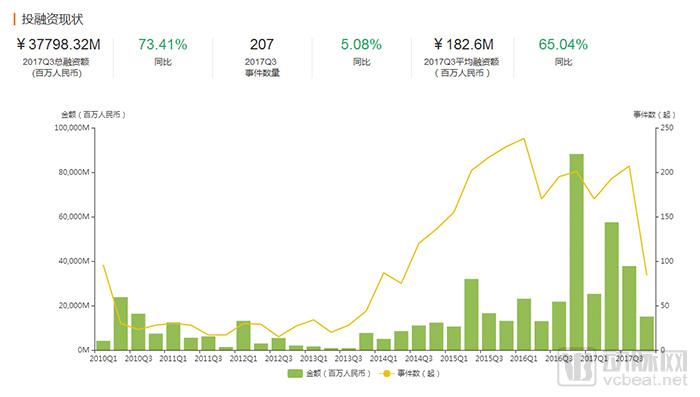
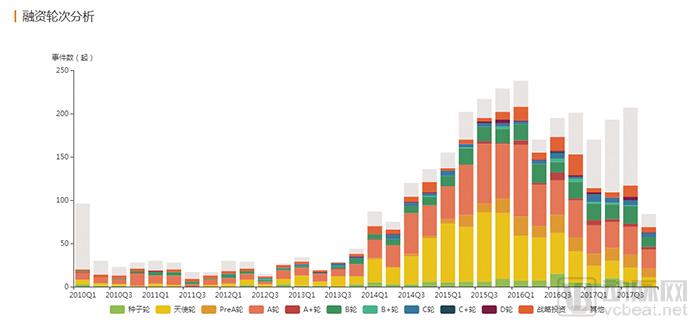
Figure: Healthcare venture capital data products based on the VCBeat database.
In the future, we will provide more industry research findings based on survey data from healthcare companies in the VCBeat network.
I. VCBeat Releases the VB Quadrant Model
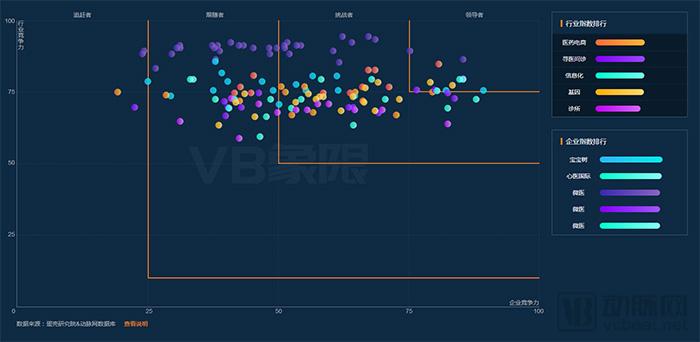
At the time of the 3rd Future Healthcare 100 Forum in 2017, based on prior multi-dimensional data research on enterprises, VCBeat Institute, in collaboration with Zero2IPO Capital, launched a initiative based on the VCBeat databaseVB Quadrant Model。
Based on the enterprise and industry data accumulated in VCBeat’s knowledge base, and supported by rigorous analyses from VBInsight and Zero2IPO Capital, we have developed an analytical model that reflects the development status of startups in the healthcare sector. We call this model the “VB Quadrant.” During the model’s development, we extend our gratitude to Zero2IPO Capital for its expert participation in designing model dimensions, assigning weight scores, and conducting data research.
1. Why We Developed This Model
VCBeat has gradually accumulated foundational data on over 10,100 companies in the healthcare sector, more than 70,000 policy updates, information on over 4,000 institutions, and upwards of 7,500 investment and financing records in recent years.
This dataset, encompassing information on over 10,100 companies, includes multidimensional details such as establishment date, website, business registration, company size, financing stage, operational status, and geographic location. Augmented by VCBeat’s interviews with these companies, as well as peripheral data including job postings and news reports, it forms a comprehensive body of corporate operational data.
2. The first batch of quadrant charts for 8 sub-sectors was released
We aim to develop a quantitative analysis model to conduct multi-dimensional quantitative assessments of projects in the field of healthcare industry innovation driven by new technologies, thereby helping users gain a better understanding of the current state of industry development.
Over the past few months, VBInsight, in collaboration with Zero2IPO Capital, conducted a multi-dimensional data survey covering more than 20 aspects across 300 innovative enterprises in 10 sub-sectors. Based on this research, the first batch of VB Quadrant Models was developed for eight sub-sectors.
VCBeat and Zero2IPO Capital will gradually expand the scope and dimensions of their corporate research, aiming to establish the VB Quadrant Model as a highly instructive metric for enterprise analysis in the primary market. This approach will leverage data trends to provide a more intuitive view of how companies evolve from small to large and from weak to strong.
II. Design Philosophy of the VB Quadrant Model
In a specific niche of the healthcare sector, which companies are competitors in the market? How are they positioned relative to one another? What is an evaluation of their respective strengths and weaknesses? Using the VB Quadrant, we can analyze the relative positions of competing companies within this niche.
VCBeat Institute outputs the positions of companies within the VB Quadrant Model using unified evaluation criteria, enabling a rapid understanding of their market performance in relevant sectors.
The VB Quadrant Model features two axes: the horizontal axis represents a company’s competitive positioning, while the vertical axis indicates its competitive positioning within its specific niche sector. We assess corporate competitiveness by gathering metrics across dimensions such as employee headcount, operational performance, financing status, management team background, and business scope. Industry competitiveness is evaluated by collecting indicators including market size, regulatory policies, investment and financing activity, and the maturity of business models.
By integrating the above two calculation results, the position of an enterprise within the VB quadrant can be determined. The quadrant is divided into four regions, and the distribution of enterprise data points across these regions reflects varying levels of competitiveness.
Leader:The enterprise operates in a sub-sector with significant growth potential and holds a substantial market share in its target market, positioning it as a unicorn within the industry. As an industry leader, the company sets the benchmark for other players in terms of product pricing strategies, new product R&D, distribution channel development, and strategic planning. It is the most likely candidate to achieve an initial public offering (IPO) in the near term.
Challenger:They are the most dynamic group of companies in the market, capable of challenging market leaders and other competitors, with the ambition to seize the position of market leader.
Followers:These companies follow market leaders and challengers in terms of products, technology, and pricing. They often lack maturity in areas such as market presence, product development, and technological innovation, and thus secure their survival by serving niche or overlooked market segments. Some enterprises formulate their corporate strategies by imitating challengers and leaders.
Chasers:Companies in this segment currently have a relatively small scale or operate in limited market spaces. These entities are predominantly startups. However, they may also demonstrate the most significant progress over the next one to two years.
Of course, a company’s competitive position is not static; today’s market leader may not remain the industry frontrunner tomorrow. Consequently, market leaders strive to maintain their leadership, while other competitors race ahead, endeavoring to improve their standing. It is this intense market competition that drives healthcare enterprises to compete with one another, thereby promoting the development of both the industry and society. The VB Quadrant Model, developed by VCBeat (VBInsight), objectively measures and evaluates competitive indicators of companies in the healthcare sector to determine their competitive positions in the market.
III. Implementation Methods of the VB Quadrant Model
Step 1: Experts determine the scoring dimensions for the indicators. By examining both the industry and enterprise perspectives, we identify the dimensions commonly monitored that represent industry and corporate competitiveness, thereby establishing a three-tier indicator model for assessing corporate competitiveness. These dimensions primarily include the company’s founding background, amount of financing raised, financing rounds, revenue figures, profitability data, company size, number of customers, and market space.
Step 2: Determine the weights of indicators at each level. Experts are invited to employ the Analytic Hierarchy Process (AHP) to evaluate the relative importance of indicators, taking into account the nature of industry competitiveness. The AHP quantifies factors that are difficult to measure directly; combined with expert scoring, the geometric mean method is used to calculate the priority vectors for each dimension, thereby determining the indicator weights. For certain specific indicators, experts directly assign and quantify their weights based on practical considerations.
Specific Implementation: The weights of each dimension are calculated using the square root method for the AHP analysis table, and a consistency check is performed on the weight matrix.
Step 3: Establish scoring criteria for underlying metrics. Based on the actual conditions of indicators across different dimensions, an expert panel shall define distinct scoring gradients and standards. Metrics for certain dimensions can be updated in real time, reflecting daily updates from the VCBeat database.
Step 4: VCBeat and Zero2IPO Capital collect corporate operational data, input industry and company data into the aforementioned model according to the established criteria, automatically calculate weighted scores to derive each company’s total score, and finally assess comprehensive competitiveness through quadrant analysis.
IV. Open Enterprise Data Collection Channels
During its collection of corporate data from public sources, VCBeat Institute found that, for various reasons, the operational and financing/investment data of many companies remain undisclosed. In other cases, the data are outdated, preventing their inclusion in our outputs. If you wish to have your company included in the VB Quadrant or to update the latest operational data and corporate status, please contact VCBeat Institute via email at vb@vcbeat.top to complete the data collection process.
V. Analysis of the VB Quadrant Model by Subsector
VCBeat, in collaboration with Zero2IPO Capital, conducted surveys of hundreds of companies across eight sectors through enterprise research and data analysis. Based on data collection and quantitative analysis, the VB Quadrants for these eight sectors were derived.
1. Medical Consultation
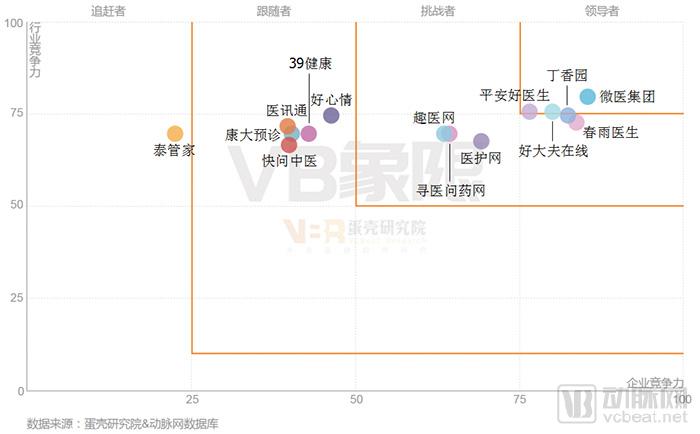
According to iResearch data, China's internet healthcare market size surged from RMB 200 million in 2009 to RMB 22.3 billion in 2016. The market growth rate has remained stable and is expected to stay at around 40%, indicating that the industry has transitioned from a phase of rapid expansion to one of steady development.
In 2017, internet healthcare companies made numerous attempts to explore the monetization of their commercial value. With capital infusion, some players rapidly emerged as leaders in the field, unicorns began to appear, and a large number of followers were either eliminated or forced to transform their business models.
The biggest challenge for internet healthcare has long been figuring out how to implement a viable business model and address the profitability issues faced by internet healthcare companies. Although the industry has seen substantial financing amounts and numerous funding events, achieving profitability and completing an initial public offering (IPO) remains challenging.
In 2017, the internet healthcare industry was primarily focused on finding ways to penetrate the core of medical services, giving rise to models such as internet hospitals, offline hospitals, and offline clinics. Initially, internet healthcare mainly aimed to meet users’ needs for appointment registration and lightweight consultations. After five years of fluctuations and adjustments, starting from 2017, leading companies in the industry began to cover pre-diagnosis, during-diagnosis, and post-diagnosis stages, gradually entering a phase of rational development.
2. Healthcare Informatics
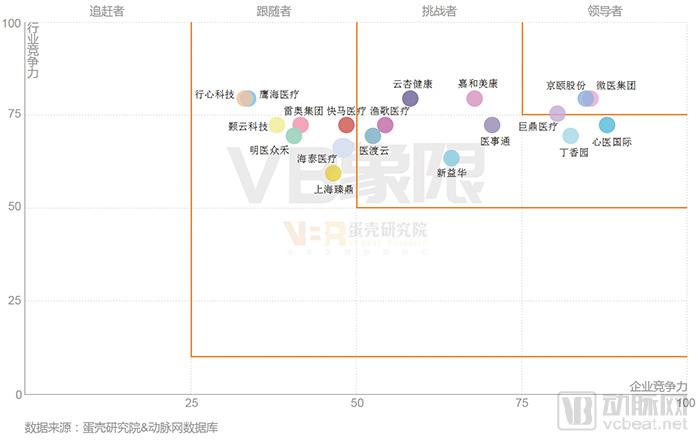
In 2017, the healthcare informatics industry was a year of exploration. The sluggish revenue growth of listed companies prompted them to urgently seek new industry growth points.
VBInsight’s VB Quadrant analysis of the healthcare IT industry reveals that the sector is substantial in scale, has undergone prolonged development, and has established its foundational structure. New industry opportunities remain to be uncovered, while leading enterprises are in the phase of seeking breakthroughs.
The scope of healthcare IT companies compiled by VCBeat Research Institute excludes large enterprises that have already entered the capital markets. From the perspective of industry participants, most of these companies are innovators that have bypassed the traditional six major hospital information systems. They have entered the market by focusing on other hospital systems or medical big data and are currently in the phase of exploring commercial value. As a result, their business models have not yet achieved a virtuous cycle, with most companies still in the stage of quiet cultivation.
3. Artificial Intelligence
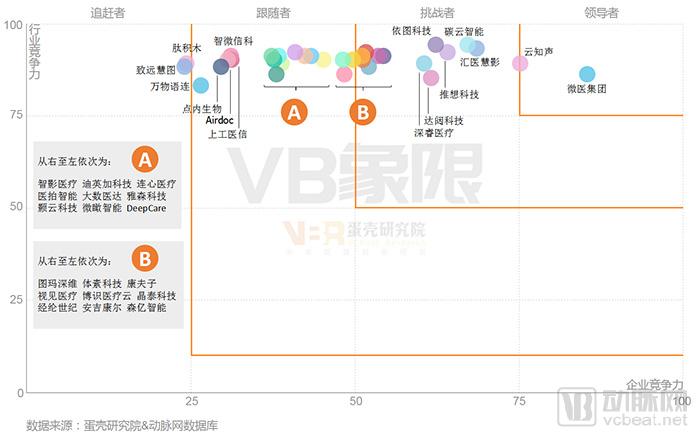
Through its VB Quadrant analysis of the “AI + Healthcare” sector, VCBeat has found that the industry remains in its nascent stage, with most companies still focused on technology research and development. Given the vast market potential of this entirely new sector, which lacks a clear leader and represents a highly promising blue ocean, “AI + Healthcare” received the highest score for industry competitiveness within the VB Quadrant framework.
From the perspective of industry participants, the disparities in artificial intelligence (AI) capabilities among companies are primarily attributable to differences in research outcomes. As commercialization has not yet matured, most enterprises score relatively low in terms of corporate competitiveness. (Since our assessment of corporate competitiveness evaluates a company’s overall status, enterprises with diversified business operations tend to achieve higher scores, given that the commercialization process within the “AI + Healthcare” sector is still in its early stages.)
For more detailed analytical reports, please scan the QR code below to purchase, or become a VCBeat member.

Scan the QR code above toPurchase the full report for 499
Scan the QR code below to become an official VCBeat member, and you canFree AccessAll Reports by VBInsight!