

Baiyunshan Invests RMB 800 Million in Yixintang, Becomes Its Third-Largest Shareholder
Yixintang recently announced the completion of its private placement of A-shares, issuing 47.1698 million new shares at a price of RMB 19.08 per share, raising a total of nearly RMB 900 million.
The placement targets include Yixintang founder Ruan Hongxian and Baiyunshan, with Ruan Hongxian subscribing for 52.4111 million shares at a cost of approximately RMB 100 million, and Baiyunshan subscribing for 41.9287 million shares at a cost of approximately RMB 800 million.
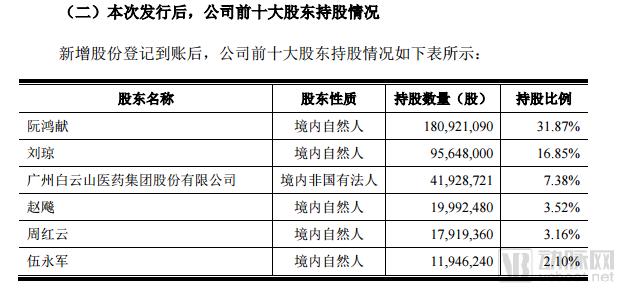
VCBeat (WeChat ID: vcbeat) has learned that, following the completion of this issuance, Ruan Hongxian’s shareholding in Yixintang decreased to 31.87%, while he remains the largest shareholder; Guangzhou Baiyunshan Pharmaceutical Holdings Co., Ltd.’s shareholding reached 7.38%, making it the third-largest shareholder of Yixintang and the largest non-natural person shareholder.
In fact, signs of this deal emerged as early as the beginning of this year. At that time, Yixintang announced a public offering of 78.838 million shares to unspecified investors at an issue price of RMB 19.28 per share, aiming to raise no more than RMB 1.52 billion. The unspecified investors included Ruan Hongxian, Baiyunshan, and several institutional investors.
On the same day, Baiyunshan also announced that the company had reviewed and approved a proposal to subscribe for non-publicly issued A-shares of Yunnan Hongxiang Yixintang Pharmaceutical (Group) Co., Ltd. with RMB 800 million from its own funds.
Subsequently, Yixintang’s private placement of shares underwent several changes. On November 1, 2017, the China Securities Regulatory Commission (CSRC) approved Yixintang’s private placement plan, authorizing the company to issue no more than 79.665 million new shares through non-public offering.
However, apart from Ruan Hongxian and Baiyunshan, several investment institutions that disclosed their intentions at the beginning of the year did not follow through. As of December 12, only Ruan Hongxian and Baiyunshan had fulfilled their share subscription plans as agreed.
What Is the Purpose of Yixintang’s Fundraising?
As the first listed company in China with pharmaceutical retail as its core business, Yixintang is based in Yunnan and deeply rooted in Southwest China, holding a pivotal position in the pharmaceutical retail market.
According to Yixintang’s third-quarter report, as of September 30, 2017, Hongxiang Yixintang and its wholly-owned subsidiaries operated a total of 5,009 directly-run chain stores. These included 3,163 in Yunnan, 515 in Guangxi, 581 in Sichuan, 222 in Shanxi, 162 in Guizhou, 183 in Hainan, 157 in Chongqing, and 26 in other provinces and municipalities.
Hongxiang Yixintang and its wholly-owned subsidiaries operate 3,897 stores qualified for medical insurance card payments, accounting for 77.80% of the total.
During the reporting period, the Company strengthened its expansion in the Sichuan-Chongqing and South China regions through external acquisitions. Currently, the number of the Company’s directly-operated chain stores in the Sichuan-Chongqing region has exceeded 700, with 180 stores in the Hainan region and over 500 directly-operated chain stores in the Guangxi region.
Yixintang has initially established a business layout with Southwest China as its core operating region, South China as its strategic depth region, and North China as a supplementary region. In many markets outside Yunnan Province, it holds significant brand and service influence.
Mergers and acquisitions are the primary driver of Yixintang’s sustained growth. According to the third-quarter report, the company achieved total operating revenue of RMB 5.6 billion during the reporting period, representing a year-on-year increase of 23.53%. Net profit attributable to shareholders of the parent company amounted to RMB 316 million, an increase of 11.36% compared with the previous year.
We can gauge the changes in Yixintang’s store count in recent years from a single chart.
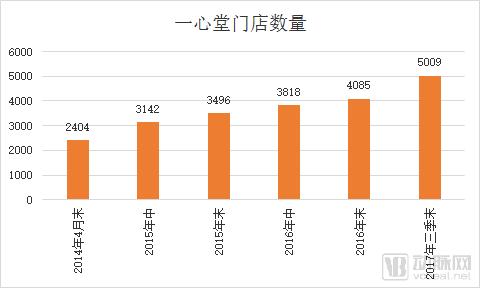
As can be seen, since its listing, the number of Yixintang stores has more than doubled. In this regard, Yixintang has also been dubbed the “M&A King.”
“Steady progress in organic growth, continuously expanding market share,” and “prominent expansion through M&A, driving rapid growth in core business revenue.” This is how Yixintang explained the reasons for its performance growth.
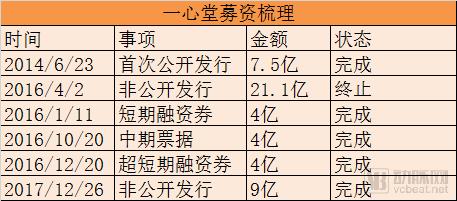
Mergers and acquisitions require substantial capital injection. In fact, since its initial public offering, Yixintang has repeatedly raised funds through methods such as private placements, issuance of short-term bonds, and commercial paper.
VCBeat’s rough statistics show that since its listing, Yixintang has completed five fundraising rounds, raising a total of RMB 2.85 billion.
Speculation on Baiyunshan's Takeover
Baiyunshan is primarily engaged in: (1) the research and development, manufacturing, and sales of finished Chinese and Western medicines, chemical active pharmaceutical ingredients (APIs), natural medicines, biopharmaceuticals, and intermediates for chemical APIs; (2) the wholesale, retail, and import/export of Western medicines, traditional Chinese medicines, and medical devices; (3) the research and development, production, and sales of big health products; and (4) investments in the health industry, including medical services, health management, and wellness and elderly care. Over the past three years, Baiyunshan has achieved sound business development and operational results.
According to Baiyunshan’s semi-annual report, Baiyunshan currently oversees 26 pharmaceutical manufacturing enterprises and institutions (comprising 3 branch companies, 19 controlled subsidiaries, and 4 joint ventures), including 12 China Time-honored Brand pharmaceutical enterprises such as Zhongyi Pharmaceutical, Chen Liji Pharmaceutical Factory, Qixing Pharmaceutical, Jingxiutang Pharmaceutical, and Pan Gaoshou Pharmaceutical, as well as Wang Lao Ji Great Health Company and the jointly operated Wang Lao Ji Pharmaceutical Company.
Baiyunshan divides its business into four segments: Grand Southern Pharmaceuticals, Grand Health, Grand Commerce, and Grand Healthcare. In the first half of 2017, the revenues for the first three segments were RMB 3.983 billion, RMB 5.0 billion, and RMB 2.015 billion, respectively. It is evident that Grand Health is Baiyunshan’s most important business segment and primary source of revenue.
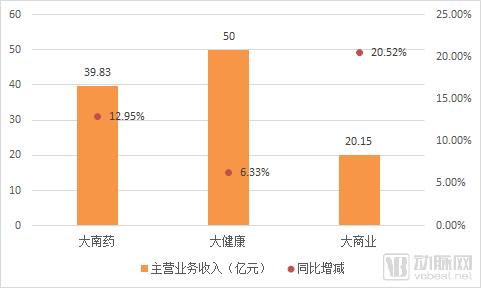
Baiyunshan's 2017 Semi-Annual Report Performance
Baiyunshan’s takeover of Yixintang has also sparked considerable market speculation. Beyond bolstering Yixintang’s capital for expansion and M&A, there is a high likelihood of synergies emerging between Baiyunshan’s pharmaceutical manufacturing and distribution operations and Yixintang’s business.
Overall, 2017 was a year of rapid change for the pharmaceutical industry, with both manufacturing and distribution sectors facing significant pressures from policy and consumer levels.
In terms of Yixintang’s core pharmaceutical retail business, there is both endogenous drive from regional M&A integration and incremental market growth brought about by prescription outflow and the separation of prescribing from dispensing. With these two factors superimposed, relevant companies should exert efforts in multiple areas to strategize for future development.