

Tencent AIMIS Sets Sights on Dominating China's Medical AI Market with Nearly 100 Hospital Partnerships Amid Accelerating Industry Consolidation
On November 15, 2017, Tencent Miying was included in the first batch of national next-generation artificial intelligence open innovation platforms, tasked with building the National Next-Generation Artificial Intelligence Open Innovation Platform for Medical Imaging.
Following the announcement, a variety of reactions emerged within the industry, ranging from endorsement to skepticism. Some believe that Tencent AI boasts robust technical capabilities and offers six major medical AI imaging products, making it well-equipped to take on this significant responsibility. Others, however, argue that as an internet company, Tencent entered the market late and its products lack a competitive edge, even lagging behind those of some startups.
Regardless of whether it is widely accepted, Tencent Miying has ultimately joined the “national team.” In the wake of this development, Tencent has accelerated the deployment and implementation of its smart city and smart hospital initiatives, intensifying competition among medical AI providers for hospital contracts and giving rise to an initial trend toward industry consolidation.
After Joining the "National Team," Miying Accelerates Its Strategic Expansion
Prior to joining the “National Team,” Tencent Miying primarily entered hospitals by forming alliances. According to information obtained from VCBeat, the frequency of such collaborations was previously low, and no renowned Grade A tertiary hospitals in Beijing or Shanghai were among the partner institutions.
On August 23, 2017, Tencent Miying’s early esophageal cancer screening system was launched at the People’s Hospital of Guangxi Zhuang Autonomous Region;
As of the end of September 2017, Tencent Miying had jointly established Artificial Intelligence Medical Imaging Joint Laboratories with Sun Yat-sen University Cancer Center (Guangdong Esophageal Cancer Institute), Guangdong Second Provincial General Hospital, Shenzhen Nanshan District People’s Hospital, Liuzhou Workers’ Hospital, West China Second University Hospital of Sichuan University, West China Fourth Hospital of Sichuan University, and Sichuan Second Traditional Chinese Medicine Hospital.
On September 26, 2017, Lishui Central Hospital signed a framework cooperation agreement on “Internet + Smart Hospital” with Shenzhen Tencent, becoming the first hospital in Zhejiang Province to formally sign an agreement with Tencent.
In late October 2017, Tencent Miying, together with 69 members of the “Western Ophthalmology Alliance,” including Xi’an No. 4 Hospital, established the “Joint Laboratory for Artificial Intelligence in Medical Imaging.”
On November 15, 2017, Tencent Miying was included in the first batch of national next-generation artificial intelligence open innovation platforms. Prior to this, Tencent initially focused on individual hospitals as a breakthrough point, and then established collaborations with hospitals through alliances or joint laboratories. At that time, Tencent Miying did not engage in direct competition with startups in the medical AI sector; its products were not yet sufficiently distinctive, and thus did not exert significant pressure on entrepreneurs.
After being selected as part of the “National Team,” Tencent Miying has leveraged its esophageal cancer screening system, WeChat Pay, smart hospital solutions, and its “National Team” status to continuously expand its presence in offline hospitals. It has even adopted a city-by-city strategy to capture market share, gradually penetrating developed regions such as Shanghai and Zhejiang, and showing early signs of competition with startups.
Although Tencent’s medical AI products do not hold an absolute advantage, its robust healthcare service ecosystem has fueled rapid expansion, with the company partnering with nearly one hospital every two days.
On November 17, 2017, Tencent Miying’s AI-powered medical imaging diagnosis project was launched at Wenzhou Central Hospital;
On November 21, 2017, the Obstetrics and Gynecology Hospital of Fudan University signed an agreement with Tencent, planning to leverage Tencent Miying to enhance operational efficiency within the hospital and its medical consortium. The two parties will collaborate and explore applications in the field of AI-driven healthcare, including screening for diseases such as cervical cancer.
On November 23, 2017, Tencent Miying was fully implemented in Hebei Province, establishing collaborations with Hebei Medical University, the First Hospital of Hebei Medical University, the Third Hospital of Hebei Medical University, the Fourth Hospital of Hebei Medical University, and Hebei Eye Hospital.
On December 1, 2017, Tencent Miying was fully deployed in Chongqing Municipality. Five major Grade A tertiary hospitals in the Chongqing region—including the First Affiliated Hospital of Chongqing Medical University, Chongqing Fuling Central Hospital, Chongqing Fourth People’s Hospital, Chongqing Three Gorges Central Hospital, and Chongqing Ninth People’s Hospital—will gradually leverage Tencent Miying’s artificial intelligence technology to assist physicians in screening for early-stage esophageal cancer, pulmonary nodules, diabetic retinopathy, and other conditions.
On December 3, 2017, the Tongxiang Municipal Health and Family Planning Bureau and Tencent signed a cooperation agreement for the “Medical Artificial Intelligence Project” in Wuzhen, establishing the “Tencent Internet+ Medical Big Data Research and Demonstration Base,” marking the full deployment of Tencent Miying in Tongxiang City;
On December 4, 2017, Zhejiang Provincial People’s Hospital and Tencent unveiled the “Joint Laboratory for Artificial Intelligence in Medicine” in Hangzhou, leveraging Tencent Miying to conduct research and applications in AI-powered healthcare. Meanwhile, the two parties will also collaborate with Zhuojian Technology to promote the launch of innovative medical payment services, including WeChat-based medical insurance payments and WeChat-based payments for the New Rural Cooperative Medical Scheme.
On December 6, 2017, Tencent Miying was launched at the Shenzhen Traditional Chinese Medicine Hospital;
On December 7, 2017, the Second Hospital of Lanzhou University and Tencent held a signing ceremony for the “Internet + Smart Hospital” initiative and unveiled the “Joint Laboratory for Artificial Intelligence in Medicine.” The two parties will collaborate to explore the applications of Tencent Miying in the fields of AI medical imaging and AI-assisted diagnosis, while also cooperating on mobile payment innovation and electronic prescriptions.
On December 9, 2017, Liuzhou, Guangxi, partnered with Tencent Miying to deepen their “Internet + Healthcare” collaboration, strengthening cooperation in areas such as medical insurance payment, online consultations, and prescription circulation to jointly build smart hospitals;
On December 14, 2017, Tencent Miying was fully launched at the Affiliated Hospital of Yan’an University to assist physicians in conducting AI-assisted screening for lung cancer.
In less than half a year, the number of partner hospitals for Tencent Miying has approached 100 (including 69 medical institutions within the “Western Ophthalmology Alliance”), a pace sufficient to astonish the industry.
Tencent Healthcare's positioning remains as a connector.
Chen Guangyu, Vice President of Tencent Group, stated that the primary challenge in promoting AI products lies in positioning. He emphasized that Tencent’s overall healthcare product strategy remains centered on connectivity, with its AI offerings designed to function as physician assistants. For instance, in the early screening of esophageal cancer, Tencent Miying does not disrupt physicians’ existing workflows; instead, it provides them with more decision-support information more efficiently.
At VCBeat’s “2017 Top 100 Future Healthcare Forum,” Wu Mingzhu, Director of the Tencent Miying Application Center, also stated that he hopes to leverage AI technology to help physicians improve efficiency in screening for diseases such as lung cancer, diabetic retinopathy, and esophageal cancer.
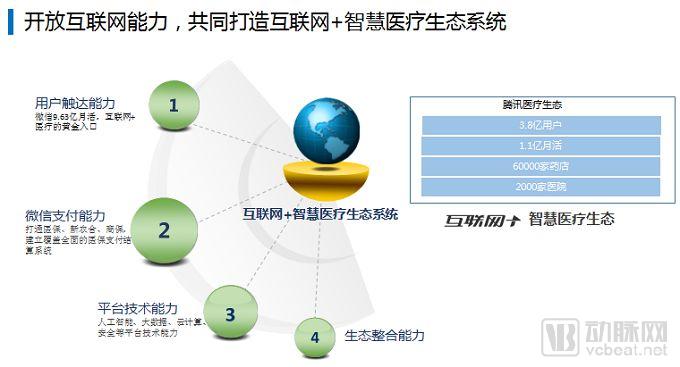
Tencent developed and promoted the Miying system, with ulterior motives beyond its immediate application; it also aims to position the system as a component of its broader “Internet + Smart Healthcare” ecosystem. Tencent’s “Internet + Smart Healthcare” portfolio encompasses services such as WeChat-based medical insurance payments, commercial insurance, online medical consultations via WeChat, electronic prescriptions through WeChat, WeChat-enabled patient follow-up services, AI-assisted diagnosis and treatment, structured medical records, and healthcare big data.
Miying’s inclusion in the “national team” may have come as a surprise even to Tencent, but this role indeed strengthens Tencent’s hand in promoting its “Internet + Smart Healthcare” strategy.
Enhancing the Layout of Smart Cities and Smart Hospitals
At this stage, Tencent’s medical AI technologies and products may not hold an absolute leading edge; however, its smart city and smart hospital solutions—built on the foundation of Tencent Miying, WeChat Pay, and the New Generation Artificial Intelligence Open Innovation Platform—are difficult for local governments and hospitals to resist.
Such comprehensive services, spanning from smart hospitals to smart cities, will bolster the implementation of Tencent’s “Internet + Smart Healthcare” strategy.
At the signing ceremony with Lishui Central Hospital, Wu Xiongfei, Deputy Director of the Lishui Municipal Commission of Economy and Information Technology, stated that the development of Smart Lishui encompasses smart industries, smart government, and smart public services, with healthcare being a top priority within smart public services. As a Grade 3A general hospital, Lishui Central Hospital has substantial demands for and investments in informatization. We believe that Lishui City’s collaboration with Tencent on the “Internet + Smart Hospital” initiative is driven by two factors: first, recognition of the value of Tencent Miying; and second, appreciation of Tencent’s comprehensive service capabilities as an internet giant.
On December 1, 2017, Tencent Miying was launched in Chongqing. Tencent and the Chongqing Municipal People’s Government signed a strategic framework agreement in Chongqing, under which both parties will deepen their cooperation in smart cities, smart government services, and smart healthcare. The attendance of key officials from the Chongqing Municipal Party Committee and Municipal People’s Government, along with Ma Huateng, at the signing ceremony underscored the high level of importance attached by both sides.
Not only that, but industry insiders also revealed to VCBeat that after Tencent Miying became a national AI open innovation platform, startups have clearly felt the pressure. When they expand their business to new cities, they find that Tencent Miying has already penetrated the market.
From the perspective of regional business layout, hospitals initially targeted by startups were mostly located in first-tier and new first-tier cities such as Beijing, Shanghai, Hangzhou, and Wuhan. In contrast, Tencent Miying started in Shenzhen and gradually expanded to regions including Sichuan, Guangxi, Hebei, Shaanxi, Zhejiang, Shanghai, and Chongqing, with a focus on second-tier cities.
This has led to a situation where startups entering second-tier cities find that Tencent Miying has already established its presence. Moreover, even companies that had deployed their business operations in these second-tier cities ahead of time are now being overtaken by Tencent Miying. After all, compared to startups offering single AI-assisted diagnostic products, Tencent—with its comprehensive portfolio spanning smart cities and smart hospitals—is undoubtedly more favored in the eyes of government authorities.
Accelerating Industry Consolidation
Faced with the rapid momentum of Tencent Miying, startups are not helpless.
First, Tencent Miying has not yet established an absolute advantage in technology and products. According to VCBeat, many startups are actually more confident in their own products. In terms of clinical application, research depth, and medical distribution channels for AI healthcare products, many startups are no inferior to Tencent Miying, and some even hold certain advantages.
However, it is well known that Tencent Miying not only enjoys substantial financial backing but also benefits from support across comprehensive medical service sectors, including WeChat Pay, online consultations, and healthcare big data. This complete “Internet + Smart Healthcare” ecosystem constitutes a barrier to entry that startups find difficult to compete against.
Currently, many medical AI startups have secured substantial funding rounds. However, healthcare is a slow-moving industry, and significant upfront cash burn is unavoidable. Relying solely on current ample liquidity is clearly unsustainable in the long run. In particular, given Tencent Miying’s ambitious aspirations, it is prudent to plan ahead and prepare for potential challenges.
For medical AI startups, we believe there are roughly three development paths:
First, leverage external partnerships to address internal gaps. Medical AI startups should build platforms that foster synergies with companies in fields such as medical big data, internet healthcare, and healthcare informatics, integrating and bundling their products for deployment in hospitals.
Second, seek a “powerful backer” by aligning with internet giants or large healthcare enterprises. Today, innovations across various industries ultimately bear labels such as “Tencent-affiliated” or “Alibaba-affiliated,” and medical AI appears to be following a similar trend;
Thirdly, only well-funded medical AI companies, such as iFlytek, have the opportunity to truly exist independently. For such companies, rather than concerning themselves with so-called factional dynamics, it is more important to refine their products and meet the needs of their partners to the greatest extent possible.
Although Tencent has not disclosed the reasons for Miying’s inclusion in the “national team,” there is no denying that this development will have a profound impact on the entire medical AI industry. Tencent’s ambition to capture market share in medical AI through Miying has become evident, which will intensify competition and accelerate consolidation within the sector. As we have now entered 2018, the outcome is expected to unfold within the year.