

Ji Health Raises $9M in Angel Round, Targets Post-Checkup Market and Monetizes Health Data
The imbalance between supply and demand has created significant growth potential for the health management industry. The market size of China’s health management sector is projected to reach RMB 203.9 billion by 2020, with an annual growth rate of 14.82%. As the trend of consumption upgrading becomes increasingly pronounced, the healthcare industry is facing unprecedented opportunities.
Yet, in the face of tremendous opportunities, challenges persist:
How to Break Down Information Silos and Achieve Interconnectivity of Electronic Health Records and Fragmented Data Across Different Medical Institutions?
How to Return Healthcare Data to Patients and Establish Joint Ownership Between Medical Institutions and Patients?
How can we ensure that everyone has a comprehensive, portable health record and can access high-quality medical services anywhere?
Ji Jiankang, leveraging the strengths of Ciming Health Checkup, attracted widespread attention within the industry from its inception. How has this “spotlight” company leveraged data to drive its success?VCBeat (WeChat: vcbeat)The answer was found in a conversation with Wu Yong, Executive Chairman and CEO of CI JI Health.
Multiple Ventures, Pursuing the Dream of Multi-Scenario Medical Services
Wu Yong is the co-founder of Mingyi Zhudao. He graduated from the Department of Clinical Medicine at Nanjing Medical University, where he earned his M.D. degree. With many years of clinical experience in surgery, he has accumulated extensive medical resources. Having been immersed in the healthcare industry for many years, he has a deep understanding of its pain points. Therefore, in 2014, when the wave of internet innovation swept across China, Wu Yong resolutely resigned from his position to join the entrepreneurial ranks.
He candidly stated that, given the unique attributes and industry characteristics of healthcare, along with an offline mindset emphasizing the essence of medical care and patient experience, he decided to relinquish his board and management roles at Mingyi Zhudao, a star project, retaining only his status as a shareholder to embark on a new entrepreneurial venture.
“By chance, Dr. Han Xiaohong, founder of Ciming Health Checkup and Chairman of Ji Jiankang, shared with me the company’s development strategy and current status. With vast amounts of precise health checkup data that have been structured through more than two years of dedicated R&D, the company has established a standardized health management service system for its checkup users. Artificial intelligence technology has increased physicians’ efficiency by dozens of times. Suddenly, it struck me that Ji Jiankang is akin to NetEase in the early days when it launched its news portal.”
He believes that under Dr. Han’s leadership, Ji Health has reached a level poised for explosive growth. “I felt that realizing my dream of multi-scenario medical services on this platform was within such close reach that, after carefully considering the entire business logic, I accepted Dr. Han’s invitation to join the team.”
Ji Jiankang has assembled an elite team comprising experts in big data, artificial intelligence, and healthcare, most of whom hold advanced degrees or have served as executives at Fortune 500 companies. The team includes 30 physicians and maintains close collaboration with over 2,000 doctors and nurses from Ciming Health Checkup. This cross-disciplinary integration of industry experts and AI data specialists will bolster Ji Jiankang’s confidence in becoming a leader in the field of health management.
Using Health Checkup Data as the Entry Point
Wu Yong believes that CI Health is a health management and medical services company built on big data and artificial intelligence technologies, providing post-examination report interpretation, health guidance, medical interventions, and health insurance services to users of physical examination institutions. “We have a professional team for technology R&D and physician services, along with tens of millions of health-related big data records. By integrating various physical examination data and vital sign indicators, we establish comprehensive health records. We leverage big data mining and applications to assess users’ disease risks, while employing artificial intelligence technologies to deliver precise health management and follow-up medical services covering the entire life cycle.”
Backed by the formidable support of Ciming, the data advantages of Ji Health are fully evident.
“Ji Jiankang leverages health checkup data as an entry point to mine and apply big data in healthcare, relying on artificial intelligence technology to achieve precise matching between user health management and medical services, thereby preserving and enhancing the value of life,” said Wu Yong.
Previously, he stated in a media interview that Ji Jiankang leverages Ciming Health Checkup’s 15 years of data accumulation, supported by 18 million structured health examination records, to build precise health management models and enhance physicians’ efficiency in managing patient care.
The Ji Health Platform has currently achieved 95% service standardization, increasing the service efficiency of health management physicians by more than 20-fold.
Unlocking the Value of the Post-Health Checkup Market
Using health checkup data as the entry point is the first step taken by CIJI Health.
Ji Jiankang not only provides full-process, personalized health management services for users after their medical check-ups, but also offers green-channel medical services, including appointment scheduling at tertiary hospitals, remote consultation on behalf of patients in other regions, expert consultations, domestic and international remote consultations with specialists, overseas second-opinion reports, expedited testing, hospital transfer and transportation, and professional medical accompaniment.
Wu Yong defines Ji Jiankang as a big data-driven precision medical and health service platform, whose core consists of four components: Record Health, Measure Health, Manage Health, and ultimately Safeguard Health. Among these, “Record Health” refers to retrieving users’ historical health information with their consent, comprehensively and accurately recording dynamic data from the past, present, and future, and then returning these data to the users.
In the field of health management, Ji Jiankang targets the post-checkup health management market. Currently, post-checkup tracking, follow-up, and other health management services remain relatively underserved. The emergence of Ji Jiankang precisely fills this gap. By collecting checkup data, it enables multi-channel, multi-dimensional health management functions, while the value of such data is immeasurable.
Dr. Han stated that the internet, mobile health, big data, and cloud computing have provided the industry with opportunities to address health management issues through low-cost, high-efficiency means. “Through our data platform, we can facilitate doctor-patient communication, enable mutual selection between doctors and patients, overcome geographical barriers, and resolve language obstacles.” Ji Jiankang is a key platform for achieving this goal.
Ji Jiankang leverages users' historical health data to provide effective, precise, and customized offline health services. Users can also communicate and interact with doctors conveniently and in real time via mobile devices, enabling online self-health management based on physical examination data.
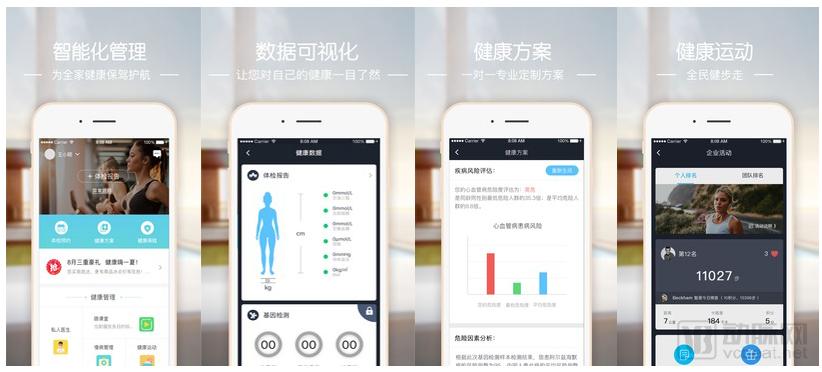
CI Health App Interface
Wu Yong is highly confident in his product, stating, “By leveraging our explorations in health big data and artificial intelligence, along with Ji Health’s team of professional physicians and offline resources, we can not only utilize big data analytics to screen and segment populations for precise health management, but also integrate a wealth of smart healthcare and offline medical services—a capability unmatched by similar products and companies.”
In addition, the company also collaborates with domestic medical institutions to provide users with healthcare products, such as early cancer screening, genetic testing, and biological age assessment.
By collaborating with public and private hospitals at all levels, health examination institutions, internet healthcare providers, artificial intelligence firms, and insurance companies, CI Health has continuously increased its investment in big data mining and AI technology R&D. It is refining existing health management service processes, leveraging health big data as an entry point to more effectively connect medical resources across all tiers, accelerate the penetration of AI technologies in the healthcare industry, break down information silos, precisely match resources, and overcome barriers to tiered diagnosis and treatment.
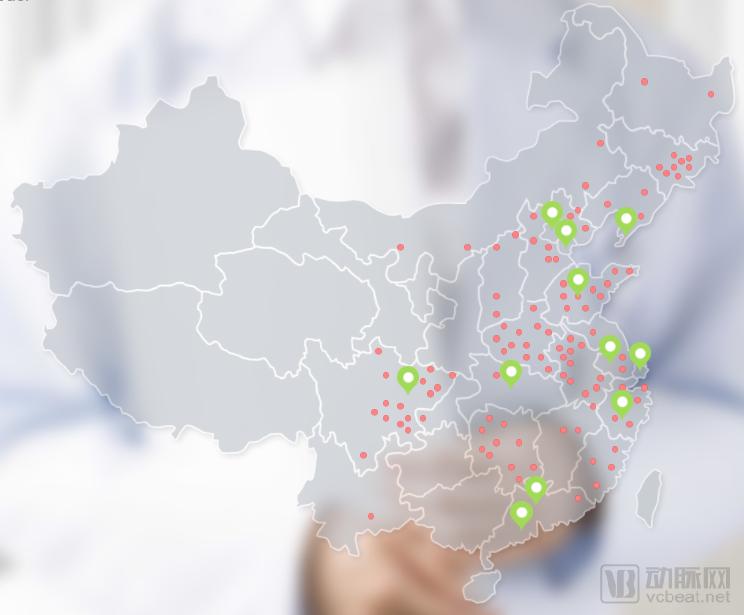
Distribution of CI JI Health’s Large and Small Testing Sites(Source: Official Ji Jiankang)
According to data disclosed on its official website, Ji Jiankang has established over 70 flagship stores, more than 300 testing bases, and upwards of 1,000 health kiosks across China. It also employs over 6,000 health managers and private physicians, and has accumulated tens of millions of health examination records. Leveraging an O2O model for offline blood collection services, the company has set up more than 300 blood collection stations covering 32 provinces, municipalities, and autonomous regions. Additionally, it operates over 20 laboratory centers in cities including Shenyang, Beijing, Wuhan, Changsha, Chengdu, Guangzhou, and Sanya, with the aim of creating the largest life-science testing portal for China’s 1.3 billion people.
Reducing Marginal Costs Through Big Data and AI
The health management demanded by the general public is professional medical service that is high-standard yet low-cost. This requires ensuring sufficient professionalism in medical services while controlling service costs.
Wu Yong believes that the competitive advantage of Ji Jiankang’s health management services lies in its collaboration with senior health management physicians in the industry, integrating big data and AI into health management services. This has led to the development of Ji Jiankang’s “AI + Health Management” Intelligent Physician Platform, which ensures over 95% standardization of health management services while achieving a dozens-fold increase in service efficiency. Ji Jiankang has reduced the physician service time per corporate client from tens of minutes under traditional models to an average of one minute, with a marginal service cost of approximately RMB 1. Through its “AI + Health Management” model, Ji Jiankang has significantly lowered service costs and enhanced service capacity, thereby realizing economies of scale.
“In fact, during its first two years of development, Ji Jiankang invested tens of millions of yuan in R&D expenses, primarily to address how to improve the quality of health management services while significantly reducing marginal costs. ‘This issue was largely resolved by June 2017, enabling the Ji Jiankang platform to commence large-scale commercial deployment of health management services,’ said Wu Yong.”
Following the completion of its angel financing round this October, Ji Jiankang will continue to intensify its efforts in big data mining and artificial intelligence (AI) technology research and development, thereby enhancing its existing health management services. In Wu Yong’s view, only by leveraging health big data to enter the medical sector, more effectively linking medical resources at all levels, and accelerating the penetration of AI technologies within the healthcare industry can Ji Jiankang achieve its ultimate goal: building a comprehensive, full-lifecycle medical and health ecosystem.
Exploring Monetization Models Through Third-Party Partnerships
It is reported that Ji Jiankang’s partners include Yilianzhong, iFlytek, Mingyi Zhudao, Shuidi Huzhu, and ZhongAn Insurance. Wu Yong stated that integrating with various types of third-party applications represents Ji Jiankang’s exploration of pathways to diversify its revenue streams, as well as its initial step toward building a comprehensive healthcare ecosystem.
According to Wu Yong, in existing collaborations, the partnership between Ji Jiankang and Mingyi Zhudao aims to explore a monetization model for post-examination third-party service output; the cooperation with Yilianzhong is intended to identify new sources of health examination data, extending data collection, analysis, and management deep into community medical service centers; and the collaboration with iFlytek is geared toward advancing data intelligence.
“We have partnered with Yilianzhong, a listed company specializing in medical insurance big data, to collaborate with the examination departments of healthcare institutions at all levels in Fujian Province, private health checkup providers, and community health service centers. This initiative allows us to provide post-examination extended services to their users while simultaneously expanding our channels for third-party health checkup data sources.”
In the strategy of Ji Jiankang, Wu Yong expects to build a commercial closed loop based on the following structure:
Structured Analysis Based on Health Checkup Report Data: Converting Offline Static Data into Online Dynamic Data (Building a Database Using Mobile Device Identifiers, with Data Desensitization to Mitigate Privacy Risks) – Monetization through Business Alliances.
“Within the Ji Jiankang alliance system, any institution capable of providing health checkup report data is regarded as a site administrator. At this stage, we offer post-checkup services to their clients free of charge. Once large-scale monetization begins, revenue will be distributed among these institutions based on the volume and quality of their data,” said Wu Yong.
On the other hand, CI Health is leveraging data mining techniques to transform existing offline static data into online dynamic data, aiming to gradually monetize precise online advertising traffic into its own related service products and establish an independent closed loop for precision marketing. We refer to this model as H-DSP.
Wu Yong also revealed that Ji Jiankang is collaborating with some of ZhongAn Insurance’s existing health insurance products, “because ZhongAn Insurance currently does not prioritize profitability and offers high cost-performance value to users.” Through this partnership with ZhongAn, he hopes to leverage structured health checkup data in the future to design proprietary health insurance products. “Health insurance has only been formally promoted in China for a short period, leaving substantial room for growth.”
Currently, the monetization of healthcare data remains in its nascent, primitive stage. Professionals with a technical background lack access to raw data, those with a medical background lack technical expertise, and individuals with either a purely technical or medical background lack commercialization pathways. Once these three elements are integrated, this vast market sector will undoubtedly give rise to enterprises of substantial scale.
“In the course of serving users, we continuously explore new service offerings and strive to enhance user experience. There may be products that start strong but lose momentum, similar to NetEase’s ‘Youdao,’ or products that spark controversy, akin to NetEase’s ‘Yanxuan.’ However, as long as we have a core base of truly loyal users, it is only a matter of time before we establish several effective pathways,” Wu Yong told VCBeat.