

A Comparative Overview of Tencent, Alibaba, Baidu, and iFLYTEK's Medical AI Strategies in 2017
In 2017, medical artificial intelligence experienced rapid development, with more than 28 startups securing financing totaling over RMB 1.7 billion. Traditional internet giants, boasting strong AI talent and technological reserves, also actively entered the medical AI sector.
After Tencent released its Miying product and was selected for the national AI team, its medical healthcare initiatives gained significant momentum.
Alibaba Cloud has released the ET Medical Brain, leveraging the advantages of cloud computing and AI technology to achieve breakthroughs in data processing, intelligent medical imaging, speech recognition, and other fields.
Baidu has proclaimed its “All In AI” slogan, but it had already dissolved its healthcare division to go all-in on autonomous driving, leaving its voice rarely heard in the medical AI community.
iFlytek Rides the AI Wave to a Market Cap Exceeding RMB 100 Billion. iFlytek has made solid strides in the healthcare sector, partnering with Anhui Provincial Hospital to establish China’s first smart hospital, and collaborating with Tsinghua University to develop a robot that passed the written component of the medical licensing examination.
In addition to intelligent voice technology, iFlytek Healthcare has also launched an imaging-assisted diagnostic system and the AI Doctor Assistant, which are highly competitive in the industry.
JD.com may seem unrelated to medical AI, but it has strengthened its presence in the tech-healthcare sector by taking a stake in iFlytek.
Tencent Miying Enters Hospitals as Part of “Internet + Smart Healthcare”
In VCBeat’s article “Tencent Miying’s Ambition to Seize the Medical AI Market Becomes Evident: Nearly 100 Partner Healthcare Institutions, Accelerating Industry Competition and Consolidation” article mentioned that within less than half a year since the launch of Tencent Miying, the number of cooperating medical institutions had approached one hundred.
Beyond the inherent advantages of its medical AI technologies and products, its rapid expansion is also driven by its inclusion in the first batch of China’s New Generation Artificial Intelligence Open Innovation Platforms, as well as its comprehensive medical service capabilities, which include WeChat-based medical insurance payments, commercial health insurance integration, and online medical consultations via WeChat.
Much like WeChat’s medical insurance payment service and other offerings, Tencent Miying, as part of Tencent’s “Internet + Smart Healthcare” ecosystem, is often introduced into hospitals alongside the broader “Internet + Smart Healthcare” product line.
In addition, multiple executives from Tencent Miying have emphasized on various occasions that the company’s current business focuses on disease screening, providing physicians with additional information to support clinical decision-making.
According to the newly revised "Medical Device Classification Catalog," if a device only provides decision-support information without issuing diagnostic results, it requires only Class II medical device certification, which will significantly lower the threshold for hospital access.
Alibaba prioritizes foundational technologies, data, and talent, providing an open platform for the industry.
Unlike Tencent Miying’s strategy of large-scale deployment in hospitals, VCBeat has found virtually no information on the implementation of Alibaba Cloud’s ET Medical Brain in hospital settings.
Tang Chao, General Manager of Alibaba Cloud’s Healthcare Division, once stated, “Amid the AI boom in the healthcare sector, Alibaba Cloud believes that greater emphasis must be placed on infrastructure and talent.”
Therefore, Alibaba Cloud has hosted the Tianchi Competition, which has engaged over 100,000 developers from 73 countries and regions worldwide and covered 2,763 research institutions and universities, providing a robust platform for Alibaba to cultivate talent in big data and artificial intelligence.
In terms of infrastructure, Alibaba Cloud has built the ET Medical Brain open platform, working with ecosystem partners to promote the scenario-based implementation of artificial intelligence in the healthcare sector.
Alibaba Cloud aims to provide developers and enterprises with comprehensive infrastructure support spanning the entire model lifecycle, from training to deployment. This enables all developers and businesses to rapidly and cost-effectively launch their own models, while leveraging its open platform to identify genuine business application scenarios.
Alibaba has another distinct advantage: data. As a leading cloud computing company in China, Alibaba Cloud’s healthcare informatics platform has accumulated a vast amount of historical data, including clinical, laboratory, and health examination data from medical services. Alibaba Cloud aims to help hospitals achieve unified “storage, management, and sharing” of data on a single platform, which serves as the cornerstone for the research and development of medical AI products.
Tang Chao has also stated that Alibaba’s focus is on connectivity. The development of the internet has matured human-to-human connections. However, human-to-machine and machine-to-machine connections are still in their early stages. For human-machine connectivity, Alibaba aims to provide core, unified connectivity capabilities. Connecting partners across the entire industry ecosystem is also a crucial role for Alibaba Cloud as a technology-enabling platform.
As evidenced by the services offered by Alibaba Cloud, providing comprehensive infrastructure support for developers and enterprises throughout the entire model lifecycle—from training to deployment—constitutes a critical component of their service offerings.
iFlytek Healthcare: Three Major Products + One Platform
If we compare the overall strength of the companies, iFlytek still lags significantly behind Tencent and Alibaba. However, in the field of medical artificial intelligence, iFlytek possesses capabilities comparable to those of Tencent and Alibaba.
iFlytek Healthcare’s AI-based products mainly consist of three categories: Voice-enabled Electronic Medical Records (EMR), Imaging-assisted Diagnostic System, and Intelligent Medical Assistant.
Leveraging AI-powered speech recognition and natural language understanding technologies, combined with professional-grade directional microphones, the voice-enabled electronic medical record (EMR) product meets physicians’ requirements for recognition accuracy, noise reduction performance, and battery life.
Tao Xiaodong, the head of iFlytek Healthcare, formerly served as Chief Architect for Philips Healthcare’s Radiology Solutions. With extensive experience in medical imaging research, his joining has propelled iFlytek’s rapid advancement in the field of medical imaging. Currently, its imaging products are undergoing clinical validation.
In 2017, the “Intelligent Medical Assistant,” jointly developed by iFlytek and Tsinghua University, passed the evaluation for the comprehensive written examination of the National Medical Licensing Examination. This achievement established iFlytek’s leading position in the field of diagnostic assistance robots. If the “Intelligent Medical Assistant” were to obtain citizenship, akin to the robot Sophia, and subsequently take and pass the practical skills examination of the National Medical Licensing Examination, would it then be considered a genuine physician?
Based on these three products, iFlytek has developed an AI-assisted diagnosis and treatment platform to provide AI-powered diagnostic and therapeutic support to large hospitals, primary care hospitals, health examination institutions, and grassroots medical facilities.
In addition, iFlytek is collaborating with medical institutions to co-develop smart hospitals. On August 20, 2017, iFlytek and Anhui Provincial Hospital announced the establishment of China’s first smart hospital. The smart hospital framework comprises three components: smart patient services, smart diagnosis and treatment, and smart management.
Service offerings include online registration, appointment scheduling, patient triage, clinical decision support, and hospital internal management.
Compared with Tencent and Alibaba, iFlytek Healthcare’s medical AI products have undergone a significantly longer period of refinement within clinical practice. The range of conditions addressed extends beyond pulmonary diseases to include breast cancer, Alzheimer’s disease, and others. Furthermore, iFlytek Healthcare has devoted substantial resources to the field of genomics.
Baidu Gradually Fades from the Medical Sector
In 2017, Baidu dissolved its Healthcare Division and permanently shut down “Baidu Doctor,” marking Baidu’s exit from the mobile healthcare sector. However, Baidu Medical Brain, powered by artificial intelligence technology, continues to play a significant role.
As a specific application of Baidu Brain in the healthcare sector, Baidu Medical Brain leverages the collection and analysis of vast amounts of medical data and professional literature to design AI-driven products. It simulates the clinical consultation process to interact with users, repeatedly validates findings based on reported symptoms, and provides final recommendations. During this process, it collects, aggregates, categorizes, and organizes patients’ symptom descriptions, alerts physicians to additional diagnostic possibilities, and assists primary care physicians in completing consultations.
In April 2017, Baidu Medical Brain announced a partnership with Shequ 580, a leading provider of community healthcare services in China, to empower community healthcare with artificial intelligence and launch “Meile Yi,” offering users 24/7 medical consultation services. This collaboration between Baidu Medical Brain and Shequ 580 will inject an AI-powered “technical brain” into the tiered diagnosis and treatment system.
From this point forward, Baidu is solely providing technical services. It remains unclear whether any Baidu-affiliated medical artificial intelligence products will be launched in the future.
Positioning varies, but services share similarities
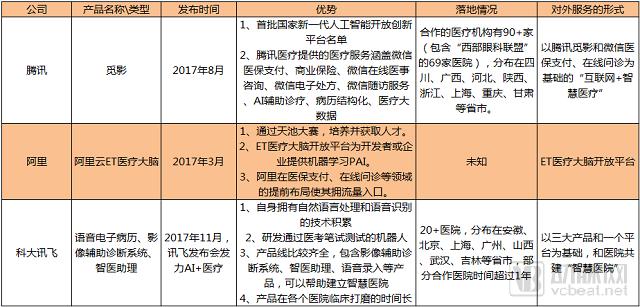
As Baidu does not offer medical artificial intelligence products, we have limited our comparative analysis to the offerings from Tencent, Alibaba, and iFlytek.
They all possess deep expertise in natural language processing, computer vision, machine learning, and speech recognition; however, their development paths diverge when these technologies are applied to the medical field.
Although all three companies have developed specific medical AI products, their current implementation strategies differ: Tencent and iFlytek Medical deploy their solutions by co-building “Smart Hospitals” with healthcare institutions, while Alibaba Cloud primarily provides technical platforms to startups. In contrast, most other startups enter the market by offering individual products targeted at specific hospital departments.
Differences in service offerings lead to variations in the stakeholders engaged. iFlytek Healthcare and Tencent typically interact with hospital presidents or officials from the Health and Family Planning Commission. Alibaba primarily engages with entrepreneurs, although its intelligent imaging and smart voice products also interface directly with hospitals. Other startups generally target department heads or academic leaders. In terms of hospital implementation, Tencent and iFlytek Healthcare hold certain advantages.
Currently, in the absence of industry-wide benchmarks, Tencent and iFlytek Healthcare appear to be better positioned for implementation. However, competition among similar services is inevitable, with success hinging on distribution channels and product quality.
Alibaba is taking a different path by focusing on talent development, technology R&D, and leveraging its platform advantages to serve enterprises.