

McKinsey China Digital Economy Report (Part II): Low Digitalization Hinders Efficiency; IoT and AI Can Enhance Healthcare Transparency
In December 2017, McKinsey released the “China Digital Economy Report.” VCBeat (WeChat ID: vcbeat) excerpted and translated the section titled “Healthcare: Building a Patient-Centered Healthcare System.” While China’s healthcare services have improved significantly, many challenges remain, and the application of digital technologies holds substantial promise. The following is Part II.
Decentralization can generate big data in healthcare and improve the utilization of healthcare resources.
Decentralization of Healthcare Centers: Consolidating Fragmented Data and Resources to Enhance Diagnostic and Treatment Services, Improve Patient Access, and Increase Facility Utilization, with a Focus on Healthcare Big Data and Resource Sharing
Domain 1: Healthcare Big Data
of Chinese hospitals or medical institutionsMedical data are currently siloed.。China still lacks standardized and closely integrated medical records.Standardized medical records represent an integration of data, and leveraging them to track patient needs, obtain clinical information, and ultimately determine the most appropriate treatment plan is highly challenging. Currently, there are several reasons for inefficiencies in healthcare.One of the primary issues is the low level of digitalization.。
As of 2015, approximately 29% of hospitals in China had not implemented electronic medical record (EMR) systems (adopting the Stage 0 model of HIMSS Analytics’ EMR Adoption Model), whereas the corresponding figure in the United States was only 4% in 2014. Furthermore, interdepartmental connectivity within hospitals remained insufficient.
By 2014, more than half of Chinese hospitals lacked clinical database health information exchange capabilities, whereas this figure was only 6% in the United States (Stages 0 and 1). Only 21% of hospitals had established intra-hospital electronic medical record connectivity (Stages 3 to 7), compared with 88% in the United States. Furthermore, hospitals dampened physicians’ incentives to share patient data with other hospitals and healthcare companies, as doing so could adversely affect their patient flow and financial performance.
Recognizing the current challenges and the immense opportunity to better leverage healthcare data, relevant government agencies announced in May 2017 a plan to collect and store data from the healthcare sector for the first time, and to regulate the use of such data.
Big Data in Healthcare May Bring Huge Value to Industry Participants.Medical technology and pharmaceutical companies can enhance their R&D productivity and provide personalized medications to patients.. By analyzing data, researchers can determine which treatments are most effective for specific conditions, identify patterns associated with adverse drug reactions or hospital readmissions, and uncover other critical insights to improve patient care and reduce costs.
Moreover, more detailed and complete data for individual patients can enable more precise treatment, while reducing costs and generating higher revenue.
As personal health data becomes increasingly detailed—for example, as the cost of gene sequencing declines and sensors, monitors, and diagnostic tools provide a continuous stream of real-time information—it becomes possible for physicians to adopt more targeted treatments and interventions.
The use of these data for personalized pharmacotherapy, along with remote medication delivery, means that more patients can receive treatment outside of costly hospital settings.
Health insurance companies can significantly reduce fraud stemming from information asymmetry and waste resulting from overtreatment. With big data analytics, claims data can be cross-checked against clinical data, and billing patterns can be analyzed to help identify inappropriate payments.
With a better understanding of patients, companies can encourage them to change their behavior, thereby reducing insurance costs. ZhongAn Insurance, a joint venture between Alibaba, Tencent, and Ping An, is exploring the use of big data in its product development and claims management processes.
Its specialized insurance product, “Tang Xiaobei,” monitors blood glucose levels in diabetic patients by connecting to glucometers. Leveraging this data, the company has designed a reward-and-penalty system for “Tang Xiaobei,” which improves patients’ treatment adherence and, consequently, enhances therapeutic outcomes.
Many companies are exploring partnerships to maximize the benefits of big data in healthcare. AstraZeneca and the Beijing Big Data Research Institute have established a joint venture, through which they will not only exchange personnel but also share clinical databases. They also plan to collaborate on developing a data analytics technology platform for the diagnosis and treatment of common diseases in China. Baidu has partnered with the Beijing Municipal Government to build Baidu Cloud, which monitors health-related big data collected from wearable devices.
Alibaba Cloud, Xi’an International Medical Center, and Donghua Software have jointly established a hospital management platform at Xi’an International Medical Center. The company stated that this initiative will facilitate the management of individual patient cases and the analysis of aggregated health data, thereby enhancing the quality of healthcare.
Alipay has also launched an end-to-end consumer e-health application called “Future Hospital,” which connects approximately 200 hospitals across more than 20 provinces and 40 cities throughout China. It provides information on hospital availability, appointment scheduling, payment services, and medical records.
The study found that the global market for personalized healthcare leveraging big data could reach $2 trillion to $10 trillion, with the magnitude of benefits depending on how rapidly health systems adapt across different markets and whether R&D applications can be translated into clinical practice. In the United States, there are substantial opportunities for medical data within the industry. It is estimated that effective utilization of big data could reduce national healthcare expenditures by more than $300 billion.
Domain 2: Shared Resources
Another approach to data processing technology is to improve the current state of healthcare through shared resources, including healthcare professionals and specialized facilities such as standalone clinical operating rooms and ambulatory surgery centers. This not only reduces costs,It can also help address the highly uneven utilization of medical facilities.
Shared physicians can help overcome geographic imbalances in healthcare supply (particularly between urban and rural areas) and the mismatch between medical supply and demand. In this context, Chinese policy introduced recommendations for multi-site practice management in April 2017, attempting to remove restrictions on the number of public and private facilities where physicians can practice.
One requirement is that physicians must be registered at the provincial level and report all their employment arrangements with their primary employers. DXY, China’s largest online healthcare community, enables registered physicians to seek job opportunities and obtain advice on training policies, legal matters, relocation, and general career development.
Similar to the sharing economy model in real estate, aggregating the demands of dispersed consumer groups can significantly improve the utilization rate of high-value fixed assets. Digital health platforms can help match specialized facilities, such as independent laboratories, with a broad base of potential patients, thereby achieving economies of scale. With the rapid development of clinical medicine, the demand for laboratory testing is continuously increasing, accompanied by growing technical requirements.
Moreover, staffing constraints make it difficult for existing laboratories in China, including those at large hospitals, to meet the growing consumer demand. Operating a hospital-based laboratory is not cost-effective because the high costs of purchasing and operating laboratory equipment, as well as paying for required specialists, render it economically unviable for hospitals.
The shared economy model involves independent ambulatory surgical centers providing surgical services, facilitating collaboration between these centers and physicians as well as other potential partners—including hospitals, medical technology companies, and pharmaceutical companies—by offering supporting facilities and services.
Dose Reduction May Have the Least Impact on Healthcare
Compared with the other two digital forces, dematerialization has a lesser impact. In terms of medical devices, 3D printing technology can produce implantable devices and customize the texture and dosage of medications to improve treatment quality.
In 2016, Aprecia received FDA approval for the first drug manufactured using 3D printing. Utilizing Zipdose technology, the medication disintegrates in the mouth with only a small amount of water, and Spritam is indicated for patients with long-term epilepsy. In the long run, bioprinting of living organs is highly likely to see broader application.However, the future adoption rate of 3D printing technology in healthcare is highly uncertain.
If similar models are adopted and widely applied, companies that continue to adhere to traditional standardized manufacturing of medical devices and pharmaceuticals may lose their competitive advantage compared to rivals leveraging these technologies.
What Will China’s Future Healthcare Look Like If All Forms of Digital Disruption Reshape the Value Chain?
Healthcare systems worldwide are becoming increasingly stringent, with higher barriers to entry and slower pace of improvement. Many stakeholders, driven by diverse motivations, interests, and attitudes toward change, are involved in this field.
However, what would be the impact if all three types of digitalization were to experience simultaneous disruptions? In a transformative scenario, we leverage IoT and AI-driven healthcare solutions to fully harness the power of big data in healthcare, thereby enhancing the supply of medical services. This shift would be substantial.
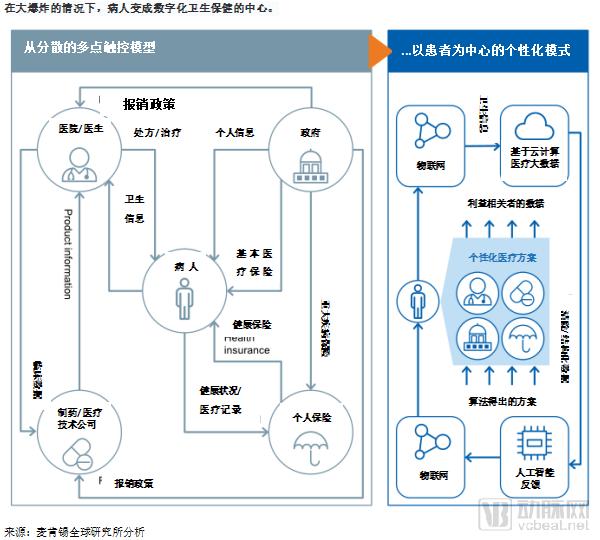
China’s healthcare system is decentralized, and healthcare providers, including hospitals, play a significant role in designing treatment plans with substantial economic implications.
Patients may be passive in diagnosis, treatment, and payment options due to a lack of the knowledge and theoretical understanding necessary for making informed decisions. This asymmetry results in suboptimal decision-making and resource waste.
In a study of 230,800 outpatient prescriptions across 28 Chinese cities, nearly half of the prescriptions issued between 2007 and 2009 were for antibiotics, with 10% involving two or more antibiotics. Consequently, antibiotic resistance in China appears to be higher than in Western countries. Fragmented information suggests that the products and services provided by pharmaceutical and insurance companies, as well as medical technology vendors, are generic and therefore not always suitable for patients.
In our era of information explosion, patients are at the center of the healthcare system. They are more knowledgeable about medications and treatment regimens, as they no longer occupy an informational disadvantage in their relationships with healthcare providers.
Data is collected from multiple sources, enabling players to track information within the healthcare system, including hospital clinical information, records of behavioral and social information, and digital devices. This data is continuously integrated, breaking down the boundaries between independent databases through seamless connections across various parts of the healthcare system. The data is structured, stored in the cloud, and available for analysis.
Leveraging the power of machine learning, artificial intelligence can process vast amounts of data and extract insights that help improve decision-making. Every patient touchpoint can be digitized, from consulting with a specialist via an online e-commerce platform to having prescription medications filled and tracking drug delivery.
This patient-centered, information-rich, and tightly integrated system is the result of high-quality spending. Patients can receive personalized disease prevention, diagnosis, and other coordinated services. The availability of extensive data enhances the quality and efficiency of care. For instance, physicians can make highly accurate treatment decisions and predict the likelihood of disease occurrence.
The competency gap between healthcare professionals working in large and small hospitals, as well as between experienced and novice physicians, has been minimized. By organizing and analyzing vast numbers of cases, big data has standardized clinical pathways. Even the least experienced doctors in primary care can now access and absorb an unprecedented wealth of knowledge. Furthermore, data can assist pharmaceutical companies in developing better products.
How Might Value Be Transformed?
Amid the current environment of information overload, it is evident that three factors can reduce China’s overall healthcare expenditure by 27%, with payers capturing the majority of these savings. These savings should be reinvested in enhancing the quality of service delivery and improving access rates within the healthcare system.Providers of digital solutions can achieve up to 10% in added value.
Because payers can control reimbursement themselves, they are likely to emerge as the biggest winners. In our simulation experiments, they could save an amount equivalent to 27% of medical costs. They have the best visibility into patient treatment, post-treatment adherence, and standard clinical pathways.
Many factors reduce compensation costs, including lower patient turnover rates, which enable more patients to opt for local treatments or home care rather than wasting time and money at large hospitals, as well as improvements in medical resource utilization, early diagnosis, and high-quality treatment.
In a 2015 survey conducted by a U.S. market research firm, which included over 7,000 healthcare providers, health insurers, and healthcare IT vendors, 94% of respondents believed that hospital information exchange platforms were viable for payers. Respondents indicated that such platforms were considered viable by 33% more than hospital systems. Over 90% of respondents stated that payers would be the biggest beneficiaries.
Big data in healthcare plays a positive role in the overall healthcare system. As we have already pointed out,The use of the Internet of Things and artificial intelligence may lead to patient flow in large hospitals; in addition, such technologies bring greater transparency, which can reduce the leverage of overtreatment and overprescription, thereby exerting financial pressure on large hospitals.
However, on a positive note, these technologies can alleviate the pressure on doctors and other staff at large hospitals. AI-enabled solutions can help physicians enhance their skills. They can also facilitate patient flow to small and medium-sized hospitals, improve treatment quality, promote greater mobility among healthcare professionals, and provide more insights through big data analysis.
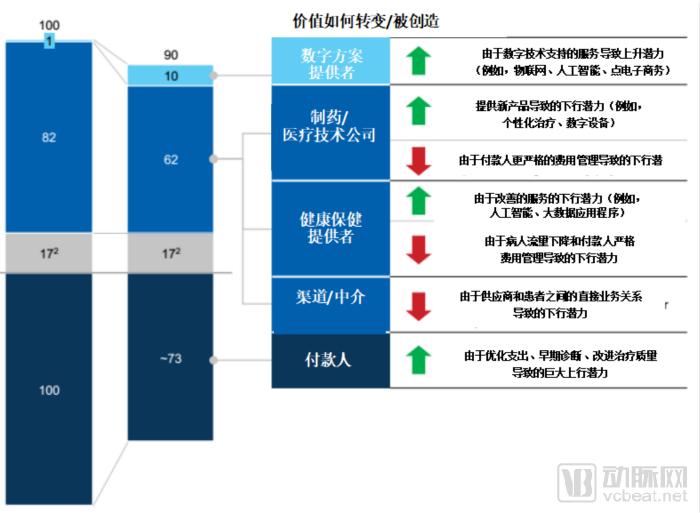
Pharmaceutical and medical technology companies may experience both value gains and value losses. Gains stem from new business opportunities, such as personalized medication services, research and development of big data-enabled capabilities, and value-added services like rehabilitation. Losses may result from the reduced economic benefits associated with overtreatment, as patients receive more precise therapies.
Pharmaceutical distributors and pharmacies may see value erode due to waste in drug prescribing and treatment. Drug distribution companies and insurance agents could potentially bypass patients to gain direct access to pharmaceutical manufacturers, medical technology and equipment providers, and insurance companies.
Providers of digital solutions can benefit from the digitalization of healthcare as long as they offer disruptive business models. For instance, by providing information exchange platforms and direct access to healthcare services, they can drive widespread patient adoption of Internet of Things (IoT) and artificial intelligence (AI) technologies. Amidst the explosion of information, we estimate that these players could capture value equivalent to 10% of total healthcare expenditures.
Whether and when an interruption will occur depends on many factors.
We have discussed that all forms of chaos have the potential to occur, but predicting how they will unfold presents certain difficulties. Several factors are worth examining.
Can Necessary Regulatory Frameworks and Sufficient Incentives Foster the Emergence of Medical Big Data?"Those who control big data in healthcare will have a significant competitive advantage, and the competition for ownership could be fierce."。
Previous studies have found that the annual value of open data in the U.S. healthcare system can be captured at between $300 billion and $450 billion. Appropriate regulations and incentives are needed to ensure this outcome.The natural owners of big data in healthcare are large hospital groups, but they may lack sufficient incentives to share data with other stakeholders.
As overtreatment declines, the number of patients treated and associated revenues have decreased. Patients must not only overcome concerns about privacy and reluctance to share their health data, but also acknowledge that doing so will improve the quality of their care.
The quality of digital and mobile health in China is surrounded by much hype. In recent years, hundreds—if not thousands—of apps and digital solutions have emerged. However, these largely impact peripheral healthcare tasks such as appointment scheduling, mobile payment integration, and the establishment of online communities. The majority of healthcare services in China continue to be delivered digitally under the remote control of public hospitals. Consequently, the data currently available is insufficient to drive disruptive innovation at the core of the healthcare system.
Will Healthcare Systems Pay for Digital Solutions? Although most existing companies have developed digital health applications, there is a lack of evidence demonstrating that these apps lead to long-term improvements in users’ health. In fact, patients are ready to use them regularly, thereby generating economic benefits for healthcare systems. However, the lack of evidence means that healthcare systems may be reluctant to invest in these technologies.
However, healthcare systems possess the capability and expertise to gather the necessary evidence from their collected data to measure changes in patients’ health status over time. What can incentivize healthcare systems to leverage their data to support digital solutions? China is undertaking some bold initiatives in this field.
Neusoft Corporation, a leading provider of IT solutions and services, has established a cloud-based hospital in Ningbo to serve patients with chronic diseases. The Ningbo Cloud Hospital boasts over 1,000 contracted physicians and 13 online clinics. It can process medical reimbursements through social insurance and government assistance programs.
Will Technology Continue to Advance? Medical digitalization requires further strengthening of data analytics, along with the continuous development of artificial intelligence and Internet of Things (IoT) technologies. However, even as these advancements proceed, the data generated by healthcare systems remains highly complex, difficult to share and structure, thereby preventing technology from realizing its full potential.
Theoretically, it makes sense to combine clinical data from hospitals, insurance company data, patient behavioral data, and R&D data from pharmaceutical and medical technology companies. However, the challenges that come with this are enormous.
Generally speaking, the healthcare sector is composed of independent systems that each generate their own data,These systems may be incompatible with data from other sources, and integrating these disparate data streams is highly complex., a more sophisticated tool is required, such as in the manufacturing industry. Integrating behavioral data from numerous devices and mobile platforms into data analytics will be more complex.
In China, digital companies are leveraging their super-apps, daily footprints, and e-commerce platforms to generate actionable big data and build comprehensive health profiles for each user.
Baidu’s latest intelligent big data platform offers solutions applicable to healthcare. If China’s major digital players expand the use of cloud computing and big data in healthcare, they may accumulate sufficient data to make the processing costs affordable. For the development of AI in healthcare, ensuring access to usable data is critical.
Will healthcare professionals and patients embrace behavioral change? If this challenge can be resolved, triggering a "big bang" in the healthcare sector, the medical system will undergo transformation. A primary response to patient care is the emergence of a system centered on patients, prevention, and self-management once illness occurs. This shift depends largely not only on changes in the attitudes of healthcare providers but also on transformations in patients’ attitudes.
Physicians are highly trained experts who may resist having their clinical judgments challenged or even being replaced by digital tools powered by data from millions of other cases. Patients need to learn how to choose which physicians and IoT devices to trust, and adjust their daily habits accordingly.
"Substantial improvements in quality are still needed to persuade them to adopt a new mindset for managing their health."
In China, there is a deeply entrenched perception among patients that only public hospitals in major cities can provide qualified healthcare services, leading to long queues outside these large hospitals. A survey found that68% of patients do not believe that community hospitals can provide them with high-quality medical services.
Note: All price fluctuations and related data mentioned in this article are current as of the report’s publication date. VCBeat strives to ensure the accuracy, completeness, and rigor of the translation.