

McKinsey China Digital Economy Report (Part I): Building a Patient-Centric Healthcare System – Digital Transformation Can Reduce Healthcare Expenditure by 45%
China’s healthcare services have improved significantly, especially since the 2009 reforms. Over the past decade, healthcare expenditure has grown 5–10 percentage points faster than GDP, and China’s healthcare population coverage has now reached 95%.
However, this system still faces many challenges, and only digital technology can provide solutions. The application prospects for new technologies are vast, such as medical big data, the Internet of Things (IoT), and AI-assisted diagnosis (which enables personalized treatment and places patients at the center of healthcare).
In December 2017, McKinsey released its landmark report, “China’s Digital Economy Report.” VCBeat (WeChat ID: vcbeat) has excerpted and translated the section titled “Healthcare: Building a Patient-Centric Healthcare System.”
Since its establishment in 1990, McKinsey has been providing leaders in the business, public, and social sectors with facts and insights grounded in management and policy decision-making. The report content is presented below; due to its length, it will be divided into two parts: Part I and Part II.
Despite the rapid increase in healthcare spending in China over the past decade, it accounts for only 6% of GDP, compared with an OECD average of 9% in 2014. According to the World Health Organization, China’s per capita healthcare expenditure, measured in purchasing power parity terms, is approximately 20% of Japan’s and 30% of South Korea’s.
China exhibits severe resource disparities. For instance, urban residents have two to three times more access to healthcare professionals than their rural counterparts.
According to survey results from Fudan University, one-fifth of China’s top 100 hospitals are located in just three cities: Beijing, Guangzhou, and Shanghai.
As China’s population ages and household incomes rise, residents are demanding more high-quality medical and health services, thereby increasing the pressure to further develop healthcare infrastructure.
This pressure is forcing the government to turn to digital solutions, which will bring significant potential benefits to the main stakeholders in the system, primarily the following four groups:
Patient
Digital technologies ensure that patients can more easily access high-quality medical services. By implementing AI-driven solutions, they are empowered to gain greater insight into their health information and participate more directly in their diagnosis and treatment.
The transparency of treatment costs and information regarding online medical teams enables patients to communicate more conveniently with healthcare providers, thereby reducing overcharging and overtreatment by hospitals.
This plays a significant role in developing more personalized and patient-centered clinical plans. By leveraging digital technologies and data to integrate comprehensive personal information, health management can become more holistic, leading to improved patient adherence and reduced healthcare costs.
The digitization of medical data ensures that patient information belongs to the patients themselves, rather than being stored in hospital archives, thereby facilitating patients’ assumption of responsibility for their own health.
Healthcare Providers and Payers
A data-driven healthcare system has improved access in underserved areas, while lower costs, higher efficiency, and more standardized processes enabled by big data have greatly benefited healthcare providers.
Digital technologies reduce information asymmetry and pricing variability by enhancing the level of informatization in hospitals across different regions and increasing the transparency of charges and outcomes for identical treatments.
Outcome-based pricing makes treatment costs more transparent and should also help reduce the incidence of overcharging and overtreatment by hospitals. A comprehensive, industry-wide big data infrastructure enables payers to optimize treatment rationalization and maximizes cost-effectiveness across the healthcare system.
Pharmaceutical and Medical Technology Companies
By leveraging digital tools, pharmaceutical and medtech companies can effectively attract a larger patient base, while digital devices and software can display more real-time performance data on their products.
Data-driven insights derived from real-world employee data can help these companies enhance their R&D efficiency. Furthermore, they enable the provision of personalized treatment regimens, which not only boost corporate revenue but also strengthen patient loyalty.
Healthcare System
Since 2015, the government has placed smart healthcare in a key strategic position within its “Internet Plus” big health policies and the Healthy China: Joint Action initiative.
The government aims to establish an interconnected healthcare data platform to meet the demand for personalized healthcare, promote the application of healthcare services, facilitate the allocation of medical resources, and enable the sharing of these resources.
One of the government’s 2030 goals for healthy living and health insurance is to increase the coverage of registered physicians from 2.2 per 1,000 population in 2015 to 3 per 1,000, thereby reducing premature mortality from major chronic diseases by 30% compared with 2015 levels and expanding the healthcare market size to RMB 1.6 trillion.
These objectives were re-emphasized in early 2017, alongside discussions on optimizing the management of patients undergoing conventional treatment through one-stop health management services, and enabling patients to access and monitor their own medical data via mobile devices.
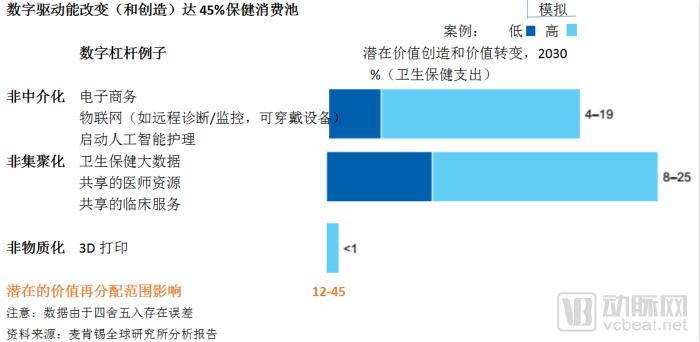
Our analysis reveals that digitalization can transform and create new value across 12%–45% of healthcare expenditure items.
As the value chain continues to evolve, enhanced patient services are enabling more efficient players to emerge and capture greater market share from existing competitors. Digital solutions and healthy competition will reduce healthcare expenditures, allowing these savings to be reinvested in expanding service coverage and improving quality of care, thereby enhancing productivity.
The following will provide a detailed explanation using data and case studies:
By restructuring the value chain, digitalization can transform (and create) 45% of healthcare spending. Our simulations reveal that digitalization can transform and create new value across 12%–45% of healthcare expenditures.
Digital healthcare is primarily driven by the disintermediation and de-aggregation of analog processes. By leveraging e-commerce, the Internet of Things (IoT), and AI-driven care to establish direct connections with patients, traditional healthcare providers and channels can bypass intermediaries. This approach has the potential to ultimately alter 4%–19% of healthcare expenditures.
By leveraging the disaggregation (decentralization) effect generated through healthcare big data and shared resources, such as physicians and specialized equipment, it is possible to shift 8%–25% of medical expenditures from inefficient to efficient providers.
The dematerialization of design and production for virtual products creates market entry opportunities for new digital practitioners, but our analysis shows that its potential impact is smaller than that of other digital-driven forces.
To understand how value is transformed into the three primary types of digital disruption, we analyzed 56 use cases in healthcare and mapped them onto the value chain. We observed particular nuances in disintermediation and unbundling (disaggregation).
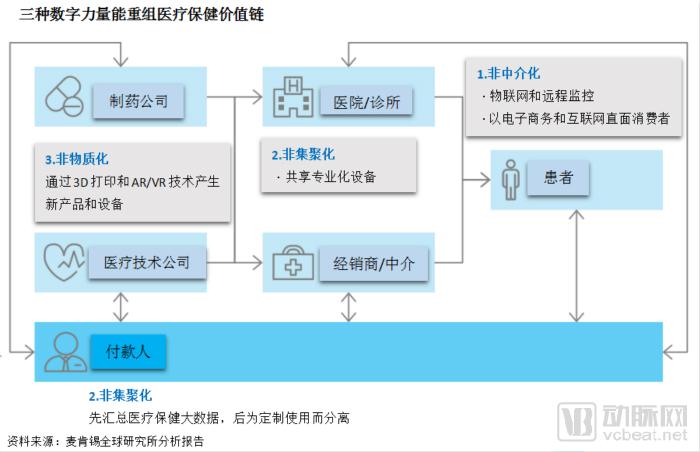
Disintermediation can improve methods for prevention, diagnosis, and treatment, providing patients with timely and continuous access to healthcare.We specifically note three forms of disintermediation detected in the Health Internet of Things (HIoT): IoT and remote monitoring, AI-driven care, and e-commerce.
Domain 1: Internet of Things and Remote Monitoring
Healthcare providers can leverage Internet of Things (IoT) technology to establish direct connections with patients and implement remote digital health and health management programs. These digital forms of healthcare can significantly reduce treatment costs per patient.
Furthermore, they can reshape incentives and behavioral patterns, thereby fostering new areas of focus in prevention, disease management, and health.
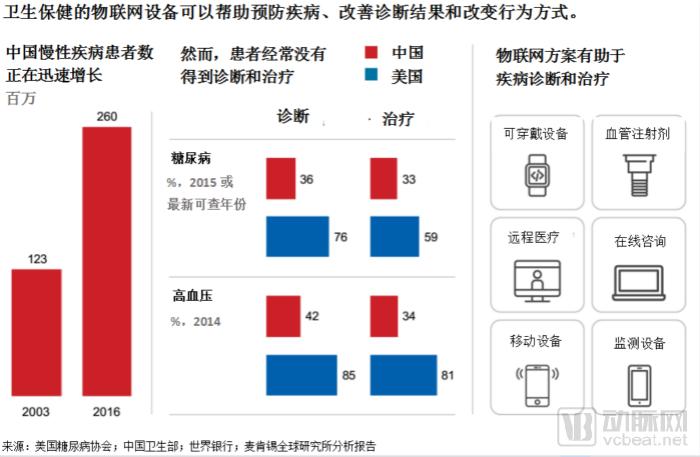
The Internet of Things can help address China’s burden of chronic non-communicable diseases, which are currently the leading cause of disease worldwide. China has approximately 260 million patients with chronic conditions, a figure that is likely to continue rising. According to estimates from the former Ministry of Health, chronic diseases account for 85% of all deaths in China, compared with a global average mortality rate of 65% in 2010.
In China (as in other countries), the incidence of non-communicable diseases is on the rise, particularly hypertension, diabetes, heart disease, and stroke.
This reflects a combination of factors, including physical inactivity, unhealthy dietary habits, irregular sleep-wake cycles, environmental pollution, excessive smoking, and alcohol abuse.
A major issue is that patients are often unaware of whether they have these conditions; only 33% of diabetic patients in China receive treatment, compared with 59% in the United States and 50% in Japan. China spends $50 billion annually on treating diabetes and related conditions, accounting for approximately 13% of the nation’s total healthcare expenditure.
Of these, 80% of patients opt for treating complications, while only 20% take measures to prevent them. The World Bank estimates that, when accounting for the impact of non-communicable diseases (NCDs) on labor force and capital accumulation, the five major NCDs will cost China $27.8 trillion between 2012 and 2030.
IoT-based solutions help address these issues. For example, wearable devices embedded with medical big data can remind patients to improve their health conditions.
Chinese consumers appear to be open to these solutions. In 2015, 12% of diabetic patients and 11% of cardiac patients in China adopted wearable mobile health technologies (or connected monitoring systems), compared with only 6% and 4%, respectively, in the United States.
Lifesense, a wearable device manufacturer, offers products including wearables and blood pressure monitors, enabling customers to track their health status and receive lifestyle recommendations.
“Teng Ai Tang Da Fu” from Tencent uses an internet-connected sensor to collect patients’ digital data and measure blood glucose levels. Information stored by this device can be more rapidly uploaded into databases. The application links registered family members and friends via WeChat, enabling real-time sharing of patients’ blood glucose monitoring results, while online consultation apps are also emerging.
“Spring Rain Doctor” helps patients find medical information on its platform and connects them with doctors through remote consultations. Alibaba Health, a subsidiary of Alibaba Group, acquired Wanli Cloud, a remote imaging company, with the aim of providing services to small hospitals in smaller cities and rural areas.
Healthcare products and services can help users become aware of their issues earlier, thereby helping them prevent the onset of disease or the worsening of chronic conditions.
Self-awareness and remote monitoring can help individuals modify their behaviors and enable timely interventions when necessary. Evidence suggests that these care models and incentive mechanisms are likely to reduce costs by promoting self-management of diseases, while also decreasing the likelihood of patients being admitted to relatively expensive hospitals.
Domain 2: AI Nursing
Artificial intelligence is another digital solution that enables healthcare providers to make more direct and accurate diagnoses, thereby allowing patients to receive more targeted and precise treatment.
Extensive data indicate that in China, diagnoses are often inadequate, best practices for treatment are not followed (and overtreatment is all too common), and the quality of healthcare varies significantly across different regions, hospitals, and clinics.
A study found that rural doctors asked only 1% of essential questions, correctly diagnosed only 26% of unstable angina cases, and prescribed unnecessary or even harmful medications in 64% of cases. According to a report by the Chinese Alzheimer’s Association, only one-fifth of patients with dementia are correctly diagnosed.
Processes appear to be more efficient in secondary and tertiary hospitals. However, even in these settings, the evidence remains limited and mixed. There is also evidence indicating substantial variation in patient expenditures at public tertiary hospitals.
Some studies have found that a shortage of qualified primary care physicians and generally low quality of primary care lead to increased rates of unnecessary hospitalizations. Patients in China often exhibit poor attitudes toward doctors and nurses and are not proactive in seeking their medical advice.
The study also describes the prevalence of human error and the shortage of technical talent in China’s healthcare industry. A deeper understanding of artificial intelligence (AI) and medical equipment can enhance the accuracy and consistency of diagnosis and treatment. AI can provide more detailed information to support targeted diagnosis and treatment in traditional hospitals, thereby improving their productivity.
Meanwhile, it can offer new services, creating opportunities for new digital players to enter the market. It can capture value from traditional healthcare providers, help patients detect early signs of disease, improve health through personalized recommendations, and enable effective communication between patients and physicians, thereby enhancing treatment outcomes.
AI-based image recognition and machine learning can reveal more details than MRI or X-ray images.
Outside China, many companies are developing artificial intelligence solutions to improve the accuracy of scans. In China, Baidu has launched an intelligent chatbot that provides information to physicians and assists them in formulating treatment recommendations.
AI company DeepCare specializes in medical imaging to improve the accuracy of cancer diagnosis. Biotech firm iCarbonX partners with technology companies worldwide to collect medical data, perform algorithmic analysis, and deliver personalized health patterns and medical recommendations directly to consumers via a mobile application.
Beijing-based LinkDoc Technology employs advanced algorithms to train computers to digitize and organize a series of oncology medical record data, which are then compiled into a database.
Healthcare professionals can leverage databases to conduct clinical observations of treatment outcomes. This approach, which is widely adopted in China, may aid in the treatment of lung cancer. DXY, an online community for healthcare professionals, and Xiangya Hospital of Central South University are jointly developing an artificial intelligence solution for diagnosing skin diseases.
Domain 3: E-commerce
Just as e-commerce is transforming the businesses that consumers face, it can change certain aspects of healthcare, especiallyInsurance and Drug Distribution。
In the insurance industry, the digitalization of the process from sales to underwriting means that the traditional insurance agency model will be bypassed. New consumer behaviors and new market entrants are threatening traditional distribution channels. Policyholders are increasingly demanding digital-first distribution models in the small private commercial sector, while aggregators are calling for direct-to-consumer insurance sales. A UK insurer introduced an application that allows customers to make decisions directly, reducing approximately 20 million phone calls annually.
In China, the penetration of digital channels in the insurance industry accounted for only about 5% in 2016, but this was significantly higher than the less than 0.5% penetration rate in 2011, with the annual growth rate of digital penetration consistently around 135%. In the case of life insurance, the growth rate of digital channels has been approximately 180%. Ping An Insurance provides financial services, including life insurance, to Chinese consumers through the internet, mobile platforms, and social media, marking a transition towards digital insurance.
Ping An Good Doctor enables customers to find suitable physicians through its O2O platform, which hosted 50,000 doctors and more than 3,000 hospitals as of December 2017. Customers can also purchase medications and contact insurance companies directly, without the need for any intermediaries. Consumers appear to favor this model, as the company’s surveys indicate a customer satisfaction rate of 98%.
The digital distribution of pharmaceuticals and medical devices is a relatively new and untested domain. Pharmaceutical and medtech companies can establish online direct-to-consumer ordering platforms for patients and hospitals, thereby disintermediating traditional distributors such as pharmacies and helping to reshape the currently fragmented market.
Recent policies in China have allowed more players to sell pharmaceuticals online. In February 2017, the number of licenses for online drug sales increased to 913, up from 517 in 2015. Experience with online pharmaceutical sales suggests that regulators should focus on measures to prevent consumers from obtaining medications without a prescription and crack down on unethical operators selling substandard products.
In China, the potential for B2B pharmaceutical sales is enormous. The implementation of the "Two-Invoice System" has reduced the number of intermediaries in the supply chain from healthcare institutions to end users, cutting down the current 5 to 8 distribution steps to no more than two. This reform has significantly helped lower artificially inflated drug prices.
Note: All price fluctuations and related data mentioned in this article are current as of the report’s release date. VCBeat strives to ensure the accuracy, completeness, and rigor of its translations.