

Father of Chinese Interferon and National Top Science Award Laureate Hou Yunde Files Prospectus
On January 8, 2018, the 2017 National Science and Technology Awards Ceremony was held at the Great Hall of the People. Wang Zeshan, a professor at Nanjing University of Science and Technology and an academician of the Chinese Academy of Engineering, and Hou Yunde, a researcher at the Institute for Viral Disease Control and Prevention of the Chinese Center for Disease Control and Prevention and an academician of the Chinese Academy of Engineering, were awarded the State Preeminent Science and Technology Award.
According to VCBeat, Hou Yunde is a principal founder of molecular virology and genetic engineering pharmaceuticals in China. He spearheaded the establishment of a nationwide collaborative innovation system for infectious disease prevention and control, successfully responding to several major domestic and international infectious disease outbreaks over the past decade.
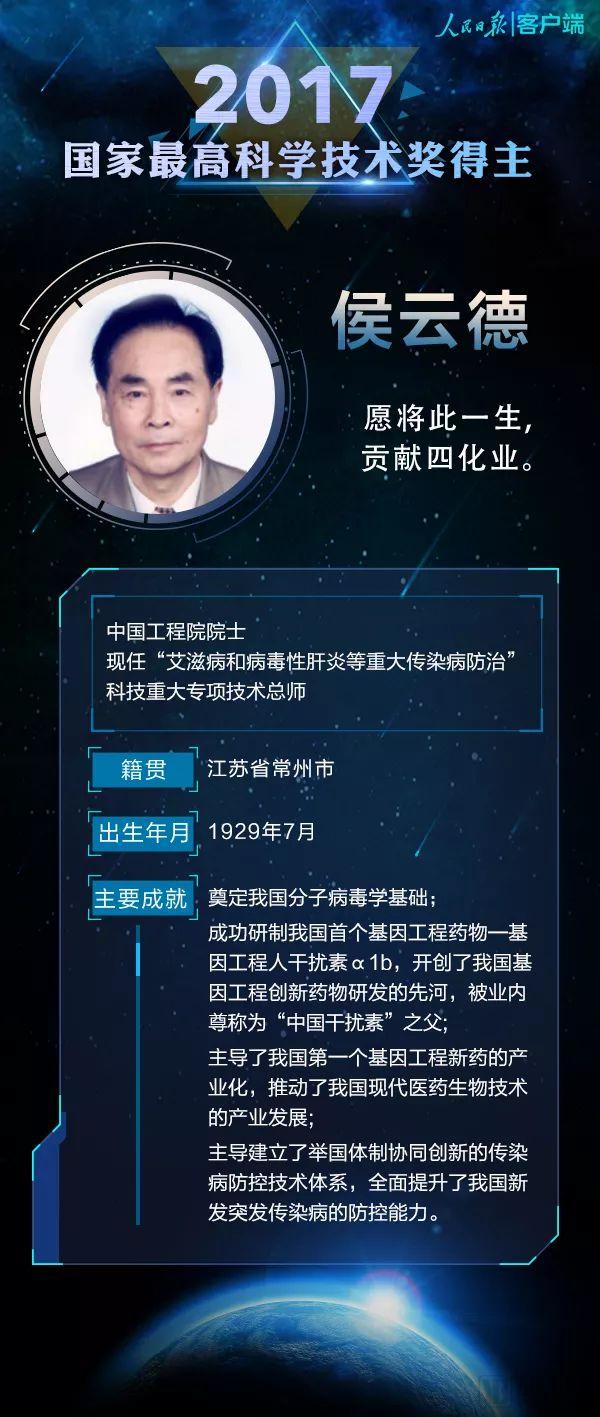
Born on July 13, 1929, in Wujin, Jiangsu Province (now part of Changzhou City)
1948 Graduated from Jiangsu Provincial Changzhou High School
Admitted to the School of Medicine, Tongji University in 1948
1955 Graduated from Tongji Medical College, Wuhan
1956–1957: Studied at the Preparatory Department for Soviet Study, Beijing Russian Language Institute
1958–1962: Studied at the Ivanovsky Institute of Virology in Moscow, USSR, and was awarded the Soviet Doctor of Medical Sciences degree, bypassing the Candidate of Sciences degree.
1962 Worked at the Institute of Virology, Chinese Academy of Medical Sciences (now part of the Chinese Academy of Preventive Medicine)
1973–1985: Director, Division of Cold and Bronchitis, Institute of Virology
1977 Promoted to Associate Researcher, Director of the Antiviral Therapy Research Laboratory
1983: Promoted to Research Fellow
1984–1997: Director of the Institute of Virology, Chinese Academy of Preventive Medicine
1984: Appointed as Chief Scientist of the Expert Committee on Biotechnology under the National High-Tech Research and Development Program (Program 863)
1986–1990: Vice Chairman of the Chinese Society for Microbiology
1986–1992: Served as a Council Member of the International Society for Interferon and Cytokine Research
1988 Reappointed as Director of the Institute of Virology, Chinese Academy of Preventive Medicine
1989, concurrently served as Director of the State Key Laboratory of Viral Genetic Engineering
1994–1998: Director of the Department of Medical and Health Engineering, Chinese Academy of Engineering
1987–1996: Served three consecutive terms as Chief Scientist of the Expert Committee on Biotechnology under China’s National High-Tech Research and Development Program (“863” Program)
1996–1999: Chairman of the Chinese Society of Virology, Chinese Medical Association
1998, Appointed as Vice President of the Chinese Academy of Engineering
1999: Appointed Director of the National Engineering Research Center for Viral Biotechnology
1996–1999 Chairman, Society of Virology, Chinese Medical Association
1. He isolated parainfluenza virus types I, II, and IV in China.
2. Pioneering research was conducted on the antiviral effects of the traditional Chinese medicinal herb Astragalus membranaceus (Huangqi) and its interaction with interferon. The study found that Huangqi can inhibit the replication of certain viruses, induce interferon production, enhance natural killer (NK) cell activity, promote the generation of 19S antibody-forming cells and increase secretory IgA (sIgA) levels, extend the survival lifespan of diploid cells in vitro, and clinically demonstrate its efficacy in preventing common colds. Furthermore, a synergistic effect between Huangqi and interferon was identified.
3. Discovered that human umbilical cord blood leukocytes possess strong interferon-inducing capacity, selected and bred the high-yield viral strain NDV-F, and ultimately developed a clinical-grade interferon preparation.
4. He developed a series of genetically engineered interferon products, including subtypes α1b, α2a, α2b, and γ. Among these, recombinant interferon α1b and α2a received the National New Drug Certificate in 1992. Recombinant interferon α1b is an internationally pioneering new drug product and China’s first genetically engineered polypeptide drug.
5. Successfully constructed the prokaryotic high-efficiency expression vector pBV220 series and the universal high-efficiency expression vector pBV320 series
6. Interferon Research
In 1981, he authored the book *Interferon and Its Clinical Applications*, which was the first monograph on interferon research in China. The book combines theoretical depth with close ties to clinical practice, summarizes the research achievements of Chinese scholars, and was awarded the title of National Outstanding Scientific and Technological Book for the period 1978–1981.
In 1984, he was conferred the title of "Expert with Outstanding Contributions Among Young and Middle-Aged Professionals" by the Ministry of Personnel of the Central Government.
The book Principles and Methods of Viral Genetic Engineering, which he edited in 1985, was the first monograph on genetic engineering techniques authored by Chinese scholars based on domestic experience, playing a significant role in promoting the application of genetic engineering techniques within China’s medical virology community.
From 1986 to 1996, he was appointed by the State Science and Technology Commission as the Chief Scientist of the Expert Committee on Biotechnology under China’s “863” National High-Tech Research and Development Program.
In 1990, he authored all chapters of the highly interdisciplinary book Molecular Virology. This monograph, comprising over one million Chinese characters, systematically introduces the molecular structures and functions of viruses across various categories, summarizes research findings from both domestic and international sources as well as the author’s own work, and reflects the progress of international molecular virology research in the 1980s. It stands as the most comprehensive and systematic virology monograph in China’s virology community.
In October 1994, the 3rd Asia-Pacific Congress on Medical Virology recognized his outstanding contributions to medical virology and awarded him an honorary award.
On January 8, 2018, Hou Yunde was awarded the 2017 State Preeminent Science and Technology Award.
Prior to this, a total of 27 scientists had ascended the highest podium in China’s scientific and technological community, being awarded the “State Preeminent Science and Technology Award.”
Source: People's Daily Client, CCTV News WeChat, Chinese Government Website, Baidu Baike