27 Medical-Related Projects Honored at the 2017 National Science and Technology Awards, with 5 in Oncology and 4 in Traditional Chinese Medicine; Universities and Hospitals Emerge as Key Research Forces
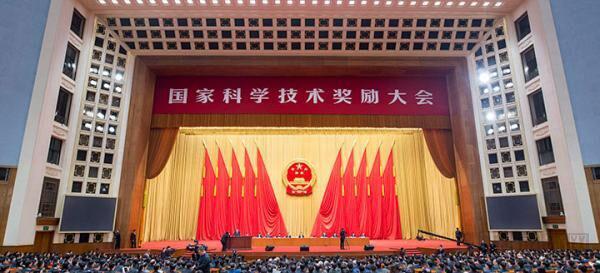
On January 8, the 2017 National Science and Technology Awards Conference was held at the Great Hall of the People. A total of two individuals were awarded the State Preeminent Science and Technology Award, 35 projects received the State Natural Science Award, 66 projects received the State Technological Invention Award, and 170 projects received the State Scientific and Technological Progress Award.
Wang Zeshan, a professor at Nanjing University of Science and Technology and an academician of the Chinese Academy of Engineering, and Hou Yunde, a researcher at the Institute for Viral Disease Control and Prevention of the Chinese Center for Disease Control and Prevention and an academician of the Chinese Academy of Engineering, were awarded the State Preeminent Science and Technology Award.
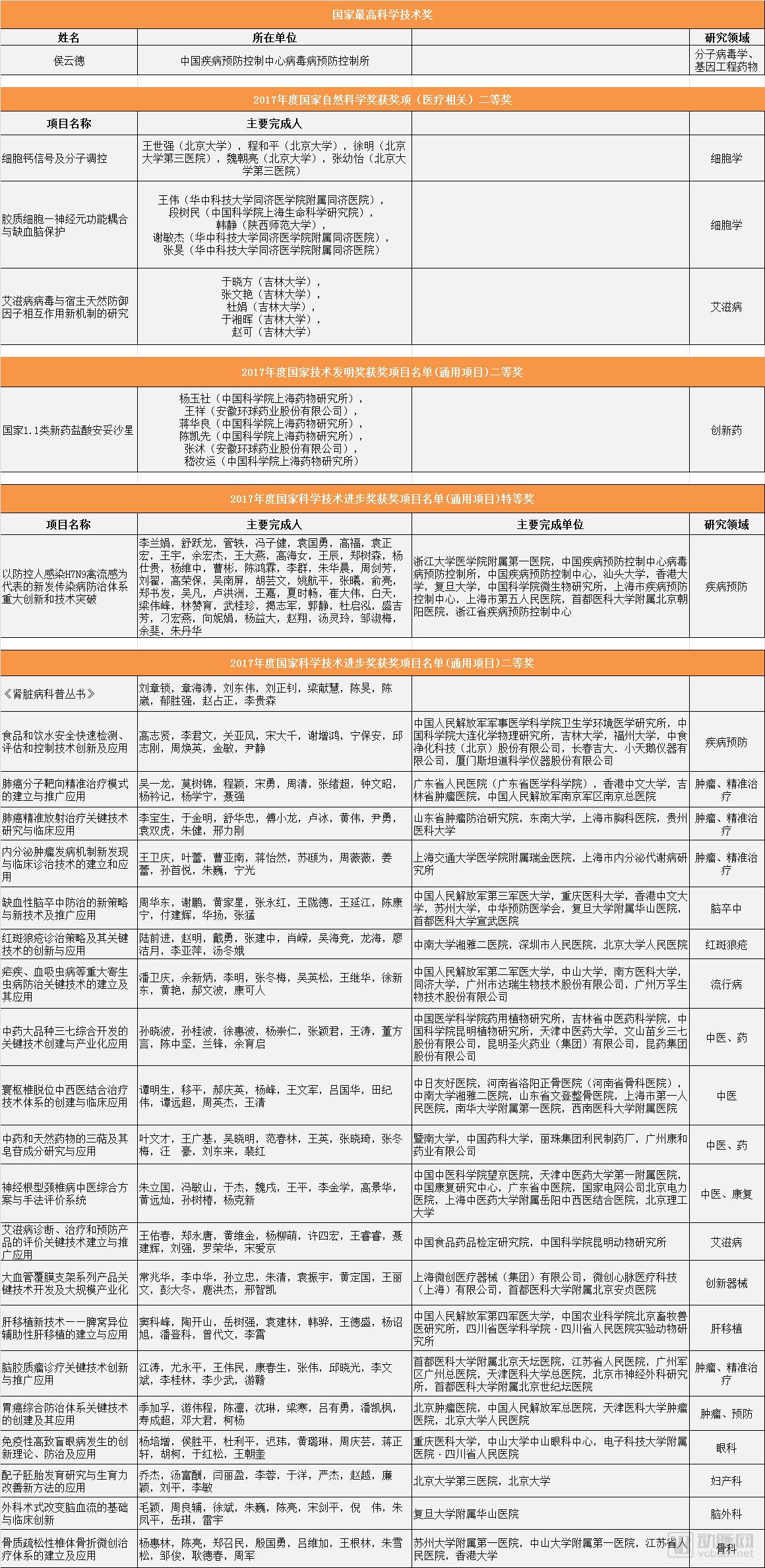
According to statistics from VCBeat (WeChat ID: vcbeat), a total of 27 award-winning projects were related to healthcare. Among these, there were five projects focused on oncology, four on traditional Chinese medicine, and three on infectious disease and epidemic prevention. Other projects covered areas such as gynecological diseases, HIV/AIDS, orthopedics, stroke, and cytology.
Oncology is the Key Research Focus
Cancer is a major disease threatening human health and a key focus of research institutions and companies worldwide. Data released by the World Health Organization in February 2017 indicated that 8.8 million people die from cancer each year.
What does a figure of 8.8 million represent? It is equivalent to the total population of Xi’an in 2015.
Currently, cancer-related deaths account for approximately one-sixth of all global deaths. There are over 14 million new cancer cases annually, a figure projected to rise to more than 21 million by 2030. China has become the country with the highest number of new cancer cases globally. It is estimated that in 2010, the total annual economic burden of cancer, due to medical expenditures and productivity losses, amounted to $1.16 trillion. This may explain why oncology-related projects attract the largest number of researchers and receive the most awards.
Among the five award-winning projects related to oncology, four focused on cancer treatment and one on cancer prevention. The awards reflect the state’s growing emphasis on the concept of “preventive healthcare,” with a trend toward nipping diseases in the bud.
Accelerated Development of Traditional Chinese Medicine
On July 1, 2017, the Law of the People's Republic of China on Traditional Chinese Medicine officially came into effect. This law legally affirmed the important status of traditional Chinese medicine (TCM), adhering to the principle of equal emphasis on support and regulation to strengthen oversight of TCM. It also introduced reforms and innovations to existing management systems in various areas, including the licensing of TCM clinics, the accreditation of TCM practitioners, and the administration of Chinese herbal medicines.
In the past two years, important documents such as the Outline of the Development Plan for Traditional Chinese Medicine (2016–2030), the Development Plan for Traditional Chinese Medicine under the Belt and Road Initiative, the 13th Five-Year Plan for the Development of Traditional Chinese Medicine, and the White Paper on Traditional Chinese Medicine in China have been successively released. As a result, traditional Chinese medicine has gradually become a strategic industry with unique advantages and broad market prospects in national economic and social development.
According to incomplete statistics, by mid-October 2017, national and local competent authorities had successively issued more than 200 policies and administrative orders related to the traditional Chinese medicine (TCM) industry. Among these, national-level authorities issued over 50 policies, while provincial-level authorities issued more than 100. In terms of issuing bodies, the main publishers included the State Council, the National Health and Family Planning Commission, the State Administration of Traditional Chinese Medicine, and the China Food and Drug Administration. Departments such as the National Development and Reform Commission, the Ministry of Science and Technology, and the Ministry of Industry and Information Technology also participated in the formulation of some policies.
Among the four award-winning Traditional Chinese Medicine (TCM) projects, all four are related to TCM practices: two involve TCM pharmaceuticals, one focuses on TCM therapeutic interventions, and one pertains to TCM rehabilitation.
According to data presented in the “Outline of the Strategic Plan for the Development of Traditional Chinese Medicine (2016–2030),” China had 3,813 TCM manufacturing enterprises in 2014, with the total industrial output value of the TCM industry reaching RMB 730.2 billion. TCM has been disseminated to 183 countries and regions. During the 12th Five-Year Plan period, the main business revenue of TCM enterprises above designated size increased from RMB 317.2 billion to RMB 786.7 billion, representing an average annual growth rate of 19.92%.
Traditional Chinese Medicine Will Become a Major Growth Driver in the Coming Years.
Disease Prevention Gains Prominence
Among the award-winning projects this time, four are research initiatives related to disease prevention, underscoring the nation’s emphasis on preventive healthcare.
According to a survey by the World Health Organization (WHO), in 2012, there were as many as 38 million deaths worldwide caused by chronic non-communicable diseases. Among them, China accounted for 8.6 million, and of these, approximately 3 million people died prematurely from certain preventable diseases.
According to a survey by the World Health Organization, the ratio of investment in prevention to treatment costs and emergency rescue costs required to achieve the same health standards is 1:8.5:100. This means that for every additional yuan invested in prevention, treatment expenses can be reduced by 8.5 yuan, and 100 yuan in emergency rescue costs can be saved. However, 60%–80% of Chinese people’s lifetime healthcare expenditures are often spent on treatments during the last month of life.
With the advancement of modern genetic technologies, molecular imaging techniques, and bioinformatics, medicine has entered an era of precision. By integrating patients’ living environments with clinical data, precise disease classification and diagnosis are achieved, enabling the formulation of personalized strategies for disease prevention and treatment.
A typical example is that in early 2015, Obama proposed the “Precision Medicine Initiative” in his State of the Union Address.
China also convened its first expert meeting on precision medicine strategy in March 2015, launching the Precision Medicine Initiative. Under the guidance of the precision medicine concept, some major medical institutions have begun to apply advanced technologies—such as modern genetic techniques, molecular imaging, and bioinformatics—to develop targeted prevention and treatment plans for patients.
When the technical conditions for early prevention, early screening, and early treatment are already in place, what are we still lacking?—A lack of awareness regarding disease prevention.
The establishment and implementation of disease prevention awareness not only benefit individual health but also hold significant importance for national healthcare expenditures.
Universities and hospitals are key research forces in healthcare.
Among the 27 award-winning medical projects, 20 were led or participated in by hospitals. Only a few projects focused on basic scientific research were undertaken solely by universities and research institutions. For example, the project “Study on the Novel Mechanisms of Interaction Between HIV and Host Natural Defense Factors” was conducted entirely by Jilin University.
Hospital-led medical innovation is dictated by the nature of physicians’ professional responsibilities. Compared with routine clinical consultations and paper publications, scientific research and innovation contribute more significantly to a physician’s career development. Academic papers serve as important reference criteria and indicators in the evaluation process for professional title promotion. Given the close relevance to their own career advancement, physicians tend to exhibit greater enthusiasm for scientific research.
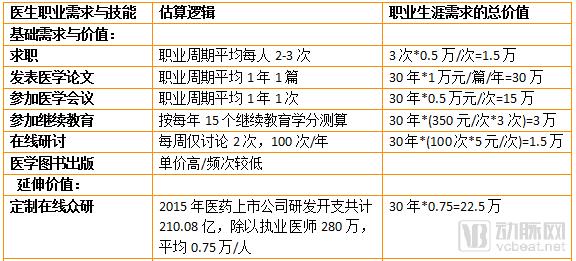
Data source: China Health and Family Planning Statistical Yearbook 2015; CSMAR Economic and Financial Database
As can be seen from this table, physicians are required to submit one academic paper nearly every year, and the papers must be derived solely from scientific research.
Among all the award-winning projects, 19 involved participation from universities. In the vast majority of cases, scientific research was conducted through joint efforts by universities and hospitals.
Underlying this trend is the strong demand for interdisciplinary talent driven by scientific and technological innovation. In most collaborative efforts, universities handle the technical aspects, while hospital experts address the medical components. Medical robot and medical AI products promoted since 2017 have all been jointly developed by healthcare professionals and scientists/engineers; both groups are indispensable.
Appendix: 27 Healthcare-Related Award-Winning Projects in the 2017 National Science and Technology Awards