

DXY Releases '2017 China Hospital Recruitment Development Survey Report': Deep Insights into Talent Mobility Trends and Hiring Preferences Amid Healthcare Reform
As healthcare reform deepens, restrictions on talent mobility have been further relaxed. However, are professionals within the public system truly willing to embrace this deregulation and adopt the status of “independent practitioners”? For talents already active in the job market, do hospitals accurately understand their job-seeking behaviors and preferences?
Recently, the “2017 Report on the Development of Hospital Recruitment in China” (hereinafter referred to as the “Recruitment Survey”) has revealed the answer.
The survey, launched separately for HR professionals in the healthcare industry and medical practitioners in September 2017, lasted for one month. The recruitment report collected a total of 1,037 questionnaires from HR professionals and nearly 7,000 from medical practitioners, aiming to explore the current status of hospital staff turnover, changes in hospital recruitment models, and the employment situation and job-seeking behaviors of medical practitioners.
Among the 7,000 healthcare professionals who participated in the job-seeking survey, 84% indicated that they had considered changing jobs or careers¹, highlighting a strong willingness among medical talent to move. This suggests that it is only human for most healthcare workers to have felt at least one moment of attraction toward external opportunities during their professional lives. We also have reason to believe that as the competition for talent intensifies, high-caliber professionals will receive offers from both within and outside the public system, and they may well act on these opportunities once more suitable positions arise.
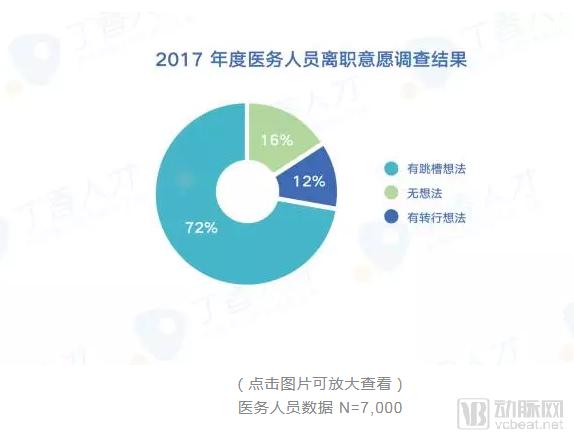
In this survey, 12% of healthcare professionals indicated they were considering a career change. Furthermore, nurses exhibited a higher intention to switch careers compared to physicians. Approximately one in every five nurses expressed a desire to leave the profession. Interviews revealed that the primary reasons driving nurses to consider exiting the healthcare industry include an intense work pace, high-pressure working conditions, and a lack of respect and understanding from some patients and their families.

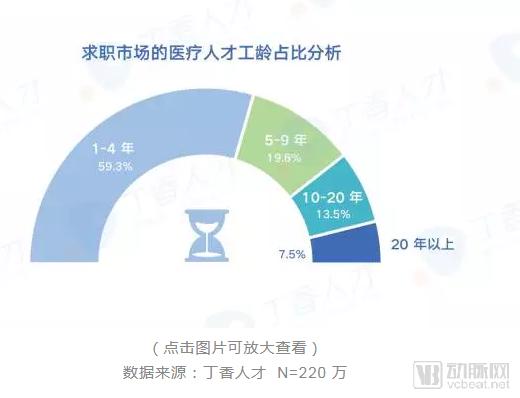
According to DXY Talent (a professional recruitment platform for the healthcare industry), which tracked the job application behaviors of 2.2 million healthcare job seekers on its platform, healthcare professionals active in the DXY Talent job market from 2016 to 2017 (i.e., users who submitted resumes) primarily had 1–4 years of work experience. These “early-career professionals” were more inclined to change jobs in pursuit of new opportunities.
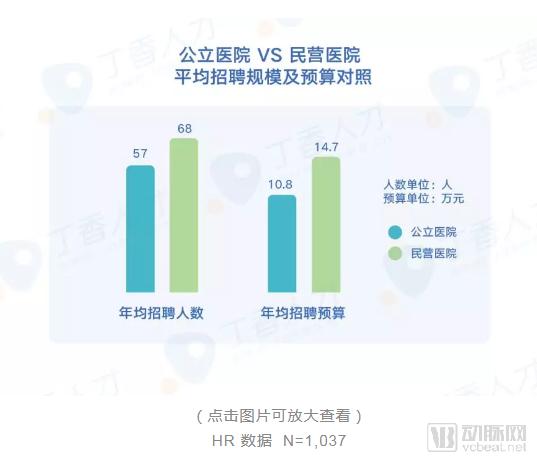
By the end of 2016, private hospitals accounted for more than half of the total number of hospitals in China (56.4%). With private hospitals springing up like mushrooms, there has been a surge in demand for healthcare talent. An analysis of hospital recruitment data from 2017 reveals that private hospitals significantly outperformed public hospitals in terms of both average recruitment scale and per-hospital recruitment budget.
Nevertheless, the research and teaching subsidies as well as living allowances that public hospitals can offer when recruiting mid-to-senior-level talent are difficult for most private hospitals to match or provide in their own recruitment efforts.
Public or private? This is not necessarily a dilemma. In terms of institutional affiliation, the long-held mindset of “only trusting public hospitals” is quietly shifting. Acceptance of private hospitals is growing, with nearly half of surveyed healthcare professionals indicating that hospital ownership type is not a major factor in their career decisions. Private hospitals are no longer confined to the outdated stereotype of “Putian-system” institutions. An increasing number of well-positioned and operationally mature private hospitals are gaining visibility, such as United Family Healthcare and Amcare, which cater to mid-to-high-end clientele; Dingxiang Clinic, founded by physician teams who left the public system; and the rapidly emerging physician groups. Healthcare professionals now have broader career options.
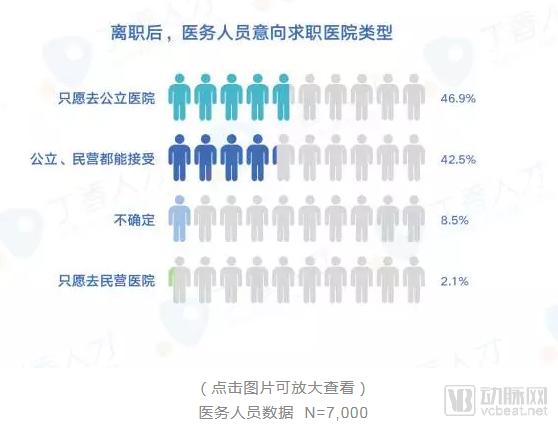
Survey data indicates that junior medical professionals have a stronger preference for public hospitals. In contrast, senior medical workers exhibit a less pronounced “public hospital preference”; among the senior respondents surveyed, approximately 36% stated they would only work in public hospitals.
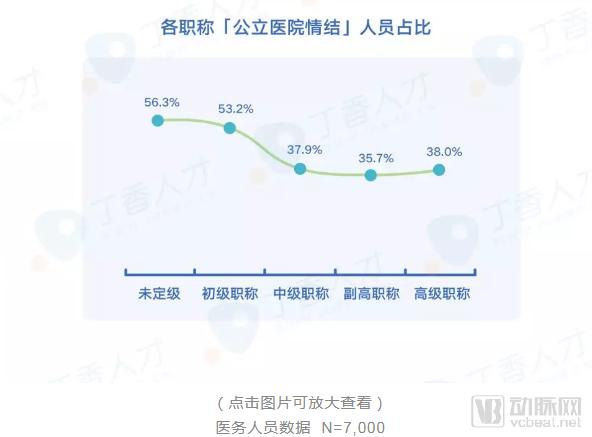
The "2016 Best Employers in the Healthcare Industry Report" indicates that junior physicians place relatively greater emphasis on "growth potential." When choosing employment, they are more inclined to select public hospitals with more robust talent development systems to enhance their professional skills. In contrast, senior physicians prioritize decision-making autonomy, such as participation in management decisions and equity ownership. This also explains why, as seniority increases, medical professionals tend to place less weight on "bianzhi" (established staffing positions) and "growth potential," instead considering moves to private hospitals that offer greater opportunities for professional advancement and higher financial returns.
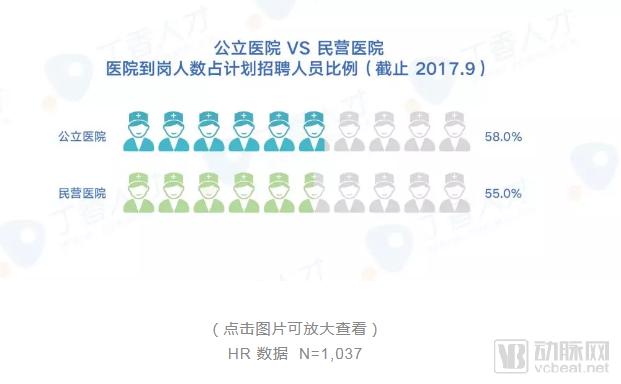
The report shows that as of September 2017, the number of staff hired by hospitals accounted for less than 60% of the total annual recruitment plan. The average recruitment completion rate for private hospitals was 55.0%, which was nearly identical to that of public hospitals.
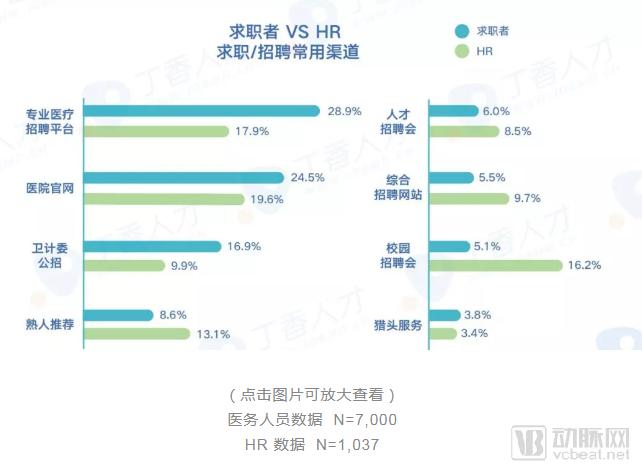
We asked 1,037 HR professionals and 7,000 healthcare workers the same question: What are your most frequently used recruitment/job-seeking channels?
Survey results indicate that hospital HR departments regard hospital official websites, specialized medical recruitment platforms (such as DXY Talent), and campus job fairs as the primary recruitment channels, accounting for 19.6%, 17.9%, and 16.2%, respectively. From the job seeker’s perspective, over 50% rely on online recruitment as their main job-search channel, including specialized medical recruitment platforms and hospital official websites. The “2017 Digital Life of Chinese Doctors/Patients” report, recently released by DXY, shows that over the past five years, doctors have been spending increasing amounts of time online, becoming ever more reliant on the internet and digital technologies for learning, work, and even service delivery.
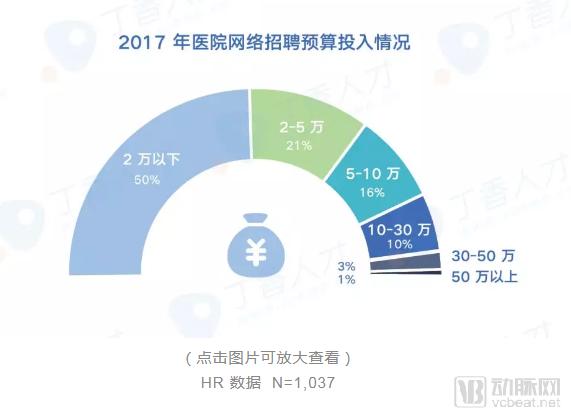
Although HR professionals have gradually come to recognize the power of online recruitment, their adoption of medical-specific job boards remains far lower than that of job seekers. A survey shows that among 1,037 organizations, the average spending on online recruitment was RMB 64,000, with half of HR practitioners adopting a “trial” approach and limiting their expenditure to under RMB 20,000.
We analyzed the types of hospitals with online recruitment budgets exceeding RMB 100,000 and found that 60% were tertiary hospitals, followed by ungraded hospitals, which accounted for 21%. In terms of regional distribution, 33% of these hospitals were located in first-tier developed cities, while 25% each were situated in areas associated with secondary and tertiary hospitals. Regarding hospital ownership, public and private hospitals each accounted for half, showing no significant difference.
1. Hospital Brand Culture, a Key Consideration for Job Seekers, Is “Undervalued” by HR
“What Job Seekers Prioritize During Their Job Search”: To address this question, we conducted a “compatibility test” between HR professionals and job seekers. Compensation and benefits, along with personal career advancement, are key areas of focus across all industries; from both the job seeker’s and HR perspectives, these emerged as the most-selected options. While 94.6% of HR professionals placed little emphasis on “hospital brand culture,” it was ranked as the third most important “job search consideration” by 7,000 medical professionals in the “2017 Annual Survey on Employment Trends for Chinese Healthcare Workers.” This highlights an urgent need to prioritize hospital culture development and brand promotion.
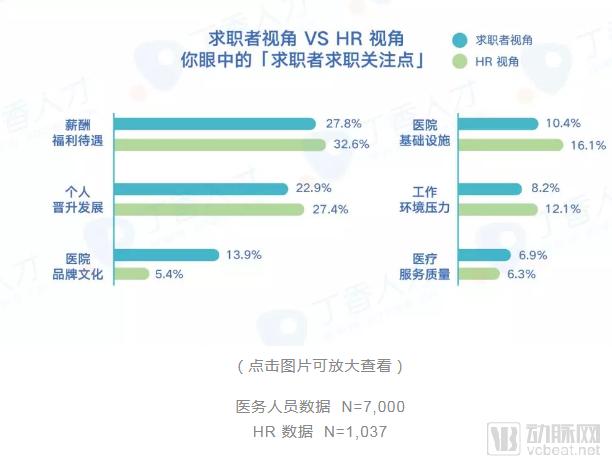
Overall, the report highlights the following key findings:
1. Healthcare professionals exhibit strong mobility awareness, and their employment preferences are increasingly breaking free from the constraints of the “public sector”; more than half of the respondents indicated that they would consider working at private hospitals when choosing a job;
2. The digital lifestyle of physicians is gradually becoming a trend, inversely influencing hospitals’ recruitment strategies; an increasing number of HR professionals are beginning to recognize the critical role of online recruitment channels in hiring.
3. The role of hospital brand culture in talent recruitment is becoming increasingly prominent; management should pay greater attention to the phenomenon that “even fine wine needs a bush” and initiate brand promotion efforts.
According to reports, the “2017 China Hospital Recruitment Development Survey Report” was released by DXY Talent, a professional recruitment platform for the healthcare industry, which has provided professional data and in-depth insights into the development trends of job seeking and recruitment in the healthcare industry for three consecutive years.
[1] Career Transition: This refers to leaving the current healthcare service system and entering fields such as biopharmaceutical companies and other non-medical-service institutions.
[2] Recruitment Budget: The recruitment budget in this survey excludes expenses for talent acquisition at public hospitals, such as costs associated with recruiting high-level professionals and key operational staff, including settlement allowances and research startup funds.
Note: Part of the data is sourced from the “2017 Annual Report on Job-Seeking Trends among Chinese Healthcare Professionals” published by DXY Talent.