

ORPEA and Taikang Forge Strategic Alliance to Launch Premium Elder Care Brand in China
VCBeat has learned that on January 9, in the presence of the heads of state of China and France, Chinese Minister of Commerce Zhong Shan and Director of the National Working Commission on Aging Huang Shuxian jointly signed a Memorandum of Understanding with French Minister of Economy and Finance Bruno Le Maire, Minister of Solidarity and Health Agnès Buzyn, and Minister for Europe and Foreign Affairs Jean-Yves Le Drian on cooperation in the silver economy. This signifies an acceleration in Sino-French collaboration in the elderly care sector.
This Memorandum of Understanding aims to implement the consensus reached by the leaders of the two countries on promoting cooperation in the elderly care sector. Under this Memorandum, both parties plan to establish a Steering Committee for Cooperation in the Silver Economy, strengthen policy dialogue and exchanges through mutual visits of experts, and encourage enterprises from both countries to engage in trade and investment cooperation in the silver economy sector.
China’s population is currently undergoing gradual aging. According to Zhai Zhenwu, President of the China Population Association, population aging in China will deepen rapidly after the 13th Five-Year Plan period, and the long-term elderly care burden on families will become increasingly heavy.
In this context, Chinese authorities seek to draw on the advanced experience of foreign institutions in providing socialized elderly care services. As France has consistently supported the overseas expansion of its domestic elderly care enterprises, there is significant potential for strengthened bilateral cooperation in the field of elderly care.
French Capital Invests in Multiple Major Deals in China: Orpea and Taikang Join Forces
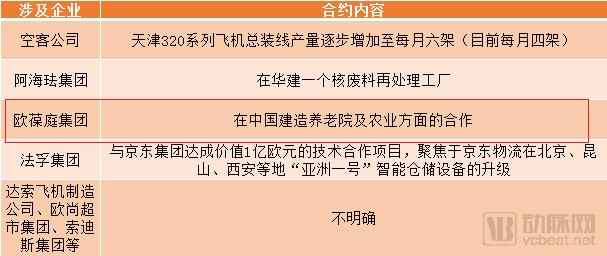
According to incomplete statistics, among the contracts signed during the meeting between the leaders of China and France, one involves elderly care (Source: 21st Century Business Herald)
As China and France announced enhanced cooperation in the silver economy, enterprises had already begun testing the waters in China’s silver economy market. Among the aforementioned incomplete statistics, VCBeat focused on the initiatives in China of Orpea, a well-known European elderly care and rehabilitation group.
On January 9, Orpea confirmed its business plan to build nursing homes in China at its Paris headquarters and signed a strategic cooperation agreement with Taikang Insurance Group.
According to Taikang Community’s official WeChat account: “On the afternoon of January 9, during French President Emmanuel Macron’s state visit to China, Taikang and Orpea, Europe’s largest elderly care and rehabilitation group, signed a Strategic Cooperation Agreement, witnessed by Chinese Minister of Commerce Zhong Shan, Chinese Vice Minister of Foreign Affairs Wang Chao, French Minister for Europe and Foreign Affairs Jean-Yves Le Drian, and French Minister of Economy and Finance Bruno Le Maire.”
In accordance with the agreement, both parties plan to establish a joint venture in China to jointly operate and expand urban elderly care nursing homes and rehabilitation hospitals. Orpea will provide its leading European care and rehabilitation technologies, standards, and processes, while Taikang will integrate customer resources, develop and support insurance products, leverage medical resources, and utilize its domestic operational capabilities. Both parties will authorize the joint venture to use their respective brands, “Taikang” and “Orpea,” to jointly create a leading high-quality elderly care brand in China.
This collaboration represents a powerful alliance between two industry leaders.
Orpea is Europe’s largest elderly care and rehabilitation group. Since its listing on the Euronext Paris stock exchange in 2002, its market capitalization has exceeded €5.1 billion. As the largest elderly care chain operator in Europe, it has established a presence in 10 countries with 733 branches, offering a total of 74,272 beds, and generating annual revenue of over €2 billion. Notably, Orpea was the only elderly care company included in President Macron’s delegation during his state visit.
As the largest chain elderly care institution brand in China, Taikang has established a three-tier medical and elderly care service system comprising “clinical diagnosis and treatment at tertiary hospitals + rehabilitation hospitals built within communities + CCRC (Continuing Care Retirement Communities) for continuous care.” In early January 2018, Taikang completed its layout of medical and elderly care communities in ten core cities across China (Beijing, Shanghai, Guangzhou, Sanya, Suzhou, Chengdu, Wuhan, Hangzhou, Nanchang, and Xiamen), and created flagship communities in Beijing, Shanghai, and Guangzhou, featuring continuous care, integration of medical and elderly care, and cultural elderly care.
In fact, this is not Orpea’s first foray into China’s elderly care industry. As early as 2013, Orpea entered the Chinese market and subsequently established subsidiaries in Shanghai and Nanjing, becoming the first foreign-funded elderly care enterprise to conduct physical operations in mainland China.
In January 2016, Orpea’s first project in China—the Orpea Xianlin International Senior Care Center in Nanjing—commenced operations.
In November 2017, Orpea partnered for the first time with Beichen, a local Chinese enterprise, to launch an elderly care project in Changsha.
On December 28, 2017, Beijing Yangzheng Investment Co., Ltd., a wholly-owned subsidiary of HNA Investment, signed an agreement with Orpea (Shanghai) Investment Co., Ltd. to jointly establish “Yangting (Shanghai) Elderly Care Management Co., Ltd.,” an elderly care operations management consulting firm. The company will provide advisory, consulting, and management services to nursing facilities developed in the Greater China region by HNA Elderly Care’s Yuejia brand, the Sino-French joint venture project of HNA Elderly Care, and other elderly care enterprises. The total investment amounts to RMB 14.28 million.
Foreign Investors Bullish on China’s Vast Elderly Care Market
On January 10, Olivier Véran, a French member of parliament, neurologist, and presidential special advisor on smart healthcare, who accompanied President Macron on his visit to China, stated in an interview with the media: “China’s population aging has occurred somewhat later than in France, but the scale of its elderly population is significantly larger—nearly ten times that of France, according to the data I have seen.”
According to the 2017 projections by the National Health and Family Planning Commission, China’s population aged 60 and above is expected to reach approximately 255 million by 2020, accounting for about 17.8% of the total population. The number of elderly individuals aged 80 and above is projected to rise to around 29 million, while those living alone or in “empty-nest” households are expected to increase to approximately 118 million. According to the White Paper on the Development of China’s Elderly Care Industry released by the Chinese Academy of Social Sciences in 2016, the market size of China’s elderly care industry is estimated to reach RMB 13 trillion by 2030.
Some argue that foreign elderly care enterprises with relatively mature business models have targeted this “time lag,” aiming to “corner” the Chinese market at the earliest opportunity.
To date, a total of 12 countries—including Japan, South Korea, France, Australia, the United States, the United Kingdom, Sweden, Germany, Canada, Israel, the Netherlands, and Malaysia—have entered China’s elderly care service industry, with enterprises from Taiwan also establishing a presence. Japan’s market entry has been particularly notable, with 39 companies such as Changsheng Group, U-CAN Co., Ltd., and Vis Fukushi Co., Ltd. beginning to lay out their operations, most of which are conducting business in China through wholly foreign-owned enterprises.
Many well-funded and experienced foreign investors have already set their sights on the lucrative Chinese market. Meanwhile, domestic private capital investment in elderly care enterprises remains in its early stages, with many startups still constrained by the lack of mature business models.
Foreign investors are increasingly vying for a share of China’s elderly care market, yet domestic capital appears to show little interest in the sector. According to VCBeat,“Elderly Care Industry: The ‘Matthew Effect’ Is Pronounced, Cross-Industry Capital Flows In, and Elderly Care Services Shift Toward Community- and Home-Based Models [2017 Year-End Review]”As previously mentioned, there were only three financing events in the elderly care sector in 2017. In the market, only traditional enterprises with established track records in other industries and substantial capital reserves have invested in the elderly care industry. This indirectly demonstrates that China’s elderly care industry is far from reaching a state of “prosperity.”
Overall, the entry of astute foreign enterprises into China’s elderly care market has provided a certain impetus to the development of the domestic industry. Strategic alliances between strong players, such as Taikang and Orpea, are likely to become more common in the future. While the advanced experience, technologies, and service standards of the overseas elderly care sector are certainly worth learning from, questions remain regarding how domestic startups should respond to market shifts and how well foreign-funded elderly care institutions are actually operating in China. VCBeat will continue to monitor these developments and trends.