

Where to Find Truth Amid the Surge of Medical 'Pseudoscience' Online?

In the field of medical science communication, authoritative and professional content is engaged in a “tug-of-war” with certain “viral influencer articles” and “marketing advertorials.” Most of these latter pieces are mass-produced on an assembly line solely to chase traffic and capture attention; their content is often cobbled together from multiple sources with little fact-checking, making their credibility difficult to guarantee.
Although an increasing number of clinical medical experts are engaging in science popularization, their efforts remain insufficient against the interference of unreliable and “pseudoscientific” information, and the public lacks adequate ability to distinguish truth from falsehood. This indicates that authoritative medical science popularization still has a long way to go in meeting the growing health needs of the general public.
To address this pressing social issue, Tencent and Health Times jointly hosted the Senior Seminar on Medical Science Communication in the Internet Era. The event explored topics such as “How to Foster a Scientific, Authoritative, and Credible Environment for Online Medical Science Communication” and “How to Establish Standards for Online Medical Science Communication.” More than 20 professionals, including government officials, hospital presidents, representatives from medical societies, and leading experts in various disciplines, attended the seminar to engage in collaborative discussions.
Online Medical Popularization: A Tough Nut to Crack
At the symposium, Zhang Meng, Vice President of Tencent and General Manager of the Medical Information Product Center, introduced that the daily volume of searches related to medical and health questions from online channels has reached as high as 60 million. There is no doubt that the Internet has become one of the primary channels for accessing health information. However, it is regrettable that this high-frequency user demand has not yet been truly met. This is specifically reflected in the fact that medical science popularization still faces numerous challenges, including insufficient access to relevant information, difficulty in distinguishing between true and false content, obscure and hard-to-understand presentations, and poor practicality.

(Zhang Meng, Vice President of Tencent and General Manager of the Medical Information Product Center)
In this regard, Zhang Meng believes that while there are many factors contributing to these issues, they primarily stem from the content creation and distribution methods of medical science popularization. This is specifically manifested in the contradiction between “being popular but lacking professionalism” and “being professional but failing to resonate with popular trends.”
On the content production side, medical professionals such as doctors struggle to allocate sufficient time for creating popular science content, as most are engaged in intensive workloads. Their focus on clinical practice may also lead to deficiencies in communication skills. Meanwhile, many editors at traffic-driven medical and health content websites lack professional backgrounds, often resorting to sensationalism and clickbait headlines to attract attention, thereby compromising the quality of the articles.
In terms of content distribution, current news platforms are driven by page views and rely heavily on machine-learning algorithms for recommendations. These systems lack sufficient capability to identify pseudoscience and soft marketing, making it difficult to ensure the authority and professionalism of the content. Meanwhile, such extensive and imprecise distribution methods fail to meet users’ needs for personalized and scenario-specific content. For instance, weight loss strategies for diabetic patients differ from those for healthy individuals, yet existing platforms often push identical information to both groups. This creates a contradiction between the “one-size-fits-all” nature of medical information and the “highly individualized” health needs of users.
What Has Tencent Done for High-Quality Medical Science Popularization?
Where there are pain points, there is innovation; innovation is precisely the most effective approach to resolving contradictions. Guided by this philosophy, Tencent established its Medical Information Product Center out of a sense of social responsibility. At the recent 10th Healthy China Forum (2017), Tencent introduced to the public its first internet-based medical science popularization product—Penguin Medical Dictionary. Ma Huateng, Chairman and CEO of Tencent, also stated during last year’s Two Sessions that he aims to create an authoritative medical intellectual property (IP) product that is globally recognized, highly detailed, and professionally rigorous, driven by a commitment to social responsibility.
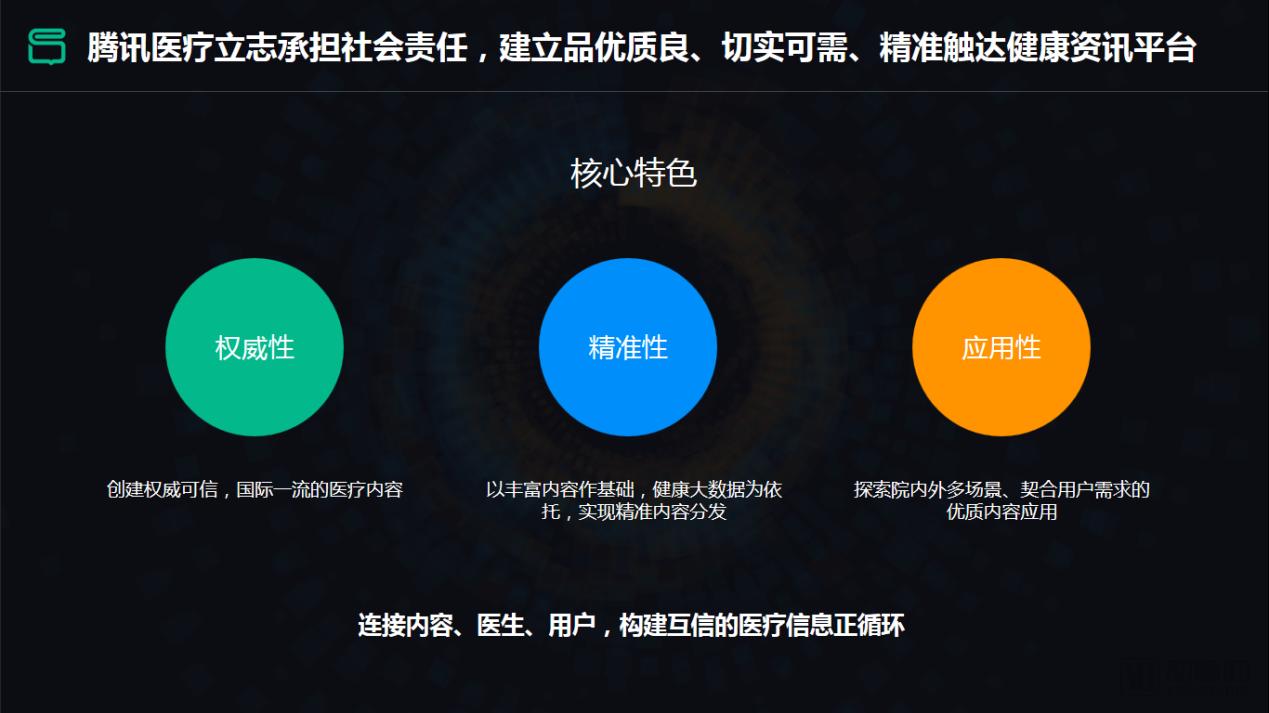
At the symposium, Tencent drew on advanced domestic and international best practices to introduce to experts and scholars its rigorous content quality control framework for Penguin Medical Dictionary. Strict topic selection, respect for copyright, a three-tier review and proofreading process, and continuous iteration constitute the core steps in ensuring content quality.
According to Zhang Meng, to address issues on the content production side and implement a content production model oriented toward content quality and effective health communication, Tencent has adopted a global perspective by signing exclusive strategic agreements with authoritative U.S. health information platforms such as Healthwise, thereby introducing high-quality overseas copyrighted content into China. Meanwhile, Tencent has established its own professional medical editorial team and collaborated with leading experts across 22 medical specialties in China, localizing the content by integrating Chinese clinical experience to better align with national conditions.
“We aim to achieve three goals: first, fairness and objectivity; second, rigor and scientific integrity; and third, staying current with the times,” stated Zhang Meng. He indicated that Tencent would exercise strict oversight over content, products, and authors, refraining from any commercial exploitation of content to ensure fairness and objectivity. The company will adhere to evidence-based principles and disseminate information reflecting the consensus of the scientific community. Through medical science popularization, Tencent seeks to enhance the public’s scientific thinking and health literacy, improve their ability to discern credible information, deliver content aligned with mainstream medical advancements, and continuously iterate based on user feedback.
In terms of the precision and applicability of medical science popularization, it is essential to leverage the advantages of the internet. As an internet company with substantial accumulated expertise in this field, Tencent is well-positioned to capitalize on its numerous strengths. Zhang Meng stated that users’ genuine need is to access desirable, useful, and actionable information at the right time and place. Tencent possesses the capability to deliver high-quality science popularization content to end users through precise distribution methods. By leveraging big data and AI capabilities, Tencent can uncover more application scenarios and distribute content across broader platforms, including WeChat and QQ, thereby providing a wider user base with precise medical science popularization integrated into their daily lives.
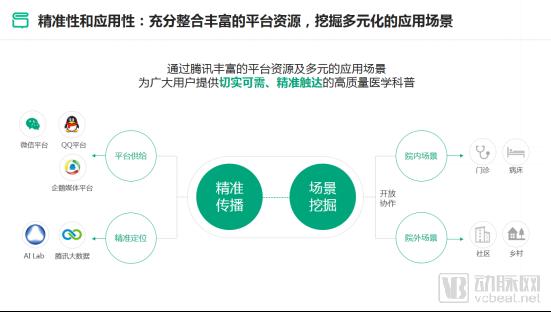
In addition to addressing existing challenges, Zhang Meng stated, “We hope our science communication model can disseminate experts’ scientifically sound and reliable medical concepts, while also feeding back user needs and habits to these experts. Tencent’s philosophy for health literacy is to connect content, physicians, users, and professional institutions, thereby building a multi-directional cycle of scientific and mutually trusted medical information.”
Co-developing Standards to Improve the Communication Context of Medical Science Popularization
When discussing the future plans for Penguin Medical Encyclopedia, Zhang Meng further stated, “In the future, we aim to develop our own proprietary knowledge-based intellectual property (IP), while collaborating with various stakeholders to establish Chinese science popularization standards that align with national requirements. Under the premise of complying with these national standards, we strive to build a clean and authoritative content platform.” To this end, Tencent is actively engaging in deep collaborations with government bodies, hospitals, media outlets, physicians, and other institutions and professionals.
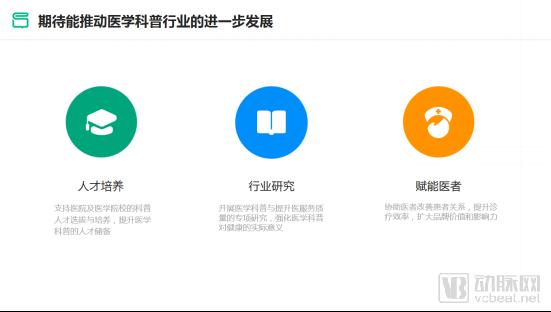
As Zhang Meng stated when recounting the original intention behind founding Penguin Medical Dictionary, Tencent’s launch of the platform is not only aimed at providing users with high-quality medical science popularization information but, more importantly, serves as a call to the industry. It seeks to engage collaborative partners in jointly establishing industry standards and processes, thereby fostering a scientific and credible context for medical science communication that benefits the general public.
For the medical science popularization industry as a whole, Tencent’s entry as an internet leader will help accelerate the sector’s optimization and upgrading. Tencent also aims to leverage its internet advantages to make authoritative medical science content more accessible, enrich acquisition scenarios, diversify services, and contribute to the dissemination of medical science knowledge.