

Huawei Reimagines Healthcare with Wireless Technologies: An Interview with Wang Yufeng, President of Huawei Wireless X Labs

Wang Yufeng, President of Huawei's Wireless Application Scenario Lab
On January 13, 2018, at the “2018 Academic and Technical Exchange Conference on Internet Healthcare,” jointly hosted by the Internet Healthcare Industry Alliance, the National Engineering Laboratory for Internet Medical Systems and Applications, and China’s IMT-2020 (5G) Promotion Group, under the guidance of the Hospital Management Center of the National Health and Family Planning Commission and the China Academy of Information and Communications Technology, Wang Yufeng, President of Huawei’s Wireless Application Scenario Lab, delivered a keynote speech titled “Wireless Technology Reshaping Healthcare.” He outlined to attendees the vision of an Internet of Everything in the 5G era and the future of wireless medical networking. After the conference, Wang Yufeng gave an exclusive interview with a reporter from VCBeat (WeChat ID: vcbeat), discussing Huawei’s intended role in the future healthcare industry.
Huawei’s vision is to achieve global connectivity. Huawei Wireless X Labs was established to explore wireless application scenarios.
Huawei Wireless X Labs was established at the 2016 Tokyo Broadband Forum. By collaborating with industry partners, it explores new wireless communication technologies and develops innovative applications to build the 5G ecosystem in advance. Ultimately, leveraging Huawei’s wireless communication technologies, it achieves deep integration across various vertical industries and drives cross-sector innovation.
From Human-to-Human Connectivity to Internet of Everything
Global interconnectivity is a rather complex matter.
However, the advent of the 5G era has at least provided the technological foundation for realizing this vision, serving as a platform for the Internet of Everything. The first generation of communication technology enabled voice interoperability. The second generation addressed digital transformation in the mobile sector, meeting mobile needs for voice and SMS. The third generation introduced mobile data connectivity for the first time, satisfying people’s demands for multimedia mobile information. The fourth generation enhanced 3G capabilities, enabling HD voice and greater bandwidth, among other improvements. In the 5G era, we will witness significant breakthroughs, with more industries undergoing digital transformation.
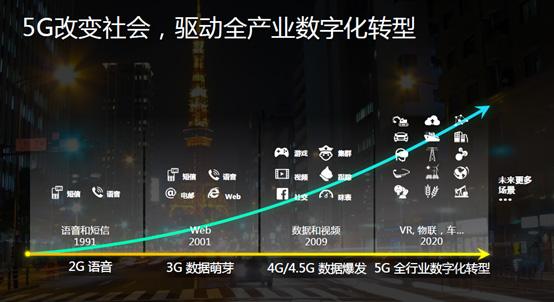
The 5G Era Will Accelerate Digital Transformation Across More Industries
Wang Yufeng believes that communication technology will evolve from connecting people to connecting myriad industries. Taking artificial intelligence as an example, AlphaGo is exceptionally skilled at playing Go, but it cannot be used by everyone for this purpose, as its size and power consumption limit its mobile applications. However, with the support of communication technology, AlphaGo’s capabilities can be wirelessly transmitted to mobile devices, thereby extending its reach. The same applies to the healthcare industry: supported by wireless technology, AI-driven decision-making capabilities can be remotely extended to doctors and hospitals.
The rapid development of modern technology has been driven by several key elements, such as artificial intelligence, cloud computing, sensors, and robotics, with wireless communication technology being one of them. The aforementioned technologies require connectivity to maximize their potential, and 5G technology serves as the foundational platform enabling stable performance across various industries. Huawei’s X Labs has identified ten major application scenarios for the 5G era, including cloud VR/AR, connected vehicles, intelligent manufacturing, smart energy, wireless medical networking, wireless home entertainment, connected drones, social networks, personal AI assistants, and smart cities. While pursuing technological development in these areas, Huawei X Labs will seek industry partners to build an ecosystem and establish standards for wireless applications. Moreover, cross-industry collaboration and innovation will become the norm in the future.
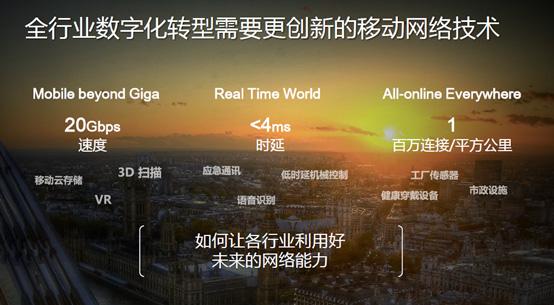
5G networks, with their high bandwidth, low latency, and extensive coverage, serve as the mobile internet foundation for digital transformation across all industries.
Application Scenarios of Wireless Healthcare
Specifically in the healthcare industry, there are three major categories of wireless medical application scenarios:
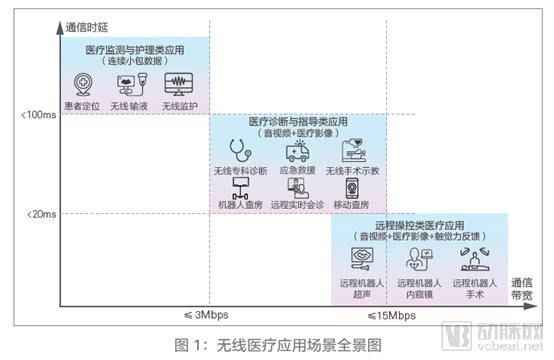
The first category comprises medical monitoring and nursing applications based on wireless data acquisition from medical devices, such as wireless monitoring, wireless infusion, mobile nursing, and real-time patient location tracking and monitoring.
The second category comprises medical diagnosis and guidance applications based on video and image interaction, such as mobile ward rounds enabling real-time access to patients’ imaging diagnostic information, remote ward rounds utilizing medical service robots, remote real-time consultations, emergency rescue guidance, wireless surgical demonstrations, and wireless specialized diagnostics.
The third category comprises teleoperation applications based on video and haptic feedback, such as remote robotic ultrasound, remote robotic endoscopy, and remote robotic surgery.
These three categories of wireless application scenarios have varying requirements for network bandwidth, latency, and reliability. The first category has the lowest demands on data bandwidth and latency, whereas the third category imposes stringent requirements on wireless communication, which can be met by 5G technology. Human reaction time typically ranges from 10 milliseconds to several tens of milliseconds. 5G technology has reduced the latency in remote surgeries performed by doctors to a level that feels nearly instantaneous, undoubtedly bringing disruptive changes to the future scope and scenarios of medical applications.
New applications in wireless healthcare can break through temporal and spatial constraints, thereby enhancing medical efficiency. Huawei X Labs is currently collaborating with the University Hospital of the Technical University of Munich in Germany on a project for remote wireless endoscopy, which enables stable endoscopic surgeries through wireless control of robotic arms. Meanwhile, Huawei X Labs and MGI Tech are jointly developing a wireless remote ultrasound robot project, allowing physicians to remotely operate robotic manipulators to acquire and analyze ultrasound images. These initiatives exemplify how wireless communication technologies are disrupting and transforming healthcare scenarios.
The Value of the Wireless Medical Internet of Things for Hospitals
Wireless Medical Internet of Things (IoMT) advances the informatization of medical services, promotes the sharing of medical resources, and enhances both healthcare operational efficiency and diagnostic accuracy.In current hospital management, several persistent challenges have remained difficult to resolve: nurses cannot locate physicians, physicians cannot find patients, patients struggle to identify the appropriate departments, and physicians are unable to locate medical equipment. These managerial inefficiencies can be fully addressed through technological solutions; however, prior advancements in sensors, batteries, and communication technologies were not yet sufficiently mature.
Following the establishment of a wireless medical internet, healthcare professionals within hospitals can access various medical information anytime and anywhere, enabling mobile ward rounds, mobile nursing, remote consultations, and robotic medical services. This reduces travel burdens for medical staff and improves their work efficiency. Between hospitals, wireless medical technology can also enhance inter-hospital information exchange and business collaboration. Leveraging their abundant expert resources and advanced medical facilities, tertiary central hospitals can provide remote guidance to lower-tier hospitals within medical consortia via the wireless medical internet, thereby improving the diagnostic capabilities of these lower-tier institutions.
The wireless medical Internet of Things (IoT) network is deployed and maintained by telecom operators, reducing hospital operating costs.Previously, hospitals needed to purchase large quantities of communication equipment and servers to establish physical private networks, ensuring the security and reliability of intra-hospital medical service communications. They also had to invest in dedicated operational teams for daily maintenance. With the introduction of wireless medical IoT, communication equipment is provided and deployed by telecom operators, who are also responsible for its operation and maintenance, significantly reducing the hospital’s investment costs in this area.
Wireless Medical Internet of Things Drives Healthcare Transformation and Launches New Smart Healthcare Services.Wireless medical networking offers seamless evolutionary capabilities and, by integrating with technologies such as cloud computing, big data, digital imaging, and AI-driven robotics, will permeate every aspect of healthcare operations, thereby facilitating the transition toward wireless and intelligent healthcare. Historically, hospital devices have relied on a variety of disparate communication protocols and methods. In the future, Huawei aims to establish a foundational platform for wireless communications—or collaborate with industry partners to define a unified standard—that can connect isolated data silos and a vast array of medical devices, thereby unlocking the value of healthcare big data.
Overall Strategy for Implementing the Wireless Medical Internet of Things
A survey on the informatization status of hospitals in China reveals that 46.32% of hospitals plan to construct and deploy wireless networks within the next two years. Currently, the application of wireless technology in hospitals is limited to Wi-Fi, which not only lacks privacy but also presents significant operational issues. Hospitals interested in implementing wireless healthcare solutions can engage mobile network operators to handle network infrastructure construction and upgrade the wireless capabilities of medical devices, thereby rolling out wireless healthcare services in phases according to their specific circumstances:
Phase I: Launch medical monitoring and nursing applications based on wireless data acquisition from medical devices, achieve full coverage of the in-hospital wireless medical network, and improve medical work efficiency;
Phase II: Expand to medical diagnosis and guidance applications based on video and image interaction, achieving fully wireless connectivity for emergency care, intra-hospital, and inter-hospital medical services, thereby enhancing emergency response speed and medical collaboration capabilities.
Phase III involves the development of remote control applications based on video and haptic feedback, leveraging innovative medical technologies to support national healthcare poverty alleviation initiatives. Outside hospitals, telecommunications operators have already provided wide-area wireless network infrastructure. If hospitals wish to conduct telemedicine services, they can negotiate with operators to establish dedicated VPN lines to ensure high-quality remote transmission capabilities. For in-hospital wireless networks, it is recommended that operators handle professional network planning and deployment, with specific implementation tailored to the communication needs of medical equipment and healthcare personnel.
Cross-sector collaborative innovation will become the norm in the future. Huawei X Labs has established a Special Interest Group (SIG) dedicated to the healthcare sector, primarily inviting departments and research institutes within the medical industry that specialize in internet healthcare and telemedicine to join. Participating organizations include the Henan Provincial Telemedicine Center, Huashan Hospital Affiliated to Fudan University, MGI Tech, Fosun Group, Medix, Soochow University, and Yitu Technology, among others.
Wang Yufeng stated, “Wireless X Labs aims to build a platform for innovation in wireless applications, where partners can jointly explore industry scenarios, create new applications, expand into new markets, and ultimately achieve mutual success. Adhering to the principles of openness, cooperation, and win-win outcomes, the Wireless Medical Internet of Things Special Interest Group (SIG) is committed to welcoming more partners from the healthcare industry to join forces in realizing comprehensive connectivity across the medical sector.”