

A-Strong Medical's Hong Kong IPO Highlights the Emerging Boom in High-Margin Medical 3D Printing
Aikang Medical (01789-HK) attracted significant investor attention upon its listing on the Hong Kong Stock Exchange on December 20, 2017. The company has three medical 3D-printed products certified by the China Food and Drug Administration (CFDA). As of December 31, 2016, Aikang Medical reported total assets of RMB 406 million, total liabilities of RMB 111 million, and net assets of RMB 295 million. In 2016, the company’s total operating revenue amounted to RMB 271 million, with a net profit of RMB 77.326 million.
AK Medical’s core business currently consists primarily of two segments: hip replacement implants and knee replacement implants, which together account for approximately 89% of the company’s total revenue. From 2014 to 2016, the compound annual growth rate (CAGR) of revenue from hip replacement implant products was 30.9%, while that from knee replacement implant products was 35%. Other businesses, including 3D-printed products and third-party orthopedic products, each contribute no more than 5% of the core business revenue.
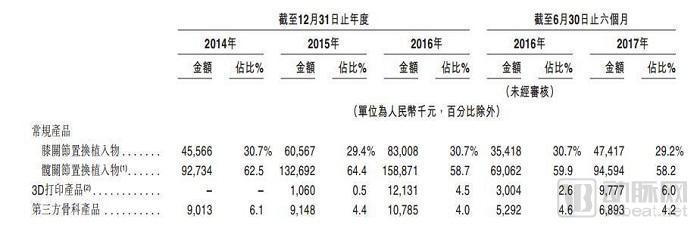
As the data shows, AK Medical’s products have a high gross profit margin, with both of its core offerings—hip replacement implants and knee replacement implants—achieving gross margins above 70%.In 2016, among the company’s 3D printing products poised for significant expansion, spinal replacement implants achieved a gross profit margin as high as 97.8%, indicating that the company’s future 3D-printed technology products hold even greater promise.。
As can be seen, medical 3D-printed products offer high profit margins and substantial market demand; once a product obtains certification from the China Food and Drug Administration (CFDA), the development prospects for the enterprise are highly promising. Taking this opportunity, VCBeat will also provide analytical reporting on the following issues:
How Exactly Is 3D Printing Technology Applied in Healthcare?
How Do Industry Giants Lead Sector Development?
Where do the technical challenges lie?
What problems have emerged during the development?
3D Printing and Precision Medicine
Lu Bingheng, an academician of the Chinese Academy of Engineering, stated in his keynote address titled “3D Printing and Precision Medicine” that 3D printing serves as a high-end medical technology for achieving precision medicine and boasts broad application prospects. From imaging diagnosis and 3D data design to the printing of structures such as bones and its use in clinical surgery, 3D printing enables personalized tissue regeneration and repair.

Academician Lu Bingheng
Market research firms categorize the applications of 3D printing in healthcare into four major groups: biomedical research, medical device manufacturing, specialized medical assistive devices, and medical supplies for direct patient use.
Academician Lu believes that applications in medical device manufacturing and specialized medical assistive devices are currently relatively mature. Typical medical applications of 3D printing technology include the construction of surgical planning models, medical training and education, surgical guides, 3D-printed implants, and rehabilitation medical devices such as prosthetics and hearing aids. For more information on the application of 3D printing in healthcare, please click “China’s 3D Medical Printing Industry Landscape: Only 2 out of 46 Companies Have Obtained CFDA Certification, with Orthopedics, Dentistry, and Preoperative Planning Accounting for the Largest Shares》。
The Dilemma of 3D Printing
![]SJR2X(MD9UDLGWU7_~]L8U.png](https://cdn.vcbeat.top/upload/image/09/01/18/09/1516266570620455.png)
Source: MedTrend
Medical 3D Printing, While Offering Clear Advantages, Faces Challenges in 3D Modeling. 33D modeling, in layman's terms, refers to the process of constructing models with three-dimensional data within a virtual 3D space using 3D creation software.Researchers utilize CT, MRI, and 3D reconstruction technologies—specifically, by scanning the human body with CT and MRI to acquire two-dimensional data, which is then professionally screened and filtered before undergoing three-dimensional reconstruction—to ultimately generate data for 3D printing models.
During the modeling process, the clarity of the initial image acquisition is crucial. With the advancement of modern imaging technologies, two-dimensional image data obtained from CT and MRI scans have already met the requirements for three-dimensional modeling. The conversion and reconstruction from 2D data to 3D data are key to achieving 3D printing.
Furthermore, in the fields of surgical planning and simulation, success hinges not only on the selection of 3D printers and printing materials but also on personalized, rapid, and precise modeling that seamlessly interfaces with 3D printing equipment. This integration enables individualized assessment and visualization of patient conditions, allowing physicians to develop personalized, precision surgical plans tailored to specific pathologies, which is key to the successful application of 3D printing technology in precision medicine.
This data conversion process is not only time-consuming due to its complexity but also frequently results in printing failures, generally requiring the assistance of professional 3D printing service providers.
Seamless integration of medical imaging, 3D modeling, and 3D printing is a key R&D focus for many companies. This seamless technology will help physicians conduct faster and more precise detection and diagnosis of neurological disorders, tumors, and cardiovascular diseases.
In China’s medical 3D printing sector, the technology itself is not the biggest barrier; rather, it is obtaining certification from the China Food and Drug Administration (CFDA). Currently, 3D-printed products with CFDA approval remain exceedingly rare. It is understood that only four products have received CFDA certification to date: the 3D-printed acetabular cup, 3D-printed artificial vertebral body, and 3D-printed spinal interbody fusion cage developed through the collaboration between AK Medical and Peking University Third Hospital; as well as Medprin’s 3D-printed dura mater (spinal) patch.
Obtaining certification from the China Food and Drug Administration (CFDA) is challenging, primarily due to stringent review processes, lengthy approval cycles, and high costs. Currently, most medical 3D-printed products that have received CFDA certification are classified as Class III devices, while 3D printing software can be certified as Class II devices. Although Class II certification is generally faster, the process for Class III certification typically takes several years. The official fee for Class III registration is RMB 153,600. Many companies now engage third-party agencies to expedite the certification process, which naturally increases the overall cost.
On December 10, 2017, the General Administration of Quality Supervision, Inspection and Quarantine (AQSIQ) released the “Analysis Report on Risk Monitoring of Additive Manufacturing/3D Printing Product Quality in 2017,” which found that 34 out of 37 batches of domestically produced 3D printing equipment had non-compliant items in terms of safety performance, with only three batches of 3D printers fully meeting all safety indicators.
This means that over 90% of domestically produced desktop 3D printers have defects and security risks. Due to their low entry barrier and simple design, desktop 3D printers have become the ideal entry point for companies venturing into the 3D printing sector. Currently, two-thirds of global companies are concentrated in the desktop-level market; however, after years of development, competition in this segment has become intensely fierce.
Industrial-grade 3D printers, aligning with the concept of intelligent manufacturing, can be widely applied in fields with substantial market demand and significant growth potential, such as automotive, aerospace, machinery, and healthcare. As the technology matures and costs continue to decline, they are poised to unleash immense, unprecedented power.
Major Medical Device Manufacturers Enter the 3D Printing Sector
In December 2017, GE Healthcare China signed exclusive strategic cooperation agreements with Stratasys, a global leader in 3D printing, and Guangyun Da, respectively, to collaborate on comprehensive 3D printing services based on imaging products and the AW image post-processing workstation, thereby creating China’s first integrated healthcare 3D printing solution.
Currently, GE is accelerating its global expansion in the field of additive manufacturing. Previously, it acquired two metal 3D printing companies, Arcam and Concept Laser, for a total investment of approximately $1.5 billion. Through collaborations with Stratasys and Guangyunda, GE Healthcare is committed to integrating the upstream and downstream industry chain, achieving seamless connectivity from 2D medical imaging to 3D modeling and ultimately to 3D printing.
In August 2017, GE Healthcare launched the new AW4.7 Intelligent Workstation, integrating imaging equipment such as computed tomography (CT) scanners with 3D printing technology.
The GE AW 4.7 workstation is compatible with both upstream and downstream connected devices. Regardless of whether the upstream imaging data originates from GE equipment or which manufacturer’s 3D printer is used downstream, the AW 4.7 seamlessly integrates with these systems, enabling rapid data conversion and model reconstruction to facilitate efficient medical 3D printing. This capability laid the foundation for the collaboration with Guangyunda and Stratasys in December.
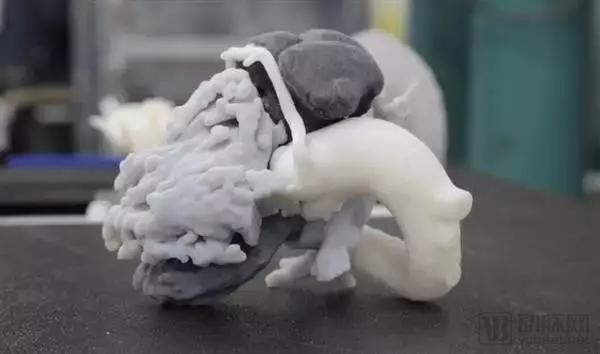
Philips is also advancing medical 3D printing through both in-house R&D and collaborative partnerships.
Philips’ latest version of its visualization and quantification platform, IntelliSpace Portal 10. The software includes a new embedded 3D modeling application that helps generate images with more accurate anatomical details. Particularly in cancer treatment, physicians can develop detailed plans for complex surgeries in advance by determining the exact size and subtle changes of tumors.
Additionally, Philips has partnered with 3D Systems and Stratasys to enable seamless integration and dedicated workflows between the Philips IntelliSpace Portal 10 and 3D Systems/Stratasys services. Philips customers can now seamlessly connect with 3D Systems and Stratasys solutions to accelerate 3D printing, facilitating rapid design, ordering, and production of 3D-printed anatomical structures. Users can create models and save data within the IntelliSpace Portal 10, transmitting it to 3D solution providers without leaving the clinical environment.
Siemens Healthineers Announces New Partnership with 3D Medical Manufacturer Materialise at RSNA
Siemens Healthineers partners with Materialise to promote Materialise Mimics inPrint software to hospitals worldwide. Mimics inPrint is a specialized solution for hospitals to 3D print anatomical models, accessible via Siemens Healthineers’ syngo.via open platform.
By leveraging virtual 3D anatomical models, physicians can formulate surgical plans in advance and rehearse procedures for complex conditions. According to the head of Siemens Healthineers’ syngo business unit, integrating 3D printing technology with syngo.via enables their participation in the entire patient workflow from diagnosis to treatment planning. This approach serves as an effective method to enhance the clinical capabilities of syngo.via and represents a significant step toward achieving personalized care and precision medicine.
The Market Is Still in the Education Phase, and the Future Remains Bright
Recently, VCBeat learned that Huizhou First People's Hospital customized osteotomy guides using WRIGHT 3D printing technology and successfully performed a knee arthroplasty.
It is understood that WRIGHT’s 3D printing technology first requires transmitting the patient’s CT data to a medical 3D printing service provider. The company then uses computer-aided planning to calculate the degrees of osteotomy and the extent of deformity correction, and subsequently employs high-density nylon material to 3D print osteotomy guides tailored to the patient’s bone anatomy.
Zhong Haobo, Associate Chief Physician of the First Department of Orthopedic Surgery at the hospital and lead surgeon, explained that there are two main traditional approaches to knee arthroplasty. The primary method involves preoperative planning and intraoperative measurements using various instruments; based on these real-time measurements and the surgeon’s judgment, native bone is resected before implanting a metal prosthesis.
Zhong Haobo explained that this method, which relies entirely on manual measurements, is prone to errors due to factors such as line of sight. Deviations in angulation may also occur during osteotomy. Furthermore, the procedure is time-consuming, requires a greater number of surgical instruments, and demands higher technical proficiency from the surgeon.
Another approach is computer-assisted navigation, specifically computer-navigated joint arthroplasty, which involves adjusting alignment intraoperatively based on angles displayed by the navigation system. However, this method requires bulky equipment, and the use of navigation itself during surgery is subject to inherent errors.
Compared with the aforementioned two methods, guidance using 3D-printed osteotomy guides enables all intraoperative calculations to be completed in a single step, thereby saving considerable surgical time.
As expected, the surgical procedure went smoothly, saving the surgeon more than 40 minutes. Approximately one day later, the patient was already able to attempt ambulation.
This is not actually a story about a 3D printing application in medicine that has shocked the industry. The development of 3D printing technology has become relatively mature, and such cases occur frequently in China every day. Reports on such news indicate that the industry is still in the phase of market education, and the market remains a blue ocean. In the future, more listed companies similar to AK Medical will emerge.